|
“It is something more than merely interesting. It is great fun and endlessly amusing as an experiment, capable of perennial improvement, as you take away the things that don’t fit in, or that don’t satisfy you, and replace them by something you like better.”
- Vita Sackville-West, English author and garden designer
|
July is the Month of Summer Shipping
|
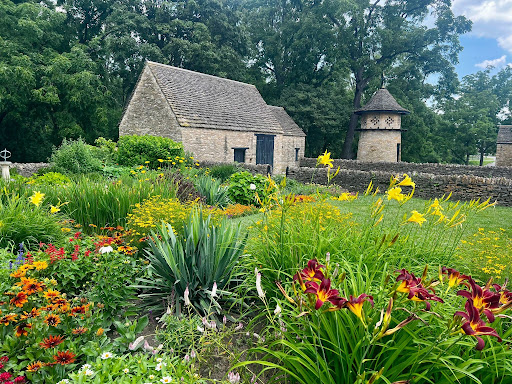
Cotswold Cottage at Greenfield Village, Dearborn, MI
|
The daylilies are blooming beautifully in our fields as they prepare to be shipped to their new homes in customers’ gardens. If you haven’t placed your summer order yet, check out the daylilies and iris and place your order now – They will arrive soon and ready to be planted and watered.
|
Gardens as a Summer Destination
|
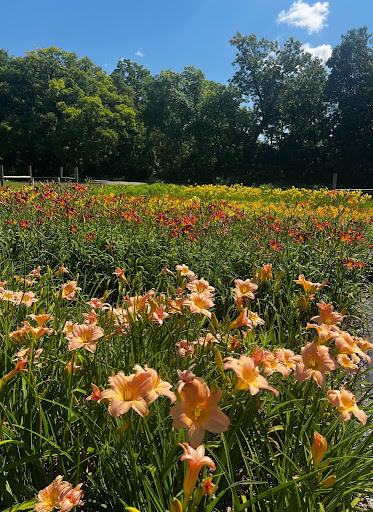
Old House Gardens Daylily Field
|
Gardeners love spending time tending their gardens, but they also appreciate the chance to relax and simply enjoy the beauty they have created. When traveling, many gardeners make a point of visiting public gardens, finding them to be both inspiring and restorative.
Many public gardens have added heirloom bulbs to their collections—some even sourced from Old House Gardens, including Colonial Williamsburg, Mount Vernon, and Alcatraz. As you explore gardens on your travels, you may spot some familiar heirlooms along the way. If you do, we'd love to see your photos!
Discovering familiar treasures in other gardens is always a delight, and often we come home inspired to try something new in our own. That spirit of discovery and experimentation was central to the work of Vita Sackville-West and her husband, Harold Nicolson, at Sissinghurst Castle. They designed Sissinghurst as a series of intimate garden rooms, each offering opportunities to experiment with different combinations of plants and styles. The result was a quintessentially English garden celebrated for its beauty, diversity, and enduring influence.
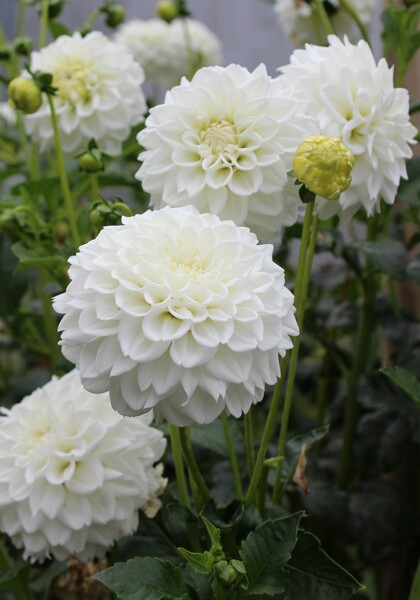
When planning the famous White Garden, Harold selected white gladioli, white irises, and white pompon dahlias that he and Vita both admired. Without the drama of colorful blooms, the challenge became creating interest through texture, form, and contrast—a design philosophy that inspired the quote at the beginning of this newsletter.
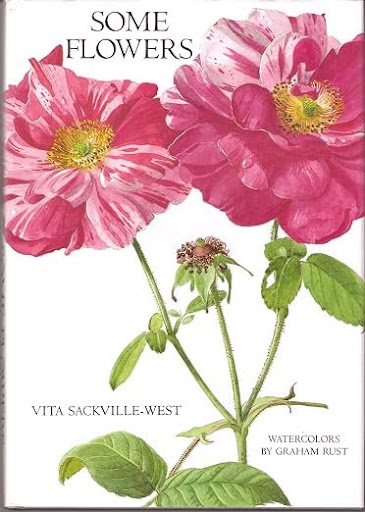
Although dahlias were Harold's favorite flowers, Vita had a particular affection for Tulipa clusiana, and bearded irises appeared throughout many of the garden rooms, including the White Garden. She celebrated many of her favorite plants in her 1937 book Some Flowers, writing about roses, White Garden plants, irises, tulips, and other cherished bulbs.
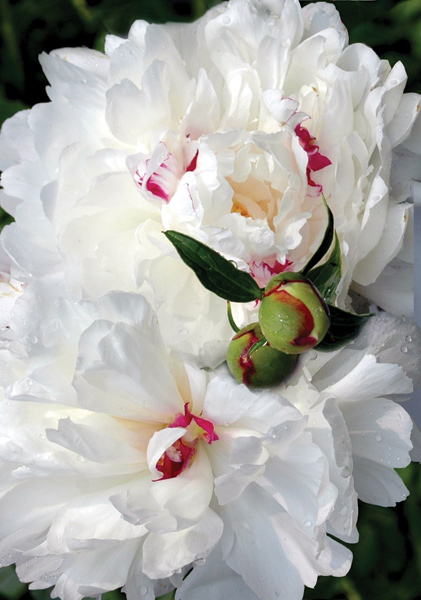
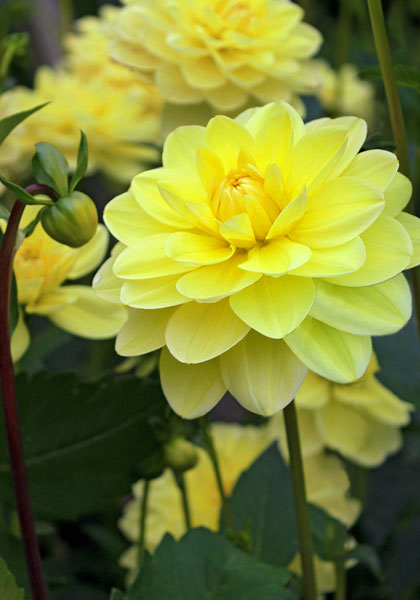
Visitors to Sissinghurst today may still encounter heirloom varieties that connect us to Vita's gardening legacy, including the peony Festiva Maxima (1851) and the dahlia Glorie van Heemstede (1947). One can also imagine the elegant white dahlia White Fawn (1942) feeling perfectly at home among the white tulips and bearded irises that have themselves become treasured heirlooms.
|
Dahlia Support
|
|
|
|
As summer warms up, the dahlias are getting taller and ready to bloom. Their hollow stems and heavy blooms frequently require support - especially the taller varieties. It is always best to support them early, but if you haven’t, there’s no time like the present!
There are many options for support, depending on the number of dahlias, growing situation, and what is available…
– Stakes: A 5- to 6-foot stake (hardwood, bamboo, or coated metal) can be inserted about 12 inches into the soil next to the tuber. Loosely tie the stalk to the stake with twine every 12 to 18 inches.
– Corral Method: For long rows or large groups, use T-posts every 15 to 20 feet. Run sturdy twine or wire around the perimeter of the plants at 12 inches high, adding additional layers as the dahlias get taller.
– Netting: For dense plantings, stretch a horticultural net over the dahlias on posts at about 12 inches. The plants will grow through the netting, supported as they reach full height.
– Cages: Four-sided cages specifically for dahlias, grow-through supports, or tomato cages can be purchased at many garden centers and may be a good solution if you have a smaller number of dahlias.
Whether your supports are fancy or basic, your dahlias will be the highlight once they begin to bloom!
|
Wisconsin Reds
|
|
|
|
A customer, Kate T., saw an article on our website about Wisconsin Red dahlias and sent this story from her family to expand on these remarkable flowers …
In 2020, my father James T. purchased a house in Mono, Ontario. The prior owner was clearly a lover of horticulture, and the property hosts a myriad of interesting trees, flowers, and plants. When my dad moved in that November, we were surprised to see a row of bright red dahlias in the garden, despite being on the verge of the first frost.
We researched these “fussy flowers” that needed to be carefully dug and stored, and after reading about the lengths people went to preserve their tubers, we didn’t have much hope for spring success. Dad, always willing to give every plant the chance to live, carefully dug them out in clumps, packed them in sand, and—at 82—carted them down into the basement cold room.
Spring came, and they lived. With so much other yard work, we didn’t have time to split the tubers properly, so we simply plunked the clumps back into the ground and waited to see what would happen.
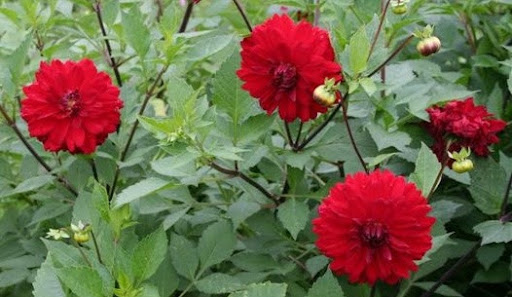
True to the character described for Wisconsin reds, the dahlias tolerated our lack of knowledge and time and grew vigorously. Dad planted them along the edge of his garden, and visitors were greeted by a shrub‑like hedge that quietly produced enormous red pom‑pom flowers right up until the first frost.
That fall, the clumps were dug again. Twice as many made their way down into the cold cellar, and back out the next spring—this time forming a double row of dahlias. By year four, the dahlias were clearly winning: some were stored in totes with sand, some without, and others wintered bare on the garage floor. They all still bloomed beautifully.
Given the success of the garage‑floor tubers, we built a 6×6 insulated box filled with pine shavings that took up the better part of a garage bay. I had my doubts, but Dad had faith—and it meant no more hauling heavy clumps to the basement.
By 2024, Dad had 150 feet of dahlia hedge. Still gorgeous despite not trimming, pinching or dead heading throughout the growing season.
A health scare in 2025 delayed planting, and long purple sprouts—nearly a foot long—emerged from the boxes. It didn’t seem to hold them back. They flowered yet again, undaunted.
Sadly, Dad passed away in December 2025. It’s spring, and we’re about to open the dahlia bin. No doubt there will be tears—but also the quiet underlying certainty that something beautiful is ready to begin again.
Thank you, Kate, for sharing your story! A 150 foot dahlia hedge sounds absolutely beautiful!
|
To Make Sure Our Newsletter Reaches You Safely . . .
|
|
|
Please add newsletter@oldhousegardens.com to your email address book or safe/approved list today.
|
Follow Old House Gardens - Heirloom Bulbs
|
|
|
(hyperlinks https://www.facebook.com/HeirloomBulbs and https://www.instagram.com/old.house.gardens/
|
To Unsubscribe
|
|
|
We hope you enjoy our monthly Gazette, but if not UNSUBSCRIBE here and we’ll drop you from our list immediately.
|
|