




Here’s a wealth of information about LILIES from our email Gazette and past catalogs, starting with the most recently published. For other topics, please see our main Newsletter Archives page.
To subscribe to our FREE email newsletter, click here.
Martha Stewart’s 300-Foot Border of Tiger Lilies

Some gardeners shy away from orange, but not Martha Stewart – as you can see in this photo from the July-August 2019 Martha Stewart Living.
That’s the driveway to Martha’s home in Bedford, New York, flanked by a 300-foot-long pergola. Wisteria and clematis drape the pergola and along its sides are six-foot-wide borders filled with crocus, grape hyacinths, alliums, and various perennials in shades of “mauve, lavender, violet, purple, and blue.”
But Martha wanted more color, so first she “sprinkled in a few kinds of orange poppies” and then to extend the bloom season she planted hundreds of tiger lilies (Lilium lancifolium). Now “just as everything else begins to fade” these lilies “explode into fat rows of tall, sturdy stems” and then “unfurl their spotted petals at the end of July, transforming the border into a sweep of orange.”
See more at themarthablog.com/2018/08/my-blooming-lily-border.html – and then if you want to see what a little orange can do for your mid-summer garden, order a few of these easy, enduring lilies now for planting this fall. (July 2019)
Do Tiger Swallowtails Like Orange Lilies Best?
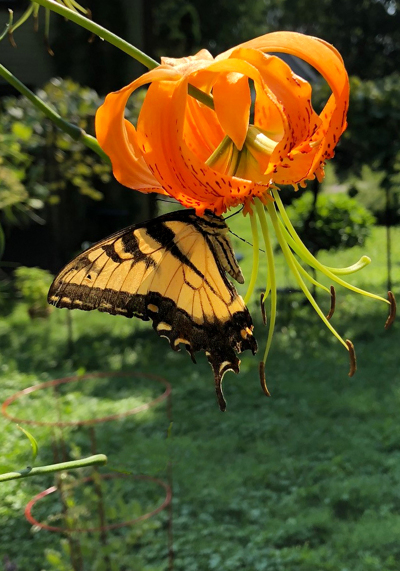
We’re not sure, but when I saw this tiger swallowtail feeding on my Henry’s lilies last summer, I remembered garden-writer Felder Rushing telling me that they flocked to the double tiger lilies in his Mississippi garden.
Could it be that the orange color and turk’s-cap form remind them of similar North American natives such as Lilium superbum that they’ve been feeding on for millennia?
If you want to see for yourself, Henry’s lily is one of four spring-planted lilies we’re shipping this April, and you can also order our two tiger lilies and L. superbum now for fall shipping.
And if these incredible butterflies visit your orange lilies, please send us pictures! (March 2019)
Good News about the Red Lily Leaf Beetle
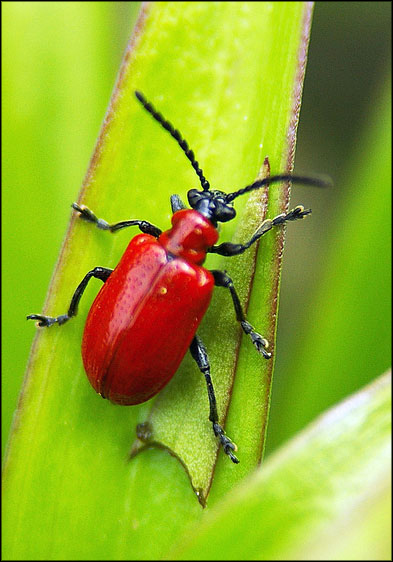
When my sister and her family visited us from Massachusetts this past summer, my brother-in-law had some exciting news – after years of being plagued by red lily leaf beetles, he’d seen very few in their garden this year. The parasitic wasps seem to be working!
If these voracious beetles aren’t in your garden yet, they’re on their way. They first appeared in Massachusetts in 1992 and have since spread throughout New England and into New York, Pennsylvania, Michigan, Wisconsin, Iowa, and Washington.
To control them, researchers at the University of Rhode Island have released three species of tiny parasitic wasps. Two of these have slowly spread throughout New England, and it looks like they’re finally making a difference in my brother-in-law’s garden.
To learn more, see Margaret Roach’s excellent interview with Lisa Tewksbury of the Rhode Island University Biological Control Lab at AWayToGarden.com/controlling-lily-leaf-beetles-u-rhode-islands-lisa-tewksbury/.
And if you’re looking for a beetle-resistant lily, Tewksbury highly recommends ‘Black Beauty’. Although adult beetles may feed on it a little, she says, the larvae never do because eggs laid on it just die. (Sept. 2018)
Our Madonna Lilies Bloom at the National Cathedral
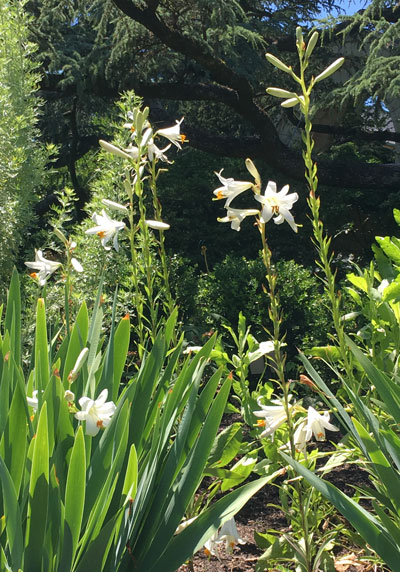
It’s always good to hear from our customers, and we love seeing photos of our bulbs in your gardens – such as the one here from our good customer Adrienne Schopf of the Washington National Cathedral in Washington, DC.
“I just wanted to send you guys a few pictures of the Madonna lilies that we planted last fall,” Adrienne wrote. “They’re doing well in our Bishop’s Garden. They’re planted in an area we call the Hortulus where we have different herbs that were planted at monasteries in the 9th century, so these lilies fit in perfectly.
“We’d been having a hard time finding them and were very excited that you offered them. We’ve ordered more from you guys for this fall. Thanks for growing such great plants and keeping the older varieties around!”
You’re welcome, Adrienne, and thanks for sharing these deeply historic lilies with your many visitors!
To enjoy this fragrant beauty in your own 21st-century garden, order now for October delivery. (August 2018)
Regal Lily: “Easy, Inexpensive, and Intoxicating”
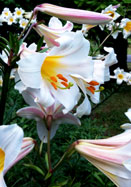
“There are few plants as rewarding and foolproof to grow” as bulbs, Dan Cooper wrote recently at his Frustrated Gardener blog. Most are “bold, colorful, long-flowering, and best of all inexpensive, giving gardeners plenty of bang for their buck. In short, they are one of the plant world’s best investments.”
Regal lilies are one of Dan’s favorite summer-flowering bulbs.
“Here’s a bulb with class, elegance and history,” he writes. “No wonder it was named Lilium regale, the regal lily. It was introduced to England from China in 1903 by Ernest Henry Wilson and quickly became a favorite of Gertrude Jekyll, who used it prolifically in her garden designs at a time when it would have been quite a novelty.
“Jekyll would frequently plant large clumps of Lilium regale in strategic spots, creating height and drama at pivotal points in her schemes. In addition to stature, the lilies also contributed intoxicating scent and blushing white flowers that stood out well against dark foliage. . . .”
“There is no flower so exquisite as Lilium regale at dusk on a warm June evening, glowing in the gloaming and sharing its intoxicating perfume,” Dan writes in closing. “Plant plenty, and then plant some more.
We couldn’t agree more! To enjoy these intoxicating beauties in your own garden, order now for delivery at planting time this fall. (July 2018)
Regal Lily: “Easy, Inexpensive, and Intoxicating”
“There are few plants as rewarding and foolproof to grow” as bulbs, Dan Cooper wrote recently at his Frustrated Gardener blog. Most are “bold, colorful, long-flowering, and best of all inexpensive, giving gardeners plenty of bang for their buck. In short, they are one of the plant world’s best investments.”
Regal lilies are one of Dan’s favorite summer-flowering bulbs.
“Here’s a bulb with class, elegance and history,” he writes. “No wonder it was named Lilium regale, the regal lily. It was introduced to England from China in 1903 by Ernest Henry Wilson and quickly became a favorite of Gertrude Jekyll, who used it prolifically in her garden designs at a time when it would have been quite a novelty.
“Jekyll would frequently plant large clumps of Lilium regale in strategic spots, creating height and drama at pivotal points in her schemes. In addition to stature, the lilies also contributed intoxicating scent and blushing white flowers that stood out well against dark foliage. . . .”
“There is no flower so exquisite as Lilium regale at dusk on a warm June evening, glowing in the gloaming and sharing its intoxicating perfume,” Dan writes in closing. “Plant plenty, and then plant some more.
We couldn’t agree more! To enjoy these intoxicating beauties in your own garden, order now for delivery at planting time this fall. (July 2018)
Which Lily to Choose? Swiss Expert Recommends 8 of Ours
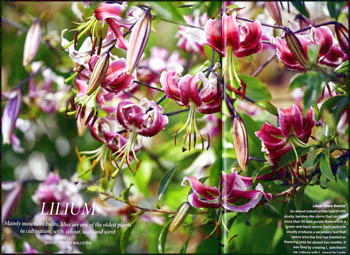
It’s lily season! The martagons are blooming here in our Ann Arbor gardens, along with the last of our iris and masses of peonies. Coral lilies will be next, and then regal lilies, Madonna lilies, and on and on well into August.
To help you decide which of these dramatic flowers to add to your garden, here’s what Swiss lily expert and nurseryman Pontus Wallsten had to say about eight of ours in the January 2018 issue of Gardens Illustrated.
In order of bloom-time:
Coral lily – “This little gem has a spicy fragrance.” (Spring-shipped.)
Regal lily – “By the wall of my house is a small clump of bulbs that have flowered faithfully for the past nine years, filling the summer air with the sweet scent of jasmine, and requiring no particular effort on my part. RHS AGM.”
‘African Queen’ – “Fragrant, vivid-orange flowers in July. Very vigorous and long-lived, it is happy in any well-drained, humus-rich spot in full sun or afternoon shade. RHS AGM.”
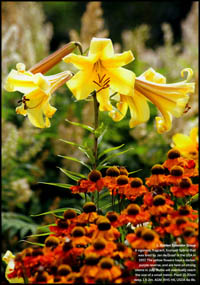 ‘Golden Splendor’ (pictured) – “A vigorous, fragrant trumpet hybrid. The yellow flowers have a darker, purple reverse, and are held on strong stems. Bulbs will eventually reach the size of a small melon. RHS AGM.”
‘Pink Perfection’ – “A superb trumpet hybrid that produces big, highly fragrant flowers in July. It is very disease-resistant and will thrive in any well-drained spot in full sun or afternoon shade with very little care. RHS AGM”
Henry’s lily – “A vigorous and long-lived species, producing 40 flowers or more, July to August. Best in part shade as color can fade in full sun. Stems can arch towards light, so may need staking. RHS AGM” (Spring-shipped.)
Gold-band lily – “Produces some of the largest, most fragrant flowers of any lily.” (Best in acid soils.)
‘Black Beauty’ (pictured) – “An almost indestructible hybrid with sturdy, bamboo-like stems that can hold more than 50 dark-purple flowers with a green-and-black center. Each peduncle usually produces a secondary bud that opens once the first has finished so flowering lasts for almost two months.”
We hope this helps. Order now for delivery at planting time – and next summer you’ll be raving about them yourself! (June 2018)
Henry’s Lily Stars in Historic English Gardens

Underappreciated Henry’s lily is one of my favorite lilies, so I was happy to see it featured not once but twice in the September 2017 issue of The English Garden.
In the gardens at Lamport Hall in Northamptonshire, “history and heritage meet modern planting techniques” in the style of Piet Oudolf. There “the soft orange flowers of Lilium henryi are used abundantly throughout the herbaceous borders,” combined with great swaths of hollyhocks, agapanthus, and American natives Joe Pye weed and Rudbeckia.
Henry’s lily also plays a major role at West Dean Gardens, a “formidable horticultural powerhouse” in West Sussex. A glorious two-page photograph of the historic walled garden there shows it blooming exuberantly in the Hot Border which “smolders across the length of the kitchen garden’s greenery.” (See a much larger version of this photo at our blog.)
Henry’s lily “grows like stink and is a real good do-er,” says gardens supervisor Sarah Wain. In fact, it’s one of the “stalwarts” of the border, along with “heleniums ‘Butterpat’ and ‘Moerheim Beauty’, daylilies, Solidago, Sedum, Heuchera ‘Palace Purple’, Potentilla ‘Gibson Scarlet’, and Rudbeckia fulgida.”
California poppies, nasturtiums, and ‘David Howard’ dahlia also figure prominently in the border, along with Crocosmia ‘Lucifer’. As luck would have it, I planted a clump of ‘Lucifer’ next to the Henry’s lilies in my backyard this summer, and though it wasn’t quite West Dean’s Hot Border, they did look great together.
Henry’s lily is one of four we now ship in the spring. To see how great it can look in your garden, order a few now! (Sept. 2017)
Regal Lilies Blooming in the Wilds of China
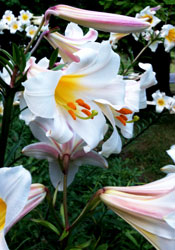
Regal lilies will be blooming here soon, and every year when their fragrance fills the air I’m reminded of this description written by E.H. “Chinese” Wilson, the great plant explorer who first brought them to America.
Of the 2000 plants Wilson collected in his eight trips to Asia, the regal lily was his favorite – although an avalanche broke his leg while he was collecting it and he walked the rest of his life with what he called his “lily limp.” In his 1917 book, Aristocrats of the Garden, he writes:
“Journey in thought with me for a moment or two, westward . . . to Shanghai, gateway of far Cathay; onward and westward up the mighty Yangtsze River for 1800 miles, then northward up its tributary the Min some 250 miles to the confines of mysterious Tibet; to that little-known hinterland which separates China proper from the hierarchy of Lhassa; to a wild and mountainous country . . . where mighty empires meet.
“There in narrow, semi-arid valleys, down which torrents thunder, and encompassed by mountains composed of mud-shales and granites whose peaks are clothed with snow eternal, the regal lily has her home. In summer the heat is terrific, in winter the cold is intense, and at all seasons these valleys are subject to sudden and violent wind-storms against which neither man nor beast can make headway.
“There in June, by the wayside, in rock-crevice by the torrent’s edge and high up on the mountainside and precipice, this lily in full bloom greets the weary wayfarer. Not in twos and threes but in hundreds, in thousands, aye, in tens of thousands. Its slender stems . . . , flexible and tense as steel, overtop the coarse grasses and scrub and are crowned with . . . large funnel-shaped flowers, each more or less wine-colored without, pure white and lustrous on the face, clear canary-yellow within the tube and each stamen filament tipped with a golden anther.
“The air in the cool of the morning and in the evening is laden with delicious perfume exhaled from every blossom. For a brief season this lily transforms a lonely, semi-desert region into a veritable fairyland.”
Thanks to Wilson, you can enjoy a bit of this distant fairyland in your own backyard. Simply order now for fall delivery! (June 2017)
Our Tiger Lilies “Look Amazing” at Frank Lloyd Wright’s Home
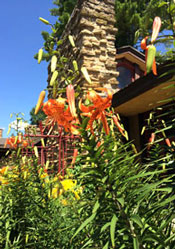
Tiger lilies were Frank Lloyd Wright’s favorite flower, and he grew masses of them in the gardens of Taliesin, his spectacular Wisconsin home and studio.
Taliesin’s Cultural Landscape Coordinator, Jessica Tripalin, emailed us earlier this summer saying, “The 50 tiger lilies you sent us last fall look amazing in the gardens here. The preservation crew is aiming to restore the entire estate to the year Mr. Wright passed. Our goal is to attain the look and feel of 1959. I am so happy with the results in the gardens this year. Thank you so much for your beautiful plants!”
Jessica also sent us this photo of a few of our tiger lilies blooming in front of one of Taliesin’s massive stone chimneys and the iron-pipe trelliswork that Wright designed for the gardens.
Tiger lilies are native to Japan and were frequently depicted in Japanese art. It’s easy to see how their simplicity, grace, and drama appealed to Wright, and no doubt they also reminded him of the months he lived in Tokyo while overseeing the construction of his early masterpiece, the Imperial Hotel.
To learn more about Wright’s gardens, read our review of Derek Fell’s The Gardens of Frank Lloyd Wright which we recently posted at our blog. (Sept. 2016)
‘Black Beauty’ is Blogger’s “Top Draw for Butterflies”
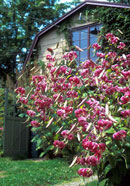
In a recent post at her award-winning blog The Garden Diaries, Clair Jones writes that the “top draw for butterflies” in her Maryland garden is the gorgeous, easy-to-grow ‘Black Beauty’ lily. She even includes a short video of a half-dozen tiger swallowtails blissfully sipping nectar from the lily’s deep raspberry-colored flowers.
Clair’s post also introduced me to “butterflying,” which she defines as observing and photographing these beautiful pollinators. Along with helpful tips for attracting and taking digital photos of them, she offers some fascinating facts about butterflies. For example, did you know that butterflies taste things with their feet?
August is a great month for butterflying, with many of the 765 species in North American active then. To enjoy more of them in your garden, read Clair’s tips – and maybe plant a few ‘Black Beauty’ lilies this fall. (Aug. 2016)
Learning from You: Lilies in the Living Room
Speaking of lilies, here’s an unexpected way to enjoy them up close, from our good customer Kathryn Hubler of Falls Church, Virginia:
“I thought you’d enjoy this photo of the gold-band lilies we received from you last year blooming in our living room. We’ve discovered we like to grow them in pots so we can enjoy their beautiful blooms and scent indoors. A pot of them is now a necessity, so we ordered fresh bulbs from you this year and will rotate the old ones into the garden.
“I grow the lilies outside, protecting the pot in the winter, and then when the first bud opens I bring them inside by our sunny, south facing window. I started doing this by accident one year when I brought the pot indoors to protect the flowers during a big rain storm. They last longer indoors, they’re never damaged by deer, slugs, or earwigs, and their fragrance is divine!”
Two of the most influential gardeners of the 20th century, Gertrude Jekyll and Vita Sackville-West, would probably approve of Kathryn’s technique. Both recommended growing fragrant lilies in pots and then moving them onto the terrace, near doorways, or alongside garden benches when they came into bloom, as they did in their own famous gardens.
Kathryn planted her lilies in the fall which gave them plenty of time to develop a good root system before they had to start growing above ground. Spring-planted lilies may be more of a challenge in pots, but we plan to try gold-band and ‘Uchida’ ourselves this spring, and we’ll let you know how they do.
For tips on growing all sorts of bulbs in containers, see our Bulbs in Pots page. Have fun, and send us your photos! (Dec. 2015)
Madonna (Lily) Blows Up Our Facebook Page
Grown in gardens since 1600, Madonna lily is still a superstar — or at least our recent photo of it in bloom here with larkspur and poppies prompted so many likes (1,854) and shares (5,246) that almost 400,000 people have seen it so far. Yes, 400,000! And that’s a global fan-base — appreciative comments were posted in Spanish, French, Italian, Portuguese, Romanian, Finnish, Thai, and Filipino.
Enjoy it yourself at Facebook.com/HeirloomBulbs — and to make sure you see our next big hit there, check “Follow” under the “Liked” button near the top of our page. Thank you, and happy gardening! (July 2015)
To Protect Your Lilies, Plant Alliums
Our good customer Amy Reynolds of Saint Louis, Missouri, emailed us this helpful tip:
“Your lily bulbs are fabulous! I popped them in the ground immediately. To protect them from an abundant local rodent population, I’ve planted them (as I always do with lilies) with several allium companions. I’ve found that squirrels and chipmunks won’t excavate past the alliums to get to nearby lily bulbs while they’re dormant, and the rabbits won’t go near allium foliage come spring.”
To try this yourself, why not order a few of our fabulous lilies and alliums right now? (Oct. 2014)
Grow Your Own Ryan Gainey Bouquet: Tiger Lilies and Crocosmia
Ryan Gainey, the celebrated Atlanta-area garden designer, has a special affection for heirloom flowers, including many of our bulbs. A while ago he sent us photos of a bouquet he’d made in a quirky old jug with tiger lilies — the iconic pass-along plant — combined with yellow ‘George Davison’ crocosmia, antique montbretia (which is also a crocosmia), and the berried stalks of Arum italicum. See Ryan’s bouquet here, and if you like it we’d be glad to send you everything you need to recreate it at home — except, unfortunately, for the Arum and the jug. (Please note: Since tiger lilies are fall-shipped but the crocosmia are spring-shipped, you’ll have to place two separate orders for them.) (Aug. 2014)
Stone Cold Survivors: Tiger Lilies Thrive in Voyageurs National Park
Starting in the 1940s, Chicago businessman Jack Ellsworth and his wife Elsie built a monumental terraced garden next to their summer home on the shores of Lake Kabetogama, deep in the wilderness of what is now Voyageurs National Park in northern Minnesota. At its peak in the early 1960s the garden included 62 rock-edged beds planted with thousands of lilies and other flowers and ornamented by 200 rock sculptures.
When the Ellsworths left Lake Kabetogama in 1965, the forest soon began reclaiming their garden. By 2001 when the National Park Service began implementing a preservation plan for it, decades of neglect, overgrowth, and zone-3 winters had taken their toll, and almost none of the garden’s original plants survived. Photos from the 1960s, though, showed the garden ablaze with thousands of tiger lilies, and after we confirmed the identity of these incredibly tough lilies, the Park Service ordered 500 more to replant in the garden a couple of years ago. Learn more here, and if you’re looking for a beautiful, historic lily for your own garden, consider planting some Lake-Kabetogama-tough tiger lilies this fall. (July 2013)
Lilies for Bright Shade
“Lilies are perceived as sun-loving plants, but there are many that enjoy a little shade,” writes Gene Bush of southern Indiana’s Munchkin Nursery in the October 2012 issue of Fine Gardening. “The top three on my list,” he continues, are Lilium speciosum, L. martagon, and L. canadense. We’d only warn you that Gene is talking about light, bright shade, and the further north you garden the shadier your shade is going to be — so proceed with caution. Another lily to try in light shade is ‘Mrs. Backhouse’ which thrives here in our Michigan garden in the bright afternoon shade of an old pear tree. (late August 2012)
“Plant These Lilies!” Say Two Famous Garden Writers
As lily season unfurls in all its glory, trying to decide which of those luscious beauties to add to your garden can be overwhelming — so here’s some helpful guidance.
“I’ve never seen an Asiatic lily I didn’t like,” wrote Allen Lacy in his 1992 The Gardener’s Eye. “I do have, however, a personal favorite: ‘Red Velvet’. It is easily the most magnificent plant in my garden in July . . . [with] dramatic trusses of as many as twenty-five outfacing flowers to a stalk. The red is intense and, somewhat to my surprise, the plants look wonderful in combination with deep pink achilleas.”
We’re big fans of Henry’s lily, as was Gertrude Jekyll, arguably the greatest garden writer of the 20th century. In her 1901 Lilies for English Gardens she wrote, “It is a handsome thing, the flower being much like that of L. speciosum but of a strong and yet soft orange color. To see the plant growing it impresses one with a feeling of vigor and well being. When established it will rise to a height of six feet and bear as many as twenty flowers. In short, though we have known it but a short time [it was introduced from China in 1889] it can be confidently recommended.” (June 2012)
Are Martagons and ‘Mrs. B’ Chipmunk Resistant?
Possibly. Our good friend Nancy McDonald who gardens near Lake Superior in zone-4/5 Grand Marais, Michigan, writes: “The martagon lilies have me grinning widely. They love our climate and soil, apparently, and for some reason the chipmunks don’t eat them — whereas Asiatic and other lilies are nearly as popular with chippies as crocuses. I planted some martagons in 1998 and they’re still going strong. ‘Mrs. Backhouse’ is, too, and she has martagon in her.”
Nancy also emailed us photos of a beautiful clump of ‘Mrs. Backhouse’ blooming in a wild corner of her garden. Give yourself a treat and take a peek. (Sept. 2010)
Can Regal Lilies Ease Arthritis Pain?
“Don’t sub any other flower,” Janet Weymiller wrote on her order for 25 regal lilies, “because my mom uses the petals in an arthritis remedy that really works.” We’re not doctors, but we know that flowers have been used medicinally since ancient times, and Nature is constantly surprising us, so we asked Janet to tell us more.
“This remedy really does work!” she emailed us. “It doesn’t cure arthritis, of course, but it takes the pain away. My mother grows regal lilies (in her New Albin, Iowa, garden). When they bloom and the petals start to turn brown, she takes them off the plant and cuts them up into chunks. Then she puts the petals into a glass jar and covers them with rubbing alcohol. She lets them sit for one month, drains off the liquid, which turns brown, and rubs the liquid onto the sore arthritic spots.”
The remedy was suggested to Janet’s mom by a local doctor who learned about it from a patient from Russia. Although we’re intrigued and hope it works, please remember that we are NOT doctors and are NOT endorsing it in any way. (August 2010)
Tiger Lilies and Dahlias in The Gardens of Frank Lloyd Wright
Beyond his iconic Fallingwater, few of us know anything about the gardens and landscapes that were always an important part of Frank Lloyd Wright’s vision. Now Derek Fell, the renowned garden photographer, sets out to change all that in The Gardens of Frank Lloyd Wright (2009). It’s a beautiful and informative book, and any gardener with a taste for art, history, or nature will find plenty to like in it.
Be sure to check out the photos of our ’Bishop of Llandaff’ dahlias and Wright’s favorite flower, tiger lilies, at Taliesin, Wright’s home and studio in rural Wisconsin. Tiger lilies, which are native to Japan and have been pictured in the country’s art for centuries, may have reminded Wright of the months he lived there during the construction of his landmark Imperial Hotel.
Dahlias figured in one of the saddest episodes of Wright’s life. While he was away from Taliesin, his live-in companion, Mamah Cheney, and her two young children were murdered in a fire set by an employee gone berserk. The next morning as Wright walked among the smoldering ruins with a Chicago Tribune reporter, “a crushed dahlia flower attracted his attention and seemed to raise his spirits. He picked up the flower and stirred the earth around its roots to give the plant a new lease on life.” Later, Wright “gathered all the flowers he could salvage from the garden and made piles of dinner-plate dahlias, summer phlox, long-stemmed zinnias, and armloads of peppery-scented nasturtiums” to fill Mrs. Cheney’s casket. (June 2010)
“Martagons Won’t Do Well in Your Zone,” We Said, But . . . .
Last fall when Master Gardener Linda Cobb of Spartanburg, South Carolina, ordered our martagon lilies, we told her we didn’t recommend them for her zone-7b/8a garden. But Linda loves a challenge, and this past June she wrote us happily:
“I visited England last year and fell in love with martagon lilies. I rushed home and ordered both the pink and white ones from you. You warned me that they might not grow in my South Carolina garden. But persist I did, and planted, watered, and waited. They came up and bloomed! I planted them in my shade garden because our shade is like the rest of the country’s sun. My soil is red clay but I amended it with 1/3 compost or peat moss and 1/3 sand which I’ve found works well in South Carolina.
“Now we wait to see if they come back next year. But in the meantime, I am so happy I was able to grow them in my own little English garden in South Carolina.” (July 2009)
Summertime. . . and the Lilies are Blooming
Despite plenty of competition, lilies are one of the iconic flowers of the early summer garden. In “Growing Old Lilies,” our good customer Sara Hartley sings the praises of her favorites. “Most recent hybrids,” she writes, “tend to blur ubiquitously: large, upward facing, rigid, stocky, scentless, differing from one another only in tint. I prefer species lilies and the old breeds most evocative of childhood memories and painted tableaux. For a New England garden into which frost intrudes, these are my favorites for a full season run . . . .”
Sara ends her essay with a few kind words about us and a shout-out to all who are growing heirloom bulbs. “Bulbs survive only by keeping the continuum growing, generation after generation,” she writes. “We gardeners form a necessary and pleasurable part of the chain, by our purchases and support of dedicated providers such as [OHG], and by perpetuating cherished bulbs in our own soil types, climates and aesthetic settings.” (June 2009)
Black Beauty Lilies Thrive in Zone-8 Florida
Our good customer Judy Little of Cantonment, Florida, writes:
“When I ordered your ‘Black Beauty’ lilies a few years ago, you warned me that they might not do well in my zone-8 garden. They have done fantastic! Now I can’t wait to try the new lilies I’m ordering. Thanks!” (late Oct. 2008)
Martagon Lilies “Worth the Wait” Says Garden Gate
Though wonderful — and newly stylish again — martagon lilies can disappoint gardeners because they’re often slow to reestablish themselves after transplanting. Here’s some advice from Deborah Gruca in a Dec. 2007 Garden Gate magazine article titled “Worth the Wait — Six Plants for the Patient Gardener”:
“Good things come to those who wait. It often takes more than five years for martagon lily to start blooming in your garden. [OHG note: That is definitely the worst case scenario!] But you won’t mind the time once you see a mature clump of dozens of plants with up to 50 of the 2-inch, downward-facing flowers on each stem! . . . .
“The large mass of flowers makes an impact in any sun to part-shade garden. The sturdy stems hold whorls of deep green leaves and don’t require any staking to keep them standing tall. Mark the spot where you plant the bulbs so you don’t accidentally dig them up — sometimes the plants don’t emerge for a couple of years after planting! [OHG: Again, this is an extreme.]
“Tip to Hurry It Along: Buy the biggest plants or bulbs you can find [OHG: Ours!], but more importantly, once you plant them, don’t disturb or move them.” (Oct. 2008)
Hurricane Ike Survivor: ‘Rubrum’ Lily
Our condolences to all of you touched by Ike’s devastation! Here’s one happy report from our good customer Stephanie Murrey-Alonso who lives in Pearland, just south of Houston:
“One of my ‘Rubrum’ lilies had just started blooming a day or two before Hurricane Ike hit us, and the next morning when I walked out there was one flower on the stalk still untouched by the Cat 2 winds. It was the most beautiful thing to see after such a ferocious storm. Your lilies are the best, and hurricane resistant, too!” (Oct. 2008)
New York Times Interviews Scott, Praises Our Lilies
Anne Raver of the New York Times is always worth reading, and we especially liked her recent column about lilies. She quotes Scott extensively and writes that “he sold me my first ‘Black Beauty’ bulbs years ago, and they have bloomed from mid-July to early August without fail ever since, in ever-widening clumps.” She also credits us with introducing her to ‘White Henryi’, “the classic trumpet lily” of ivory and amber, and praises another half-dozen of our heirlooms including the wild Lilium superbum whose “iridescent green throats . . . guide their pollinators — fritillaries and swallowtails — to the nectar inside.”
To read it all (and find out what prompted Scott to tell her, “Don’t print that!”), click here. (Sept. 2008)
Just in Time for Summer: ‘Red Velvet’ (Lily) Cake Recipe
‘Red Velvet’ is a wonderfully deep-colored lily, but I had always puzzled about its name because it didn’t match any red velvet I’d ever seen. [Our former office manager] Rachel set me straight when she pointed out that it’s the color of old-fashioned red velvet cake. To see for yourself, try the recipe from our friend Matt’s Grandma Opal. Topped with white frosting and blueberries, it’s the perfect treat for a Fourth of July picnic! (June 2006)
Garden Design’s “Way Hot 100” Includes Three of Our Bulbs
Every year in March, Garden Design magazine names their “Way Hot 100.” These are, editor Jenny Andrews says, “insiders’ top picks . . . what designers and avid gardeners are wild about this spring.” Many are brand new, but of the 11 bulbs listed we’re proud that three are heirlooms we offer:
Formosa lily: “This heirloom bulb is back in vogue,” Jenny notes, and she praises its rich fragrance.
Red spider lily, Lycoris radiata: Its “sea-urchin-like flowers” are showcased in a full-page photo. (Please note that we recommend it for zones 7-10 only).
Tulipa clusiana: “One of the few tulips that will perennialize (especially in the South), thriving in dry soils.” (We offer the hard-to-find, original, red-and-white T. clusiana.) (March 2006)
‘Black Beauty’ Showcased in Family Circle — And in Front of Our Barn
In the September 7 issue of Family Circle, our good friend Cynthia Van Hazinga has included us in her “Plant Picks from the Pros: 15 Garden Showstoppers.” One of five nursery-owners featured in the article, Scott recommends the indestructible ‘Black Beauty’ lily, Byzantine glads, and our Heirloom Fall Bulb of the Year, Tulipa acuminata.
To see a July photo of the big clump of ‘Black Beauty’ outside the Old House Gardens barn, visit http:/www.oldhousegardens.com/blackBeauty.asp. Ten bulbs planted five years ago yielded over 45 stalks and more than 450 blooms this summer! (Sept. 2004)
Lilies: A Guide for Growers and Collectors
For expert advice on lilies, you won’t find anyone who knows more than our good friend, Eddie McRae. After a lifetime working with lilies commercially in the Pacific Northwest, he now helps direct the Species Lilies Preservation Group. His new book offers chapters on growing, propagating, and hybridizing, along with complete information on 93 species — many long in gardens — and the development of modern hybrids. Far from an introductory handbook for casual home gardeners, this is a book that’s dense with specialized information for, as the title says, growers and collectors. (Jan. 2004)
Wow! 75 Flowers on One Regal Lily Stem!
Sometimes our bulbs surprise even us. Click here for a look at one of our regal lilies that’s loaded with close to 75 blooms on ONE stem.
Though we’d like to take credit for this magnificent display, it’s just the result of fasciation, a weird process that leads to those huge, crested cockscomb flowers, too. In lilies it’s often triggered by random mechanical or weather-related damage to the growing tip in spring, and typically it’s just a one-year thing.
Thanks to our good customer Carol Cote of Shady Grove Gardens in Rochelle, VA, for sharing this incredible photo with us. (Jan. 2004)
Two Great Lilies for Alkaline Clay
Many lilies prefer well-drained, acidic soil, but here‛s some good news for the rest of us. Garden-writer Lauren Springer, author of The Undaunted Garden and other terrific books, writes in the August 2003 issue of Horticulture magazine: “The jaunty tiger lily, L. lancifolium, and its taller, paler orange cousin, L. henryi, are the only lilies to thrive and return year after year in my heavy, alkaline clay soil” in zone-5 Fort Collins, Colorado. (Oct. 2003)
Who Is Mrs. Backhouse and Why Is She in My Garden — Twice?
Ever wonder about the people whose names grace our flowers? We’re going to be introducing you to some of them here in our Gazette.
First in line is Sarah Elizabeth Backhouse (1857-1921), a gifted hybridizer of daffodils and other bulbs. She lived at Sutton Court, near Hereford, England, and with her husband worked for years trying to develop a daffodil with a red trumpet. Their efforts resulted in many award-winning varieties, but their greatest achievement was the luscious, pink-cupped ‘Mrs. R.O. Backhouse’ daffodil of 1921. It’s still so well loved that it’s one of our perennial best-sellers.
But that’s not all! Mrs. B. also bred crocus, snowdrops, colchicums, hyacinths, and lilies, including a lovely, pink-and-amber martagon named ‘Mrs. R.O. Backhouse’. (Feb. 2003)
Denise’s Favorite Lily: ‘Black Beauty’
If you’ve ordered from us by phone in the past year or so, chances are you’ve been helped by fabulous [former employee] Denise Lynne. She writes:
“I first fell in love with the BULBS of ‘Black Beauty’. As they lay in their bins, waiting to be picked and sent to their new homes, they looked like huge, ripe, purple plums — plump, firm, and gorgeous. When Scott gave them an adoring tribute, I ordered 25 bulbs on the spot.
And my evaluation after their first season in my garden? I wish I had room for 50! In my small cottage garden, entirely visible from the street, ‘Black Beauty’ was a tremendous success. Tall and sturdy, its many blooms were bright, cheery, and subtly fragrant. Their dark raspberry color seemed to glow in the sunshine and at twilight they looked almost like velvet. My many garden visitors — both friends and passersby — always seemed to comment on them. I can hardly wait for next year’s show. Like all lilies, they should be even more spectacular their second year — which hardly seems possible!” (Nov. 2002)



