



Here’s a wealth of RAVES & FAVES from our email Gazette and past catalogs, starting with the most recently published. For other topics, please see our main Newsletter Archives page.
To subscribe to our FREE email newsletter, click here.
UK Blogger Praises “Bold, Bee-Friendly” Dahlia
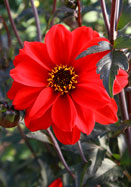
There sure are a lot of people who like ‘Bishop of Llandaff’ dahlia, including British blogger Dan Cooper of FrustratedGardener.com.
“With its dark, bronzed foliage and scarlet flowers,” Cooper writes, ‘Bishop’ “needs little introduction. It was thanks to Christopher Lloyd and his extensive use of ‘Bishop of Llandaff’ that dahlias found their way back into gardeners’ affections again. There are now lots of other ‘Bishops’ and a seed strain called ‘Bishop’s Children’” – all recent introductions – “but none surpass ‘Bishop of Llandaff’ in popularity.
“It was bred and introduced by Fred Treseder, a Cardiff [Wales] nurseryman and named to honor Joshua Pritchard Hughes, Bishop of Llandaff, in 1924. [It] earned an RHS Award of Garden Merit by 1928 and continues to be one of the most popular dahlias in cultivation today.
“Despite its bold looks, this vigorous, healthy, bee-friendly plant combines well with other perennials in a mixed border. Along with Crocosmia ‘Lucifer’, ‘Bishop of Llandaff’ is an essential ingredient in any ‘hot’ or exotic planting scheme.”
Two other dark-leaved, heirloom dahlias you might like to try are ‘Fascination’ and ‘David Howard’, and for open-center, bee-friendly dahlias don’t miss ‘Fascination’, ‘Bonne Esperance’, and ‘G.F. Hemerik’, as well as ‘Clair de Lune’ and ‘Fashion Monger’ which, alas, are already sold out for this spring – but you can click the link in their descriptions to be notified the moment they’re available again. (February 2020)
Is This the Year You Give Glads a Try?
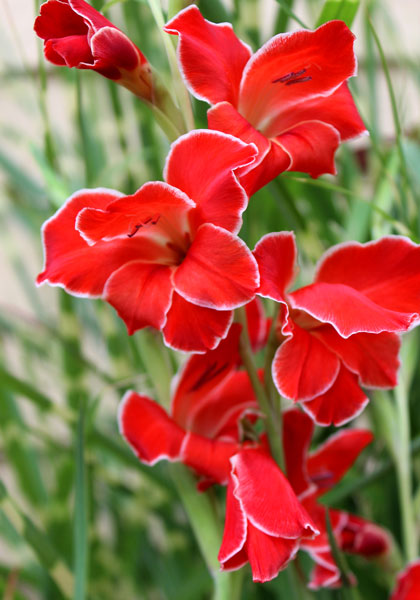
Joseph Tychonievich doesn’t just love glads. “I freaking adore them,” he writes in the May 2019 issue of Horticulture.
And if you’re not a glad-lover – if you still think of them as “funeral flowers” or “tired old grandma flowers” – he’s out to change your mind.
Maybe you prefer “a more graceful, natural look.” If so, Joseph recommends “old-fashioned varieties” such as ‘Atom’. This smaller glad has “graceful hooded blooms” of “rich, saturated scarlet” with “each petal edged with a perfect line of white.” They’re also spaced out along the stem “so you can enjoy the charm of each individual flower.”
“While some modern hybrids look too stiff and artificial to mingle easily with other plants,” Joseph continues, ‘Atom’ has “a wildling grace that looks marvelous either in a bed with other perennials or in an informal flower arrangement.”
Joseph is also a big fan of the Abyssinian glad. It’s “a treasure because right in the hottest part of the summer, when everything is looking tired and worn, this gladiolus starts pumping out crisp white flowers marked with dark maroon at the base of each petal…. The flowers boast a rich, spicy fragrance that gets stronger once dusk begins to fall.”
Gladiolus byzantinus, he points out, is one of the few Gladiolus species that hail from Europe instead of Africa, and “unlike the African bulbs that you should plant in the spring, this one is best planted in the fall, like a daffodil. Come spring the swordlike leaves pop out of the ground early, with elegant spikes of brilliant pink, graceful flowers following soon behind them. If they’re happy—and to be happy they need little more than full sun – they’ll quickly clump up and come back year after year.”
Diverse, “blessedly easy to grow,” and often “incredibly inexpensive,” glads are “too delightful a group of plants to let your prejudices stand in the way of enjoying them,” Joseph writes in closing. “Give them a shot in your garden this year. I promise you won’t regret it” – and we couldn’t agree more! (January 2020)
“Tall Drink of Water” – ‘Autumn Minaret’ Daylily
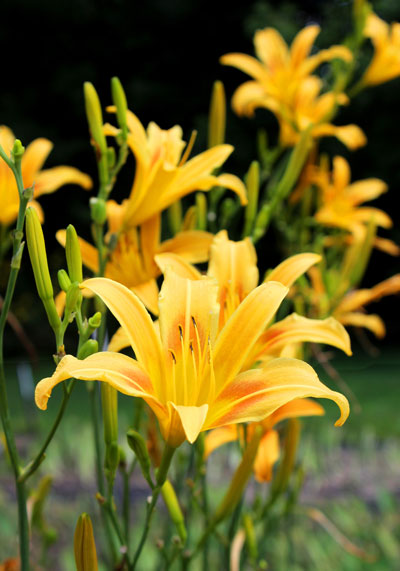
Andrew Keys – author of Why Grow That When You Can Grow This? – had high praise for our towering ‘Autumn Minaret’ in the August 2018 issue of Fine Gardening.
After describing it as a “superstar” that “sends up rockets of flowers,” he goes on to say that “daylilies always make reliable summer bloomers, and this cultivar sends up fragrant scapes of those voluptuous flowers from late summer well into fall. If that’s not enough, each one tops out up to a whopping six feet and sports yellow petals with an orange eye. This tall drink of water makes the perfect companion for meadow plants in full sun. Though daylilies will bloom in shade, more sun equals more flowers, and ‘Autumn Minaret’ is no exception.”
Always in high demand, ‘Autumn Minaret’ is sure to sell out early, even though we’ve already set a limit of five on it – so if you want it, we suggest you take a break from your holiday shopping and order it now. (December 2019)
Kids Love Eating Purslane, Too

Last month’s article about delicious, historic purslane apparently struck a chord with many of you, including Letty Savage of Sewickley, Pennsylvania, who emailed us to say:
“Loved the article on purslane. We run a kids’ garden club during the summer at our local Fern Hollow Nature Center. Each meeting features a snack, preferably something we have harvested from the garden. One week there were no vegetables ready to harvest so we picked purslane. We made a casserole using an old recipe from Euell Gibbons’ Stalking the Wild Asparagus and the kids just loved it. They also liked it raw. It makes a great snack to forage while weeding.”
In case you’d like to try that casserole, here’s the recipe from Gibbons’ classic 1962 book:
“Boil the tips ten minutes, drain, and chop fine. Stir one beaten egg into the purslane, then stir in as many dry bread crumbs as the mixture will dampen. Season to taste with salt and pepper, then bake in a moderate oven until the top is nicely browned.”
And here’s another of Gibbons’ purslane recipes, which sounds even tastier to me:
“Cut several slices of bacon in small pieces and fry them in a large skillet. When the bacon is done, dump in about one quart of the tender tips of purslane. Stir until evenly coated with the bacon drippings, then cover and let it cook 6 or 7 minutes. Season with salt and a little vinegar.”
Mmm-mmm, purslane! (September 2019)
2 Experts, 3 Fall-Planted Treasures
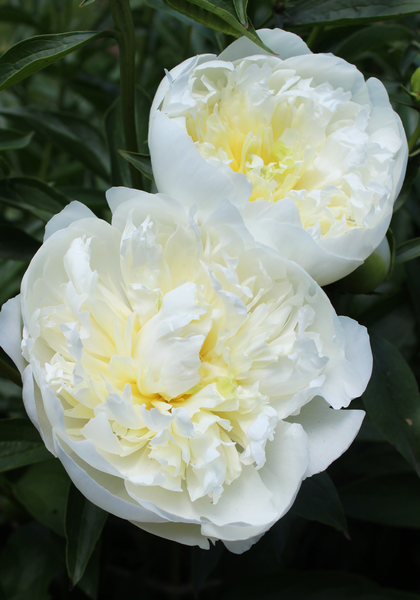
If you don’t have an expert head gardener or landscape architect living next door to help you with your bulb-planting choices this fall, here are three recommendations we’ve gathered for you. (No need to thank us.)
Galanthus elwesii – Writing in the February 2019 issue of Gardens Illustrated, British head gardener Tom Brown calls Elwes snowdrop “a superb form of this winter favorite,” adding “I particularly enjoy growing this species, not only for the large, white flowers – which can often be twice the size of our much-loved common snowdrop – but also because of the opulent, glaucous foliage.” (The RHS is also a big fan, having given it the prestigious Award of Garden Merit.)
‘Thalia’ – In his list of “100 Most Beautiful and Useful Plants,” in that same issue of Gardens Illustrated, Swedish landscape architect Ulf Nordfjell includes this popular old daffodil. He describes it as “a late-flowering cultivar that produces many pure white flowers,” and says it “provides a delicate counterpoint to early shoots of perennials such as astilbes and epimediums.”
‘Duchesse de Nemours’ – This grand old peony is another of Nordfjell’s “100 Most Beautiful and Useful Plants.” It’s “an old-fashioned, scented, double, creamy-white flowering peony, and a real beauty,” he writes, and “my favorite, especially among carpets of violets.” (And even though it’s over 150 years old, the ‘Duchesse’ is an RHS Award of Garden Merit winner, too.) (August 2019)
Garden Gate’s Top Picks – Summer-Blooming Heirloom Bulbs
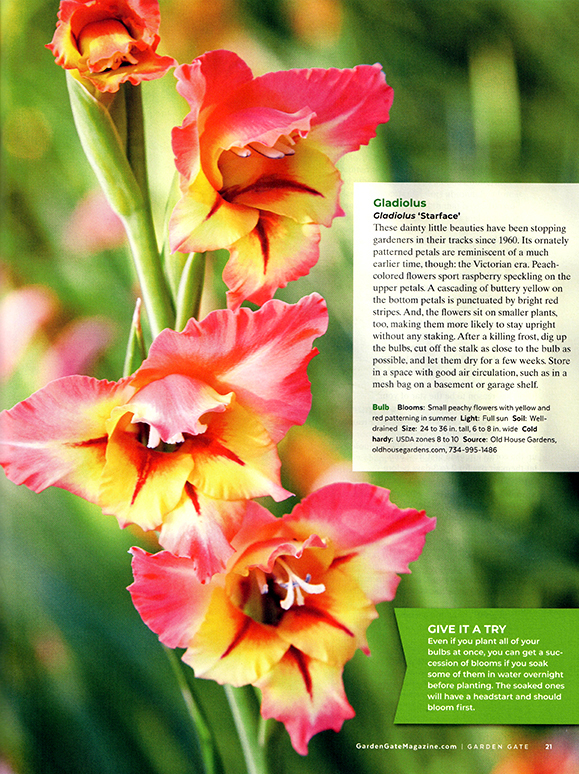
While leafing through the August issue of Garden Gate magazine I was happily surprised to see this full-page photo of my favorite small-flowered glad, ‘Starface’. It’s one of seven summer-blooming classics featured in “Top Picks: Heirloom Summer Bulbs.”
“You know a plant is well-loved, timeless, and a good addition to any garden,” writes author Chloe Deike, “when it has been zealously passed on and preserved from generation to generation.” And summer-blooming bulbs are great, she adds, for their “vivid presence, splash of color, and sudden appearance when other plants are starting to whimper and fade.”
Deike describes ‘Starface’ as a “dainty little beauty” whose “ornately patterned petals” have been “stopping gardeners in their tracks since 1960.” Other summer bulbs she praises include:
‘Star of the East’ crocosmia – With its “stouter stems” and “much larger flowers,” this 107-year-old crocosmia “won all kinds of garden awards when it was introduced” and “still has reason to be the star of your garden today.”
‘African Queen’ lily – “Voluminous and voluptuous, this apricot-colored beauty from 1958 sings out like a Broadway diva.”
red spider lily – With its “long, ‘spider-leg’ stamens that curve upward from a cluster of star-shaped flowers,” this dramatic perennial “definitely makes a tropical statement in the late summer garden.”
milk and wine crinum – A “classic pass-along plant in Southern gardens,” milk-and-wine lily “grows happily and blooms off and on throughout the summer without much fuss,” even in pots where it’s not hardy.
‘Café au Lait’ dahlia – Like ‘Starface’, this 1967 beauty also rates a full-page photo in Deike’s article. Its “enormous plush blooms” and “creamy, champagne tone” make it “one of the trendiest flowers for brides” and a “wonderfully celebratory cut flower.”
More than just pretty faces, “heirloom plants are rooted in story,” Deike writes, “embellished by a history that connects you to the past and spurs you toward the future.” And since so many are disappearing from mainstream sources, “growing heirlooms can make you an important link in the chain that keeps these plants thriving.”
You can order two of these treasures – ‘African Queen’ and red spider lily – right now for delivery this fall. The others are spring-planted, though, so they won’t be for sale again until later this summer. For an email alert then, simply click the link in each bulb’s description. (June 2019)
“Thanks to You, I’m Starting a Flower Farm!”
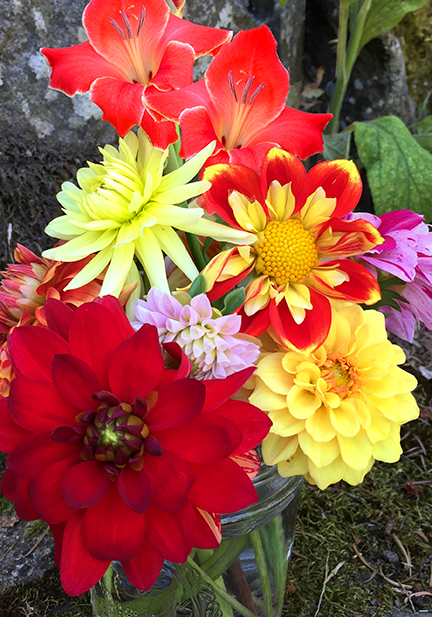
An email with that happy subject line arrived here recently from our long-time customer, Alicia Guy of Shoreline, Washington.
“After 17 years of planting OHG bulbs and dahlia tubers,” Alicia wrote, “I’m going to live on a grander floral scale! All of your high-camaraderie notes on invoices have nudged me over the edge. This spring I am starting Bitty Bouquet Flower Farm in Duvall, just outside of Seattle. I’m going to focus on heirloom flowers, most particularly dahlias.
“Just before Scott retired, I called to thank him for how much you’ve contributed to my garden life. The conversation wandered to my secret dream of having a small heirloom flower farm and, of course, he made it seem like that could be meaningful and rewarding work.
“I’ve been bowled over by how much enthusiasm taking this risk has generated with my family, friends, and (now former) co-workers, and I’m so excited to see where it all might lead. You can follow my journey at instagram.com/bittybouquet/, and thanks again for your long, slow part in this crazy mid-life career shift!”
Congratulations, Alicia! Selling heirloom bulbs was a “crazy mid-life career shift” for me, too, and though it was a lot of hard work and worry, it brought me a LOT of joy. May the beauty of your flowers and the happiness of your customers sustain you, and remember, as you said at the end of your email, “Spring is inevitable!” (April, 2019)
Love in Bloom: What Do Your Valentine’s Day Flowers Say about You?
“Does the kind of flower you send say anything about you as a lover? I think it does.”
So says Anna Pavord, superstar garden writer and bulb-lover, in The Curious Gardener. Here’s her modern take on the language of flowers, including her favorite Valentine’s Day flower – tulips!
Roses – “From a lover who feels safest as one of the herd and for whom imagination will never be a strong point.”
Carnations – “Acceptable only if they overpower you with their smell. If they don’t, then your lover too must be under suspicion of being unable to deliver what the outside appearance promises.”
Daffodils – “I’d trust a man who gave me daffodils. . . . Daffodils fit the bill seasonally, and in love as in life, you like to feel you are getting the right things at the right time. . . . There’s hope in daffodils. That’s a dangerously fragile commodity at the best of times, but now is the season to indulge it.”
Lilies – “Fine if you can live up to the theatrical aura they throw around them. Lilies will come from people who care very much about their appearance. . . . Let the stamens be the deciding factor. If your Valentine insists on cutting them off, on the grounds that the pollen will stain the Armani suit, then get free of the relationship as soon as you can. Just think how such a suitor would hog the bathroom. Impossible.”
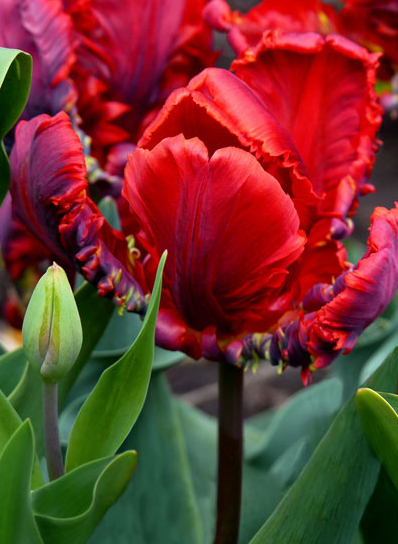
Tulips – “As far as I’m concerned, these are the best, indeed the only flowers to send or receive on Valentine’s Day. Wild, irrepressible, wayward, unpredictable, strange, subtle, generous, elegant, tulips are everything you would wish for in a lover. Best of all are the crazy parrot tulips such as ‘Rococo’ [pictured here] with red and pink petals feathered and flamed in crinkly lime-green. ‘When a young man presents a tulip to his mistress,’ wrote Sir John Chardin (Travels in Persia, 1686), ‘he gives her to understand by the general red color of the flower that he is on fire with her beauty, and by the black base that his heart is burned to coal.’ That’s the way to do it.”
If you’re a daffodil, lily, or tulip kind of lover, we’re here for you! Order any of our luscious, romantic, fall-planted treasures now for delivery at planting time in October. (Feb. 2019)
Posh UK Magazine Heralds “Modern Era” of “Truly Sophisticated” Glads
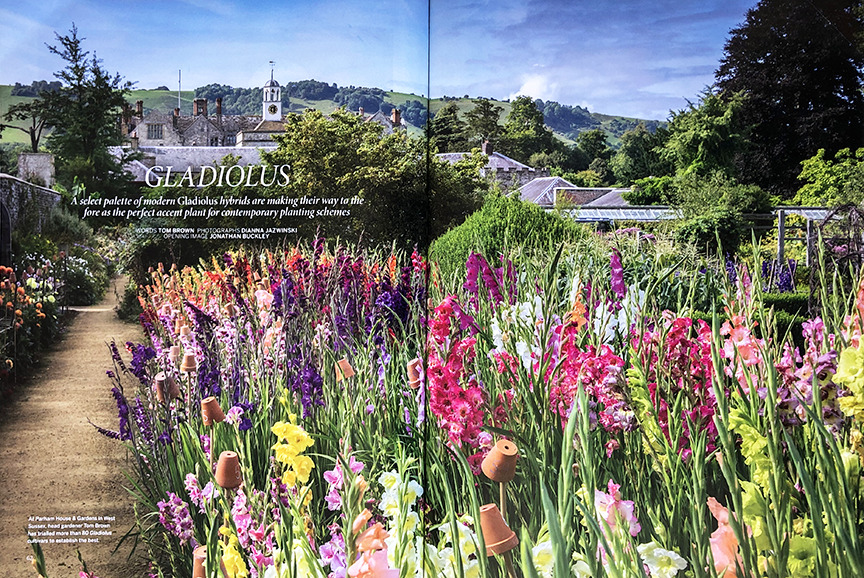
When the classy British magazine Gardens Illustrated devotes eight pages to gladiolus, you know they’re no longer just supermarket flowers.
Indeed, a “modern era of gladioli has arrived” writes Tom Brown, head gardener at Parham House and Gardens where he conducted a major trial of glads in 2017.
Although for some gardeners, he admits, glads will be “forever associated with outrageous taste,” today “subtler and more compact cultivars are beginning to push their way above the crowd.” Many of these are “truly sophisticated, associating beautifully with other late-summer performers” in the garden or bouquets.
Although most of the glads Brown mentions are too new for our catalog, one subtle older beauty he praises is the Abyssinian glad, G. callianthus ‘Murielae’. With “nodding, fragrant flowers that are an absolute delight,” this Award of Garden Merit winner “offers great versatility, and is equally superb in containers, borders or in a vase.”
“Of course, if you’re looking for loud and proud,” he continues, “there are also more traditional-looking, ruffled gladioli cultivars such as ‘Priscilla’. “The challenge when using these in a cut-flower arrangement is finding companions that will stand up to them. In this case look no further than dahlias, zinnias, and sunflowers to complement” your glads.
Glads are also great for “the late-August gap,” Brown says, “that period when late-season perennials are still gathering momentum but summer favorites are starting to struggle. Step up gladioli, igniting fireworks in the front, middle, and rear of our borders and blowing the lid off our creativity.”
“So my advice,” he concludes, “is banish all thoughts of brash and gaudy. Instead, experiment and indulge your garden and your vases with bold and beautiful spikes. In short, allow yourself to be seduced afresh by the vintage glamour and the contemporary charms of gladioli” – which you can order now for April delivery! (Feb. 2019)
Plant This: Our Customers and Experts Praise 5 Special Bulbs
Are you looking for something special to plant this fall? Here are five strong-growing, distinctive heirlooms you might want to try.
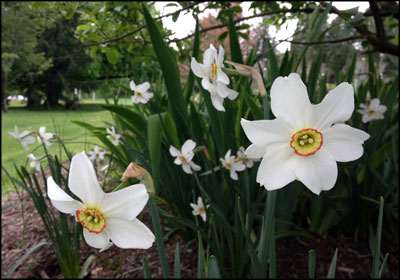
“Love them!!!” wrote Mary Sorenson of the pheasant’s-eye narcissus she planted at the Centre Furnace Mansion in zone-6b State College, Pennsylvania. Mary attached this wonderful photo and added, “They look like the most beautiful butterflies in the garden.”
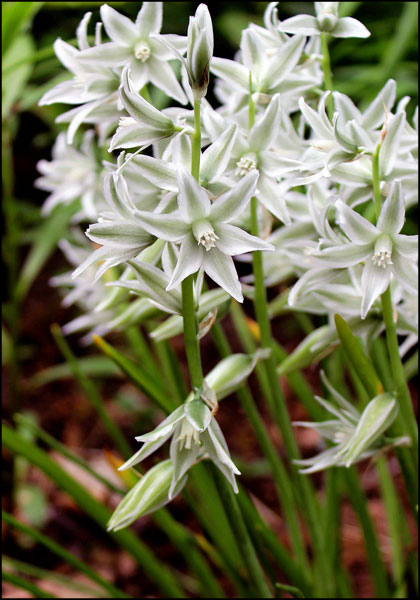
In her book Slow Flowers, Seattle author Debra Prinzing describes the pewter-and-moss colored flowers of silver bells as “fluffy and delicate.” Combined in a bouquet with ‘Super Green’ roses, apricot Verbascum, and dusty miller, they “surprised me as much as those chartreuse roses,” she adds. “Are they flowers? Are they greenery? I like that it’s hard to tell.”
“I think I can safely say that ‘Generaal de Wet’ tulip is one of the most indestructible tulips on the planet,” says Lisa Miller of zone-7a Sparks, Nevada (and it’s richly fragrant). “It has been happily blooming here in a neglected pot for at least five years now. I have more planted here and there, even in shade” – the very bright shade of Nevada, that is – “and they all just keep coming back for more abuse.”
“If only one autumn-blooming cyclamen is to be grown,” writes Rod Leeds in Autumn Bulbs, “then it must be this one” – Cyclamen hederifolium. “It is very accommodating, flourishing in so many garden situations. A semi-shaded site in friable (easily crumbled) soil suits it very well. Here it will self-sow profusely and soon build into a spectacular sight in early September.”
“You should see my ‘General Kohler’ hyacinths!” writes Donna Mack of zone-5b Elgin, Illinois. “Every spring more and more of them appear, and I actually have to dig them up and move them. They’re growing among ornamental grasses, which have a low priority for watering, so they get the dry rest they want in summer. When the grasses are cut down in spring, it’s lovely to see them blooming there.” (October 2018)
Regal Lily: “Easy, Inexpensive, and Intoxicating”
“There are few plants as rewarding and foolproof to grow” as bulbs, Dan Cooper wrote recently at his Frustrated Gardener blog. Most are “bold, colorful, long-flowering, and best of all inexpensive, giving gardeners plenty of bang for their buck. In short, they are one of the plant world’s best investments.”
Regal lilies are one of Dan’s favorite summer-flowering bulbs.
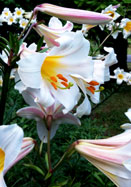
“Here’s a bulb with class, elegance and history,” he writes. “No wonder it was named Lilium regale, the regal lily. It was introduced to England from China in 1903 by Ernest Henry Wilson and quickly became a favorite of Gertrude Jekyll, who used it prolifically in her garden designs at a time when it would have been quite a novelty.
“Jekyll would frequently plant large clumps of Lilium regale in strategic spots, creating height and drama at pivotal points in her schemes. In addition to stature, the lilies also contributed intoxicating scent and blushing white flowers that stood out well against dark foliage. . . .”
“There is no flower so exquisite as Lilium regale at dusk on a warm June evening, glowing in the gloaming and sharing its intoxicating perfume,” Dan writes in closing. “Plant plenty, and then plant some more.
We couldn’t agree more! To enjoy these intoxicating beauties in your own garden, order now for delivery at planting time this fall. (July 2018)
‘Magnet’ Snowdrop: “Like the Blades of a Helicopter”
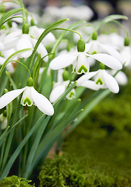
If you think all snowdrops are the same, think again. Here’s what our good customer Virginia Boyett of zone-7b Perryville, Arkansas, had to say the first year one of our favorites bloomed for her:
“The ‘Magnet’ snowdrops that I planted last fall have been in bloom for about three weeks, and they are the biggest snowdrops that I have ever seen.
“On cloudy days the buds stay closed and remind me of miniature tulips hanging upside down. Stark white, they are graceful and elegant.
“On sunny days, though, the outer whorl stands literally straight out, like the blades of a helicopter. With the extra-long pedicels, the entire bloom looks as if it could just take off and fly.
“The blooms keep coming, too. Each bulb has had 3-4 blooms apiece so far. I am loving it. I am just sorry I didn’t order more.”
Last offered in 2014, ‘Magnet’ is back in our catalog this fall, so Virginia – and you – can order it now! (August 2018)
‘Nonette’ Dahlia: “So Unique You’ll Stop and Stare”
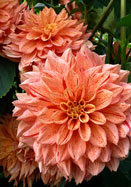
Garden writer Stephanie Cohen – who’s been called “one of the most influential women in horticulture” – gives our ‘Nonette’ a shout-out in the August 2018 issue of Fine Gardening.
Calling it “A Dahlia to Die For,” Stephanie writes that ‘Nonette’ has “bright apricot flowers that are speckled with burgundy,” and “even those who consider themselves dahlia connoisseurs find this particular blossom so unique they will stop and stare. As with many bicolor dahlias, the red stippling is highly irregular: one flower may have a lot of mottling, while another may appear to be just solid apricot. But the surprise is half the fun!” ‘Nonette’ also produces lots of flowers, “giving you plenty for the garden and the vase.”
Although it sells out every year, ‘Nonette’ is available now for delivery next spring. For plenty of flowers that will make you stop and stare, order now! (July 2018)
Which Lily to Choose? Swiss Expert Recommends 8 of Ours
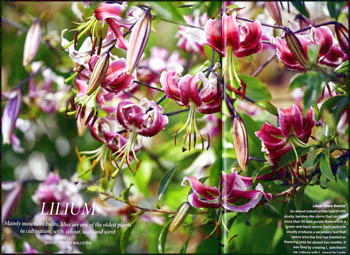
It’s lily season! The martagons are blooming here in our Ann Arbor gardens, along with the last of our iris and masses of peonies. Coral lilies will be next, and then regal lilies, Madonna lilies, and on and on well into August.
To help you decide which of these dramatic flowers to add to your garden, here’s what Swiss lily expert and nurseryman Pontus Wallsten had to say about eight of ours in the January 2018 issue of Gardens Illustrated.
In order of bloom-time:
Coral lily – “This little gem has a spicy fragrance.” (Spring-shipped.)
Regal lily – “By the wall of my house is a small clump of bulbs that have flowered faithfully for the past nine years, filling the summer air with the sweet scent of jasmine, and requiring no particular effort on my part. RHS AGM.”
‘African Queen’ – “Fragrant, vivid-orange flowers in July. Very vigorous and long-lived, it is happy in any well-drained, humus-rich spot in full sun or afternoon shade. RHS AGM.”
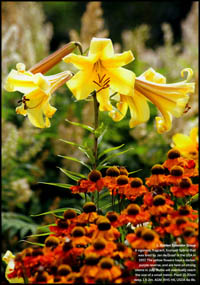 ‘Golden Splendor’ (pictured) – “A vigorous, fragrant trumpet hybrid. The yellow flowers have a darker, purple reverse, and are held on strong stems. Bulbs will eventually reach the size of a small melon. RHS AGM.”
‘Pink Perfection’ – “A superb trumpet hybrid that produces big, highly fragrant flowers in July. It is very disease-resistant and will thrive in any well-drained spot in full sun or afternoon shade with very little care. RHS AGM”
Henry’s lily – “A vigorous and long-lived species, producing 40 flowers or more, July to August. Best in part shade as color can fade in full sun. Stems can arch towards light, so may need staking. RHS AGM” (Spring-shipped.)
Gold-band lily – “Produces some of the largest, most fragrant flowers of any lily.” (Best in acid soils.)
‘Black Beauty’ (pictured) – “An almost indestructible hybrid with sturdy, bamboo-like stems that can hold more than 50 dark-purple flowers with a green-and-black center. Each peduncle usually produces a secondary bud that opens once the first has finished so flowering lasts for almost two months.”
We hope this helps. Order now for delivery at planting time – and next summer you’ll be raving about them yourself! (June 2018)
Perennial Companions for Tulips – and ‘Thalia’
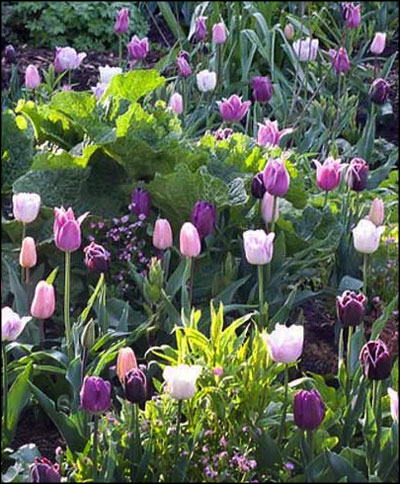
Although “tulips on their own can look spectacular,” writes UK garden designer Kristy Ramage in the April 2017 Gardens Illustrated, “I prefer to grow them more sparsely in combination with perennials, where the emerging leaves and a few early flowers are a foil for the shapely heads of the tulips.”
Kristy especially likes growing tulips “through mounds of soft foliage” such as that of columbines, meadow-rue (Thalictrum), Jacob’s ladder (Polemonium), hardy geraniums, and Anthriscus sylvestris ‘Ravenswing’, “a variety of wild chervil whose “ferny, copper-colored foliage . . . tones with the dark tulips and sets off the light tulips beautifully.” (Sadly for us here in zone-6a Ann Arbor, ‘Ravenswing’ is hardy to zone 7 and warmer only.)
She also highly recommends three of our favorite heirlooms for planting with perennials:
‘Apricot Beauty’ tulip – “Named in 1953, this lightly scented, softest salmon-rose tulip is vintage in more ways than one – imagine silk lingerie from the 1920s and you have this Single Early tulip to a tee.”
‘Columbine’ tulip – “Exquisite and rare, a ‘broken’ tulip of the type that was prized by the English florists’ societies of the early 19th century. It opens to a wide cup, displaying black anthers inside.”
‘Thalia’ daffodil – “I wouldn’t be without ‘Thalia’ somewhere in a garden. The form and color of this daffodil is so good it’s impossible not to be charmed. Introduced in 1916, it has been deservedly popular ever since for inter-planting with other bulbs or planting in drifts in a woodland.”
This spring, before your perennials reach their full-size, why not mark a few spots where a handful of tulips or ‘Thalia’ would look fabulous next spring– and then order now to make sure you’ll get them! (May 2018)
Native Dutchman’s Breeches is Dicentra Expert’s Favorite
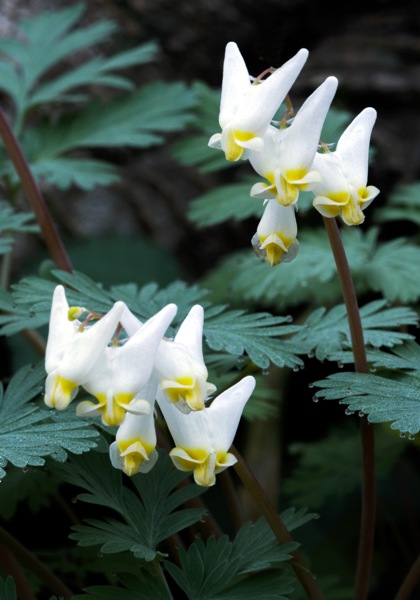
In his UK National Collection of Dicentra, Roger Brook grows 30-40 different kinds of bleeding hearts from all over the world. Although we offer just one – Dicentra cucullaria, Dutchman’s breeches – we were happy to read in the May 2018 issue of The English Garden that it’s Roger’s “current favorite.”
Dutchman’s breeches is “a diminutive, early flowering species from mountainous areas of northeastern United States and Canada,” writes author Val Bourne. “It has been grown in Britain since the early 18th century and was thought to have been sent by the Quaker botanist John Bartram (1699-1777) to Philip Miller at the Chelsea Physic Garden.”
“The exaggerated, heart-shaped flowers led the Menominee Indian tribe of Wisconsin to use this plant as a love charm,” Bourne adds. Another common name for it is “stagger weed, alluding to this plant’s toxic effect on livestock and presumably people” – which is good news for gardeners because it means that it’s deer-and squirrel-proof.
Although in his Yorkshire garden Brook says that “wet winters and slugs” make it “difficult to keep in the ground,” in colder gardens here in the US it’s usually easy to grow. In fact, I once dumped out what I thought was a pot of empty soil in a shady spot in my Ann Arbor garden and every spring since then a little colony of Dutchman’s breeches has been blooming and spreading happily there.
To see what a treat this native gem can be in your garden, order it now for fall delivery. (April 2018)
Mary Keen’s “Subtle, Indispensable” Heirloom Dahlias
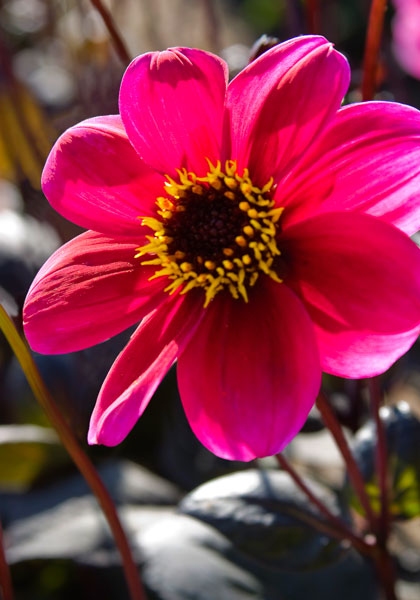
Renowned garden designer and author Mary Keen says dahlias – including some of our heirlooms – are “an indispensable feature” of her Gloucestershire garden.
In her long career, Keen has worked on many grand gardens, including those of the Rothschilds. At home, as she wrote in the July 2017 issue of Gardens Illustrated, she prefers the informal look of “a mingled matrix with a few spots of larger, brighter plants.” In this setting, “dahlias are a much better bet than roses.”
Along with the single red Dahlia coccinea, she favors “strong pinks and reds – ‘Grenadier’, ‘Pontiac’, ‘Fascination’, ‘Roxy’ [pictured here] – pale pink ‘Gerrie Hoek’, and pale-yellow ‘Glorie van Heemstede’.”
And here’s a tip: Mary says if you use too many “attention grabbers” such as tulips, peonies, delphiniums, and dahlias, “planting lacks depth and mystery.” But “you can scale down the impact by choosing more subtle forms” such as single, cactus. and waterlily dahlias which “lighten a planting better than a dinner-plate flower.” (Mar. 2018)
The Virtues of Heirloom Daylilies
In a pioneering article in the May 2007 issue of Horticulture magazine, Betty Gatewood sang the praises of heirloom daylilies.
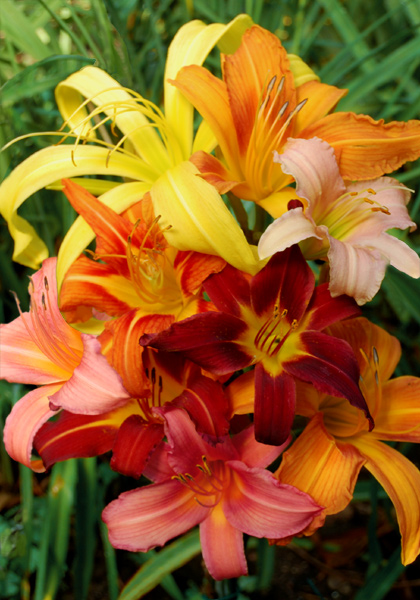
“Daylily fanciers today usually dismiss [heirlooms] as historical curiosities of limited interest,” she wrote. “The oldies, they believe, have been superseded by varieties with larger, showier flowers, sturdier stems, longer blooming periods, or other perceived advantages.”
But heirloom varieties, she points out, have their own special virtues.
First of all, “they retain the classic lily shape that has largely been bred out of modern daylilies. They are supremely beautiful. For this alone they are worth seeking out. . . .
“Many are fragrant.
“Their thinner, smaller flowers mean that deadheads are not very noticeable – in contrast to modern daylilies, which are disfigured by heavy, ugly spent blooms. . . .
“The old varieties range widely in size and in bloom time – daylilies flower in my garden from mid-May until the end of September, sometimes longer.
“Their colors are clear and stable; they combine well, and most suffer little weather damage.
“They are vigorous and naturalize well.”
“Some modern varieties bloom longer,” she adds, “but I would rather have three weeks of a flower I love than months of one that is commonplace.”
You can read the entire article here. Although most of the 35 daylilies she mentions are impossible to find today, we offer eight of them on a rotating basis and we’re building up stock of ‘Libby Finch’ and ‘Neyron Rose’.
Eleven heirlooms and our Classic Daylilies sampler are available now for April delivery. Order any of them and you’ll soon see what Betty (and we!) love about these “plants that should not disappear.” (Feb. 2018)
Frumpy No More: Glads and Dahlias for Stylish Bouquets
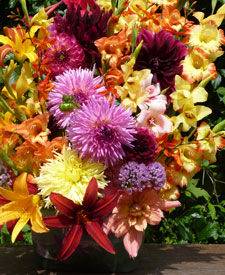
Alstroemeria and gazanias, step aside. According to a leading British newspaper, dahlias and glads are the hot new flowers for bouquets.
Although the news took a while to reach us here in Michigan, The Telegraph reported in September 2016 that “nostalgic Britons have revived an English country garden trend by decorating their homes with ‘frumpy’ British-grown flowers such as gladiolus, dahlias, and delphiniums.”
“Despite once being associated with other ‘undesirable’ stems such as chrysanthemums, experts said . . . more families are choosing these retro-style flowers instead of classics such as roses and lilies.” In fact, one major supermarket chain reported that glad sales were up 30%.
“Although gladiolus are often used in magnificent displays at venues such as Westminster Abbey, they are perfect for the less experienced arranger,” said a spokesperson at the National Association of Flower Arrangement Societies. “Gladiolus make a bold modern statement in a large vase or container on their own.”
For easy, on-trend bouquets from your own backyard, why not order a few of our retro-style glads and dahlias now for spring delivery? (Dec. 2017)
“Outstanding Excellence” – 42 RHS Award-Winners for Fall Planting
The Award of Garden Merit (AGM) is the Royal Horticultural Society’s highest honor for garden plants. It was first bestowed in 1922, and since 1993 the list of winners has been regularly updated to make sure all are still of “outstanding excellence,” “good constitution,” problem-free, and widely available.
Although many of our bulbs are too rare to make the list, here are 42 AGM-winners that we’re offering this fall. Some are already sold out, and others will be soon, so don’t delay – add some of these exceptional flowers to your garden today!
CROCUS: Cloth of Gold (save 10%), ‘Snowbunting’, ‘Vanguard’, and sold out ‘Mammoth Yellow’ and C. tommasinianus.
DAFFODILS: ‘Carlton’, ‘Jenny’, N. moschatus, pheasant’s eye, ‘Romance’, ‘Sun Disc’ (save 10%), The Tenby, and sold-out ‘Avalanche’ and ‘Geranium’.
HYACINTHS: Sold-out ‘City of Haarlem’ and sold-out ‘Gypsy Queen’ and ‘Hollyhock’.
LILIES: ‘African Queen’, ‘Pink Perfection’, regal, and sold-out L. martagon.
PEONIES: Sold-out ‘Duchesse de Nemours’ and sold-out ‘Miss America’.
TULIPS: ‘Black Parrot’ (save 10%), T. clusiana (save 10%), ‘Kingsblood’, ‘Prinses Irene’ (save 10%), ‘Temple of Beauty’ (save 10%), and sold-out ‘Apricot Beauty’ and ‘White Triumphator’.
DIVERSE: Allium senescens, Allium sphaerocephalum, Turkish glory-of-the-snow, Cyclamen hederifolium, snake’s-head fritillary, giant or Elwes snowdrop, ‘S. Arnott’ snowdrop, Byzantine gladiolus, Siberian squill, Sternbergia lutea (save 15%), Trillium grandiflorum, and sold-out ‘Atkinsii’ snowdrop and Leucojum aestivum ‘Gravetye Giant’. (Oct. 2017)
Two Great Tulips Overcome Deer, March Planting
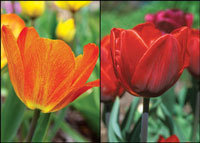
Heirloom bulbs are survivors, but even we were surprised by these two reports:
Here’s what our good customer Marianne Schmidt of zone-5b Stuyvesant, NY, had to say about one of our most fragrant tulips – although please note that we can’t guarantee it will work for you:
“Last spring the deer devoured all of my tulips EXCEPT ‘Generaal de Wet’. I don’t know if it was the fragrance or color that turned them off, but this year I’m pinning all of my tulip hopes and expectations on this beautiful tulip!”
And though we’d never recommend planting tulips THIS late, we were happy to get this news about one of our oldest tulips from our long-time customer Tara Fitzpatrick of zone-6a South Hadley, MA:
“Testimony for your ‘Couleur Cardinal’ – I forgot a bag I had intended to force inside in the basement fridge all winter. I found and planted them in the garden in March during a thaw, and they bloomed perfectly in May!” (Sept. 2017)
Henry’s Lily Stars in Historic English Gardens
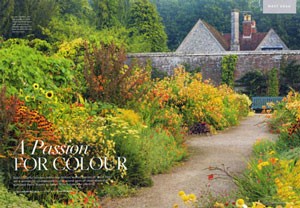
Underappreciated Henry’s lily is one of my favorite lilies, so I was happy to see it featured not once but twice in the September 2017 issue of The English Garden.
In the gardens at Lamport Hall in Northamptonshire, “history and heritage meet modern planting techniques” in the style of Piet Oudolf. There “the soft orange flowers of Lilium henryi are used abundantly throughout the herbaceous borders,” combined with great swaths of hollyhocks, agapanthus, and American natives Joe Pye weed and Rudbeckia.
Henry’s lily also plays a major role at West Dean Gardens, a “formidable horticultural powerhouse” in West Sussex. A glorious two-page photograph of the historic walled garden there shows it blooming exuberantly in the Hot Border which “smolders across the length of the kitchen garden’s greenery.” (See a much larger version of this photo at our blog.)
Henry’s lily “grows like stink and is a real good do-er,” says gardens supervisor Sarah Wain. In fact, it’s one of the “stalwarts” of the border, along with “heleniums ‘Butterpat’ and ‘Moerheim Beauty’, daylilies, Solidago, Sedum, Heuchera ‘Palace Purple’, Potentilla ‘Gibson Scarlet’, and Rudbeckia fulgida.”
California poppies, nasturtiums, and ‘David Howard’ dahlia also figure prominently in the border, along with Crocosmia ‘Lucifer’. As luck would have it, I planted a clump of ‘Lucifer’ next to the Henry’s lilies in my backyard this summer, and though it wasn’t quite West Dean’s Hot Border, they did look great together.
Henry’s lily is one of four we now ship in the spring. To see how great it can look in your garden, order a few now! (Sept. 2017)
“Jewels in the Ground” – Expert Choices for Fall Planting
Can’t decide what to plant this fall? Here’s some expert advice offered by top British garden designers in the October 2016 issue of Gardens Illustrated.
JINNY BLOM says, “‘If you do nothing else, buy bulbs. Don’t try to be clever, just pile them in and let them sort themselves out.” Her top recommendations include:
Galanthus nivalis – “Spring wouldn’t be spring without snowdrops.”
Crocus tommasinianus – “I’m always charmed by the starry flowers of this sweet little crocus which flowers so eagerly. . . . Plant great drifts of them. . . . They die away to nothing so cause no fuss at all.”
Tulipa sylvestris – “I found a patch of these exquisite, scented tulips growing in a damp meadow. . . . They are beautiful, with an elfin grace.”
‘Thalia’ daffodil – “I’ve lost count of how many of these sweet, pure-white narcissus I’ve planted. It is simply the best and most beautiful in my book, and very reliable.”
ANNIE GUILFOYLE says, “Plant bulbs in larger quantities than you think you’ll want. That way you will not be disappointed.” She especially favors:
Crocus angustifolius, Cloth of Gold – “This little Ukrainian crocus has rich, golden petals. . . . Beautifully sophisticated, it forms a carpet of color when you need it most.”
Hyacinthoides non-scripta – “For me, English bluebells are the bulbs that really herald in the spring. . . . Perfect for naturalizing in those tricky, shady corners under deciduous trees.”
ALISON JENKINS, “It’s easy to overlook bulbs, but they add . . . some magic at a dreary time of year.” She recommends just one heirloom, but it’s superb:
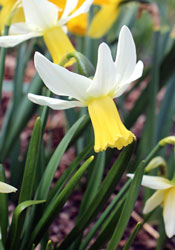
‘Jenny’ daffodil (pictured here) – “The graceful form and soft tones of this daffodil work well when naturalized. . . . It has creamy-white, swept-back petals with a pale-yellow trumpet.”
And DECLAN BUCKLEY says, “Bulbs are invaluable for injecting early season color. The key is to think big and plant in generous quantities.’ His top choices include:
Narcissus poeticus var. recurvus – “Despite its delicate appearance, this deliciously fragrant, late-flowering, wild species . . . is tough and sturdy.”
‘Gravetye Giant’ snowflake – “Fragrant, snow-white, bell-shaped flower, tipped with green. I have planted it among ferns on the edge of a woodland garden and in borders with ‘Thalia’.” (July 2017)
Customer Raves: Two Great Dahlias
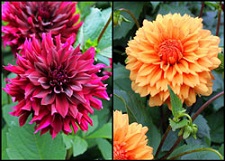
Here are a couple of rave reviews for two of our most popular dahlias:
“‘Prince Noir’ was absolutely brilliant,” our good customer Connie Casey of Old Chatham, NY, wrote us a while back. “Many, many huge wine-red flowers from late July till the end of October. It (he?) was next to our outdoor shower, set off spectacularly by two vines in back – hops and a red and orange honeysuckle. Whenever we were invited to dinner I brought a bouquet of mahogany sunflowers, red snapdragons, maroon sneezeweed, pink cosmos, and ‘Prince Noir’.”
“‘Old Gold’ is absolutely, stunningly glorious!” our good customer Sejean Sohn of Bethlehem, PA, wrote. ”It really does appear to flicker with light. I’m growing over 70 different dahlias this year from several specialty sources, but OHG’s ‘Old Gold’, ‘Prince Noir’, and ‘Jane Cowl’ are truly exceptional.”
Order them now and you may soon find yourself raving about them, too! (April 2017)
‘Atom’ & 6 Friends in “100 Great Plants for an English Country Garden”
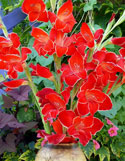
Our signature glad ‘Atom’ has a famous friend in England – and we introduced them!
Garden designer Rosemary Alexander is the founder of The English Gardening School, author of a half-dozen books, and winner of the RHS Veitch Memorial Medal. We met years ago when we lectured for a series of Horticulture magazine seminars. Although OHG usually ships to US addresses only, when Rosemary asked if she could order a few of the bulbs I’d shown in my slides, I happily agreed.
‘Atom’ was one of the first she ordered, and she liked it so much that – ten years later – she recommends it in Gardens Illustrated’s February cover article, “Rosemary Alexander’s 100 Great Plants for an English Country Garden.” Woo-hoo! “Long overlooked as an attractive garden plant,” she writes, “smaller gladioli are now back in fashion.”
Another half-dozen heirlooms we offer also made it into Rosemary’s top 100 plants: ‘Bishop of Llandaff’, dahlia, ‘S. Arnott’ snowdrop (“quickly forming very handsome clumps”), ‘Thalia’ daffodil (“longevity and vigor make this a popular choice for naturalizing”), regal lily (“I plant the bulbs in plastic pots and sink these in their final position in early summer as a glamorous, scented treat”), winter aconite, and sternbergia.
Spring-planted ‘Atom’ and ‘Bishop of Llandaff’ are going fast, but if you order them now you can enjoy their simple, bright blooms this summer – just like Rosemary does. (Mar. 2017)
Toasting Spring with Black Tulip Ale

We love bulbs, and I love beer, so when I saw a beer called Black Tulip at the grocery store recently, I felt duty-bound to drink a few and give you a full report.
Black Tulip is a tripel ale brewed by Michigan’s New Holland Brewing Company and named for a novel by Alexander Dumas (author of The Three Musketeers) set in 17th-century Holland.
Tripels are “similar to Belgian-style golden strong ales,” I learned at craftbeer.com, except they’re “generally darker and have a more noticeable malt sweetness.” Popular in Belgium and the Netherlands, they’re best enjoyed in a goblet-shaped “tulip glass,” and New Holland claims theirs is actually “dusted with tulip petals.”
Online, fellow beer drinkers have described Black Tulip as “a big, full-flavored, complex, easy to drink beer” that’s “very creamy and smooth,” with “lots of fruit and spice” and “a reasonable dose of hop bitterness.” I’d agree with all of that, and I liked Black Tulip a lot. Tripels have a higher alcohol content than most beers, though, so please drink it with care.
Black Tulip is available in 26 states. To find it near you, enter your zip code at beermenus.com/beers/5675-new-holland-black-tulip – and as our Dutch friends say, Proost! (Mar. 2017)
“Supremely Beautiful” ‘Ophir’ Daylily
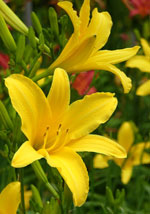
Ten years ago in a pioneering article for Horticulture magazine, Betty Gatewood sang the praises of heirloom daylilies.
“These plants, once treasured by gardeners for their elegance of form, are mostly unknown today,” she wrote. “But they are distinguished by one great quality: they retain the classic lily shape that has largely been bred out of modern daylilies. They are supremely beautiful. For this alone they are worth seeking out.”
Betty’s number one example was the lovely ‘Ophir’. One of the first American-bred daylilies, ‘Ophir’ has “trumpet-shaped flowers (rather like a golden Easter lily) of unmatchable shape,” she wrote. “It is also a robust grower, tall (about four feet), slightly fragrant, and very floriferous. Blooming . . . for almost a month, it is far too fine a plant to be forgotten.”
We completely agree – and though this “supremely beautiful” daylily is sure to sell out soon, you can still order it now for April delivery. If you listen carefully you can probably hear Betty saying, “You won’t regret it.” (Feb. 2017)
Garden Gate Names ‘Fashion Monger’ a “Best New Plant”
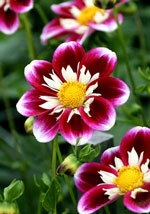
Old can be new, as our friends at Garden Gate understand, which is why they’ve named our ‘Fashion Monger’ dahlia one of their “Must Haves for 2017.”
“‘Fashion Monger’ may not be brand-new,” writes associate editor Sherri Ribbey, “but it’s been away so long it seems like it is. Originally introduced in 1955, this collarette dahlia was gradually replaced by newer cultivars. Fortunately, it was preserved and heirloom-bulb grower Old House Gardens is offering it for sale again.”
“‘Fashion Monger’ is a favorite of bees,” Sherri adds, “and it makes a great cut flower, too.”
Our supply this first year is limited, so if you want this old-but-new beauty, order soon! (Jan. 2017)
5 Timeless Iris: High Praise from the First President of the AIS
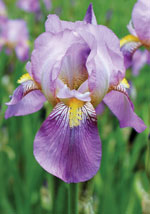
The great horticulturist John Wister helped found the American Iris Society in 1920 and served as its first president for fourteen years.
At that time, iris were exceedingly popular and scores of exciting new varieties were being introduced every year. Yet in his small book The Iris published in 1930, Wister wrote that “the more of the new things I see, the more I am convinced of the worthiness of some of our oldest varieties” – such as these:
‘Pallida Dalmatica’ (1597) – “There is nothing . . . in the whole range of iris that is finer than the true ‘Pallida Dalmatica’,” Wister wrote, adding that planting it with lemon lily (Hemerocallis lilioasphodelus) is “one of the most famous” garden combinations with iris.
Germanica (by 1500) – “The purple flag of our grandmothers’ garden . . . should never be omitted for . . . it makes a striking garden picture.”
‘Flavescens’ (1813) – Among pale yellow iris “there is nothing to surpass the variety ‘Flavescens’, well known in every old garden in this country.”
‘Queen of May’ (1859, pictured here) – “On the pink side of the lavenders, the old ‘Queen of May’ is . . . still one of the best.” It is “lovely,” he added, “with white and pink lupines and pink Dianthus.”
‘Mrs. Horace Darwin’ (1888) – Although “rather dwarf,” this white iris is “wonderfully free blooming. It is unexcelled for massing and should be used in every garden in quantities.”
Of course you don’t have to be an expert to enjoy these timeless treasures. Just order yours now for April delivery! (Jan. 2017)
Colette’s Gardenia: “I Bow Down Before the Tuberose”
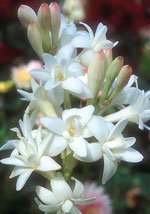
Although little known today, Colette was the highly acclaimed French author of some 50 novels, many of them scandalously sensual. In “The Gardenia’s Monologue,” which is one of the essays in her 1948 book For an Herbarium, that famously fragrant flower scorns all of her scented rivals, except one:
“I put up with all of these humbler bearers of nocturnal balms, certain that I have no rivals, save one, I confess . . . before whom at times I do worse than confess: I abdicate. On certain meridional nights heavy with the promise of rain, certain afternoons rumbling with casual thunder, then my ineffable rival need only show herself, and for all the gardenia in me, I weaken, I bow down before the tuberose.”
To savor the sublime fragrance that inspired Colette, order your single or double tuberoses now for April delivery. (And thanks to Toni Russo of Solon, Iowa, for sharing this essay with us!) (Jan. 2017)
Talking about Dinosaurs, First Gardens, and “Bulb Therapy”
If you love Old House Gardens – or heirlooms, or even just bulbs – here’s a recent blog-post and a radio interview that you may enjoy:
Pull Up a Chair is the very personal and poetic blog of our good customer Barbara Mahany who launched it after nearly 30 years of writing for the Chicago Tribune. In “Bulb Therapy” she talks of “the healing balms of the trowel” and bulbs that “will rise and reach for the light” whispering “‘here’s your reward for believing’ or ‘here’s what you get when you hold onto hope.” Barbara also has some kind words about us and our heirlooms, which she calls “the breathtakingest bulbs on the planet.” Read it all at https://pullupachair.org/2016/09/30/bulb-therapy/ .
Cultivating Place is the public radio program of our long-time customer Jennifer Jewell of northern California. Every week since February, Jennifer has been exploring the central role gardening plays in human culture, much like art, music, and literature. On the first day of fall we had a great time talking about my childhood love of dinosaurs, our first gardens, why I launched OHG, great bulbs saved and lost, and more. It’s a very pleasant half-hour (if I do say so myself), and you can listen to it now at http://mynspr.org/post/heirloom-bulbs-scott-kunst-old-house-gardens-ann-arbor-mi. (Oct. 2016)
Favorite Bulbs of Top UK Garden Designers
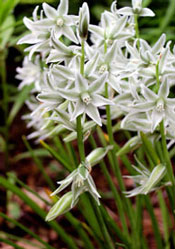
Along with an excellent article about our friends at the Hortus Bulborum, the October issue of Gardens Illustrated (#226) includes an article featuring recommendations from UK garden celebrities titled “Designers’ Favorite Bulbs.”
Famed garden writer Mary Keen recommends fragrant ‘General de Wet’ tulip, “hard to find” Tulipa clusiana, and ‘Trevithian’ daffodil which is “scented and good for picking,” and “lasts longer than most in the garden.”
Rosemary Alexander of the English Gardening School recommends “showy, long-lived” winter aconite, “timeless and elegant” ‘Thalia’ daffodil, and – pictured here – silver bells (Ornithogalum nutans). “With silvery, gray-green, bluebell-like flowers,” she writes, “it is subtle and beloved by flower arrangers as it lasts well when picked. Best in well-drained, light shade. Great among ferns.”
And Tom Stuart-Smith, whose current projects include “restoring an Islamic garden in Marrakech,” recommends “subtle” ‘Vanguard’ crocus – “for sheer impact it is superb,” he says – and pricey ‘S. Arnott’ snowdrop. “I am not a collector,” he writes, “and for the most part I am completely happy with . . . humble Galanthus nivalis . . . but I have bought about 20 ‘S. Arnott’ every year for the past ten years and am beginning to think it’s really worth it. So much substance combined with grace.” (Sept. 2016)
Bulb Love: Confessions of an Unreformed Bulbaholic
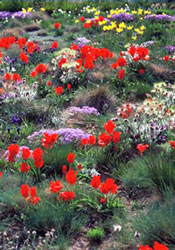
Lauren Springer Ogden, the award-winning author of Plant-Driven Design, The Undaunted Garden, and other fine books, calls herself “an unreformed bulbaholic.” She explores the roots of her obsession in this excerpt from “Bulb Love,” an essay she wrote for Horticulture magazine many years ago that we hope will resonate with you as well:
“For those who are not yet hopelessly in love with bulbs, let me attempt to describe the allure. Bulbous plants are the toughest of the tough. Most thrive in mineral-rich, humus-poor soils and tolerate periods of extreme drought. They’ve evolved to hide and wait for the return of better conditions, and then to send up, in many cases, the most extraordinary, otherworldly effort of beauty. . . .
“Bulbs need so little and give back so much. They start off homely, even ugly, and return transformed. We help them just a bit – we dig a hole in the dirt for them. Then we forget about them until, time and time again, they make their brief, joyful appearance, following the rhythms of the natural world, marking rains and seasons in floral time. . . .
“I plant them by the hundreds. There’s always room for more; the garden’s soil is my fruitcake and the bulbs are the raisins. It’s the safest addiction I know.” (Sept. 2016)
‘Thalia’ at Chanticleer: “Reliably Elegant and Breath-Taking”
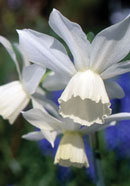
Chanticleer horticulturist Emma Seniuk had high praise for the graceful white ‘Thalia’ daffodil in the June 2016 issue of Fine Gardening
“This classic daffodil is so beautiful that upon first sight of the flower, I swore I would name my first-born daughter Thalia. Pure, nearly translucent white blossoms are held in sweetly nodding clusters with reflexed petals. There is a slight fragrance to the blooms, too.
“It is one of the latest blooming daffodils, with thin, grass-like foliage. This feature makes the deterioration of ‘Thalia’ a graceful event compared to other daffodils whose fat, heavy foliage collapses into a heap looking like a pile of discarded linguini.
“Stunning in combination with Virginia bluebells (Mertensia virginica), ‘Thalia’ is reliably elegant and breath-taking year after year.” (And you can order it now for planting this fall!) (Aug. 2016)
‘Black Beauty’ is Blogger’s “Top Draw for Butterflies”
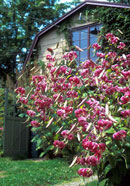
In a recent post at her award-winning blog The Garden Diaries, Clair Jones writes that the “top draw for butterflies” in her Maryland garden is the gorgeous, easy-to-grow ‘Black Beauty’ lily. She even includes a short video of a half-dozen tiger swallowtails blissfully sipping nectar from the lily’s deep raspberry-colored flowers.
Clair’s post also introduced me to “butterflying,” which she defines as observing and photographing these beautiful pollinators. Along with helpful tips for attracting and taking digital photos of them, she offers some fascinating facts about butterflies. For example, did you know that butterflies taste things with their feet?
August is a great month for butterflying, with many of the 765 species in North American active then. To enjoy more of them in your garden, read Clair’s tips – and maybe plant a few ‘Black Beauty’ lilies this fall. (Aug. 2016)
What is David Culp Growing? Heirloom Tulips at Brandywine Cottage
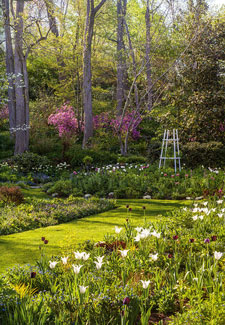
You may know David Culp as the best-selling author of The Layered Garden and an acclaimed landscape designer, but to us he’s a customer and fellow fan of heirloom bulbs, especially graceful old daffodils and unusual tulips.
David lives in a 1790s farmhouse known as Brandywine Cottage just outside of Philadelphia. His plantings there are especially beautiful in the spring – as an article by Janet Loughrey in a recent issue of Garden Design made abundantly clear.
Although “renowned for his masterful successive plantings and naturalistic style,” Laughrey writes, David is also “an avid collector of rare and unusual plants, including antique and specialty tulips. ‘I plant my favorite varieties near the house, in the rock or gravel gardens, or along the road, where they can be displayed more prominently and I can enjoy them up close,’ he says. Unusual patterns, colors, and shapes such as these striped, multicolored, or lily forms get top billing.”
Among the tulips pictured are three of our heirlooms: lily-flowered ‘White Triumphator’, stiletto-petalled Tulipa acuminata, and ‘The Lizard’, “a highly prized Rembrandt broken form with swirling patterns of rose and creamy yellow.”
Thanks, David, for giving our bulbs such a beautiful home! (June 2016)
Expert’s Top 100 Plants Include 3 Heirloom Bulbs
Once a year, Gardens Illustrated asks a horticultural superstar to write an article recommending “100 Plants Every Gardener Should Grow.”
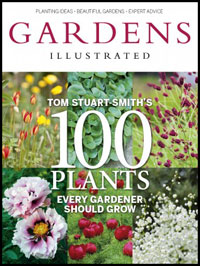
This year they turned to Tom Stuart-Smith, the internationally acclaimed British designer and winner of eight gold medals at the Chelsea Flower Show. His wide-ranging list includes trees, shrubs, vines, perennials, annuals, and grasses, along with bulbs – three of which, we’re happy to say, are heirlooms:
Traditional snowdrop (G. nivalis) – “I know there are many excellent cultivars,” Stuart-Smith writes, “but I’m very happy with this. I began at home 25 years ago with a bucketful from my mother’s garden and now there are tens of thousands thanks to regular dividing.”
Pheasant’s-eye narcissus (N. poeticus var. recurvus) – “I saw this familiar pheasant’s eye last spring growing [wild] in the Apennines and my heart missed a beat – and another when I bent to smell the sweet perfume. . . . Very tough and increases gradually even in rough grass.”
‘Black Beauty’ lily – “Magnificent Lilium speciosum hybrid of astounding vigor. Flowers from August to September. Exotic, stylish, and easy.”
The article inspired a wonderful post by our good customer Linda Brazil at her blog Each Little World. In it she mentions that years ago she compiled her own much shorter list of plants she’d never want to be without, and when she looked at it again recently, “I saw that everything on it was still growing in my garden and was a plant I would put on my list again.”
So what plants would be on your list? Would it include snowdrops, pheasant’s-eyes, and ‘Black Beauty’? And if you’re not growing them, why not take an internationally-acclaimed expert’s advice and give them a try? (July 2016)
Rethinking (and Raving About) Glads
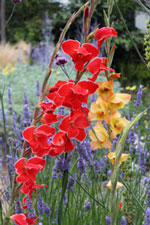
“How and why does a flower fall out of fashion?” asks Gardenista blogger Michelle Slatalla in what she calls the first of a new series, Rethinking Flowers, devoted to “old garden favorites that deserve a second chance.”
First up – gladiolus! Like many gardeners, Michelle had never grown glads before, but when we sent her a few of our small-flowered and unusual heirlooms (including ‘Atom’ and ‘Boone’, pictured here in her garden), she ended up seeing them in a whole new light.
Glads are “breathtaking,” she writes, and our graceful “heirloom varieties mingle well with other perennials.” In her California garden, for example, Michelle grows them among clumps of lavender whose cool tones perfectly complement the warmer colors of many glads.
For more – including evocative photos from Michelle’s garden and an account of an ultra high-society wedding in 1923 with the bride and her attendants “fairly staggering under the weight of gladiolus” – check out the whole wonderful post at Gardenista.com. (July 2016)
What is David Culp Growing? Heirloom Tulips at Brandywine Cottage
You may know David Culp as the best-selling author of The Layered Garden and an acclaimed landscape designer, but to us he’s a customer and fellow fan of heirloom bulbs, especially graceful old daffodils and unusual tulips.
David lives in a 1790s farmhouse known as Brandywine Cottage just outside of Philadelphia. His plantings there are especially beautiful in the spring – as an article by Janet Loughrey in a recent issue of Garden Design made abundantly clear.
Although “renowned for his masterful successive plantings and naturalistic style,” Laughrey writes, David is also “an avid collector of rare and unusual plants, including antique and specialty tulips. ‘I plant my favorite varieties near the house, in the rock or gravel gardens, or along the road, where they can be displayed more prominently and I can enjoy them up close,’ he says. Unusual patterns, colors, and shapes such as these striped, multicolored, or lily forms get top billing.”
Among the tulips pictured are three of our heirlooms: lily-flowered ‘White Triumphator’, stiletto-petalled Tulipa acuminata, and ‘The Lizard’, “a highly prized Rembrandt broken form with swirling patterns of rose and creamy yellow.”
Thanks, David, for giving our bulbs such a beautiful home! (June 2016)
2016 Great Plant Picks: They’re Not Just for Humans
Every year since 2001, Seattle’s Elisabeth C. Miller Botanical Garden has released an annual list of Great Plant Picks. Although especially well-suited to gardens in the Pacific Northwest, many of these plants are also outstanding choices for gardens across the country.

Butterflies, bees, and hummingbirds are the focus of this year’s GPP list, and Rick Peterson provides an excellent introduction to it in Pacific Horticulture. “As temperatures warm, bees emerge from their winter slumber looking for nourishment,” Peterson writes, and since “crocus are among the garden’s earliest blooming bulbs,” the GPP list includes several such as C. tommasinianus, ‘Jeanne d’Arc’, ‘King of the Striped’, and ‘Mammoth Yellow’. A few species tulips are also recommended, including T. clusiana and T. sylvestris which will have bees “bustling around the garden with satisfaction” and, in the right spot, will “reliably return year after year.”
Other Great Plant Picks that we’re offering now for delivery this fall include:
extra early-blooming winter aconite, traditional snowdrop, and giant snowdrop,
wildflowery Grecian windflower, ‘Gravetye Giant’ snowflake, and sowbread cyclamen,
unbeatable ‘Saint Keverne’, ‘Thalia’, and pheasant’s-eye daffodils,
and elegant martagon and regal lilies.
Learn more and see the entire list organized into categories such as “Fantastic Foliage,” “Made in the Shade,” and “Plants that Make Scents” at greatplantpicks.org/plantlists/search. (May 2016)
Lonely “Leftover” Survives, Blooms, Wins
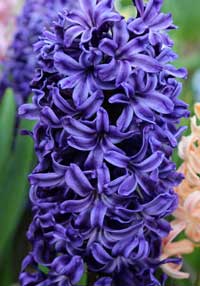
“Bulbs want to grow.” That’s what we say here at Old House Gardens whenever we hear a story like this one sent to us recently by our good customer Anita Bischoff of Kings Park, NY:
“In January, I found one ‘Marie’ hyacinth bulb lying in my garage. I must have dropped it when I planted the other 24 last fall. I put it in a glass forcing vase and then into my wine fridge. When green sprouted from the top, I put it on a windowsill. It looked beautiful as it was growing and it bloomed just in time to win a FIRST prize at the Smithtown Garden Club meeting last week – so all was not lost for the leftover. Happy Easter!” (April 2016)
Tour the Instanbul Tulip Festival – from Home
The spectacular bulb plantings at Holland’s Keukenhof Gardens are internationally famous, but have you ever heard of the Instanbul Tulip Festival – where four times as many bulbs will burst into bloom this month?

“Istanbul sparkles in April,” wrote Frazer Henderson in a recent newsletter of the Wakefield and North of England Tulip Society. “Brilliant splashes of color decorate public parks, streets, road verges, and traffic islands . . . as millions of tulips exuberantly announce the arrival of spring. Started in 2005, the city’s Tulip Festival seeks to revive the flower’s popularity and celebrate its contribution to Turkish culture. This year over 30 million bulbs – all propagated in Turkey – were planted.
One highlight of last year’s Festival was the world’s largest floral carpet blooming in front of Hagia Sophia, the spectacular Ottoman cathedral built in 543. “Over 500,000 bulbs in . . . deep purple, red, bright yellow, and burnt orange were planted in a highly geometric design covering 1262 square meters. . . . A babel of exaltations . . . confirmed the carpet’s awesomeness.”
If you can’t get to the Festival in person this spring, treat yourself to a virtual visit at http://howtoistanbul.com/en/istanbul-tulip-festival/5911#prettyPhoto. Click any of the tiny photos at the bottom of the article for a slideshow of many, many more. Enjoy! (April 2016)
Wall Street Journal Features Heirloom Flowers — and Us
“Rather than planting big-box-store flowers this spring, why not raise storied heirloom varieties that yield bragging rights as well as beauty?” So asks Bart Ziegler of the Wall Street Journal in a Feb. 20-21 article titled “Petals with Provenance.”
“Heirloom vegetables have been the rage for more than a decade,” Ziegler continues, “with foodies cooing over zebra-striped tomatoes and blue potatoes. But a lesser-known category of historic plants has its own devoted following: heirloom flowers.”

Illustrated with a big color photo that includes our catalog and even a few of our gladiolus corms, the article quotes experts from Monticello, Old Sturbridge Village, and Longwood Gardens, along with yours truly and our good customer Alicia Guy.
“Cooking-school manager Alicia Guy, who grows antique dahlias at her home outside Seattle, said of doing so, ‘It makes me feel like I have a connection with gardeners from 100 years ago that transcends technological change,’” Ziegler writes. Alicia “likes knowing her great-great grandmother might have cared for the same flowers,” including ‘Bishop of Llandaff’, a “summer showstopper.”
“The bragging rights historic plants give gardeners are well-founded,” Ziegler continues. “You can grow the same tulips planted in the White House Rose Garden when it was redesigned for President John F. Kennedy, in 1962; the variety of tuberoses Louis XIV enjoyed at Versailles; or the diminutive Silver Bells daffodils that author Eudora Welty tended in her Mississippi yard in the 1930s. All are available through Old House Gardens.”
“Raising heirloom plants,” he adds, “yields more than beauty: You ensure their survival. Catalogs from the . . . early 1800s offered hundreds of varieties of hyacinths, said Scott Kunst, founder and founder of Old House Gardens,” while today “most purveyors sell a half-dozen or so.”
The article ends with a call to action that you’ve probably heard from me before: “Heirloom flowers can’t be conserved in a museum like historic documents or antique furniture. ‘The only way to save them is to grow them,’ Mr. Kunst said.”
You can read the entire article here, but to do that you may have to pay $1 for a three-month subscription. Consider it an easy way to thank Bart and the Journal for shining a light on the flowers we love. (March 2016)
Gray is Cool — And so is 500-Year-Old ‘Florentina’ Iris
Once scorned as boring, gray is now one of the coolest colors around, as anyone knows who’s picked up a shelter magazine or watched a home improvement show recently.
But gray flowers?? Believe it or not, one of the most beautiful iris I know is the luminous, pewter-gray ‘Florentina’, and two of the 20th century’s leading horticulturists agree that it’s something special.
In her 1916 best-seller My Garden, Louise Beebe Wilder called ‘Florentina’ “a charming inhabitant of old gardens” and “one of the loveliest of irises,” and in 1930 the first president of the American Iris Society, John Wister, wrote that it “well deserves all its popularity, as nothing is better either for massing or cutting.”
Wister described its unique color as “pearly white,” and some gardeners see it as a very pale lavender, but to Wilder and me it’s truly gray. Wilder called it “French gray,” a pale gray warmed by a hint of brown or gold, but to my eye it most resembles the silvery gray of softly polished pewter.
‘Florentina’ is “invaluable to us in creating May pictures,” Wilder wrote, no doubt in part because gray goes well with just about everything. She suggested combining it with pink bleeding heart and Single Late tulips, yellow leopard’s bane (Doronicum), and lavender woodland phlox (Phlox divaricata), or planting it “in spreading groups near pink-flowered crabapple trees.”
So, are you cool enough for this gloriously gray beauty? Order a few now for delivery in April! (Jan. 2016)
Learning from You: Lilies in the Living Room
Speaking of lilies, here’s an unexpected way to enjoy them up close, from our good customer Kathryn Hubler of Falls Church, Virginia:
“I thought you’d enjoy this photo of the gold-band lilies we received from you last year blooming in our living room. We’ve discovered we like to grow them in pots so we can enjoy their beautiful blooms and scent indoors. A pot of them is now a necessity, so we ordered fresh bulbs from you this year and will rotate the old ones into the garden.
“I grow the lilies outside, protecting the pot in the winter, and then when the first bud opens I bring them inside by our sunny, south facing window. I started doing this by accident one year when I brought the pot indoors to protect the flowers during a big rain storm. They last longer indoors, they’re never damaged by deer, slugs, or earwigs, and their fragrance is divine!”
Two of the most influential gardeners of the 20th century, Gertrude Jekyll and Vita Sackville-West, would probably approve of Kathryn’s technique. Both recommended growing fragrant lilies in pots and then moving them onto the terrace, near doorways, or alongside garden benches when they came into bloom, as they did in their own famous gardens.
Kathryn planted her lilies in the fall which gave them plenty of time to develop a good root system before they had to start growing above ground. Spring-planted lilies may be more of a challenge in pots, but we plan to try gold-band and ‘Uchida’ ourselves this spring, and we’ll let you know how they do.
For tips on growing all sorts of bulbs in containers, see our Bulbs in Pots page. Have fun, and send us your photos! (Dec. 2015)
Lost . . . and Found? Gaye’s “Tiny Little Cream-Colored Daffodils”
We love it when our customers use the “Special Requests and Feedback” section of our online order form. That’s where Gaye Ingram of Ruston, Louisiana, made this plea:
“If possible, I would like to order ten moschatus, even though the limit is five. I’ve missed it every year by ordering late. Saw it decades ago and fell in love with it. I’m well past retirement age and would like to see a wee colony in my lifetime. Thank you for considering my request.”
Being soft-hearted souls, we said yes, and when she replied, Gaye told us this story:
“Thank you! I’ve pursued that particular bulb (or what I believe is that bulb) since 1968. Not even 25 years old but with degrees almost in hand, my husband and I arrived in Ruston that year to teach literature (me) and history at Louisiana Tech. We found a sweet little 1930s house on a shady street that had belonged to the mother of the chair of the Interior Design department. We felt like grown-ups!
“In spring, tiny little cream-colored daffodils with nodding heads sprang up on the lawn. I’d grown up in Central Louisiana among people whose yards and gardens were filled with passalong plants and bulbs, but I’d never seen such a demure spring bulb. I marked them and vowed to dig one or two in the fall.
“Then we moved to another place, and built a new house. I searched ever after for those quiet creamy bulbs. Went back to the place where we’d lived, but the owners had seen no bulbs. Without care and probably having their leaves mowed in late spring, they’d given up the ghost.
“The next time I saw them was in Celia’s grandmother’s garden. [Ed. note: Our good friend Celia Jones owns a small farm near Shreveport where her grandmother once grew acres of daffodils.] Celia had only a few, and knew only a local name for them. Sometime later, when I discovered Old House Gardens, I talked with Scott, but back then you didn’t offer them and he couldn’t be sure about their exact identity. More recently, whenever you did offer moschatus I ordered too late. (One has to discipline herself to order bulbs when it is 95 degrees with 80% humidity, as it is here today!)”
We sent Gaye’s bulbs to her last week, but we’re still not sure whether our Dutch-grown moschatus – or the very similar ‘Colleen Bawn’ – is exactly the same as the once widely-grown heirloom she’s seeking. Daffodils are enormously varied, and the differences don’t always show up in photos. For example, the Dutch-grown N. jonquilla of mainstream catalogs looks very much like the heirloom N. jonquilla ‘Early Louisiana’ that we offer, but the Dutch jonquils bloom weeks later and never thrive as well in Southern heat. (Learn more here.)
But we’re hopeful that Gaye now has the sweet little daffodil she fell in love with almost 50 years ago – and if you happen to be growing the beloved Southern heirloom known as goose-neck, swan’s neck, or silver bells, we’d love to hear from you! (Nov. 2015)
Customer Raves: Hooray for Hyacinths!
Although once the most popular bulb of all, hyacinths are rarely found in most gardens today. If you’re not growing them, you’re missing something special — as these fans will tell you:
Writing in Horticulture magazine, our good friend Marty Ross of zone-6a Kansas City, MO, tells of planting hyacinths “here and there in groups of three or five, almost like wildflowers. The soft pink ‘Lady Derby’, which has been around since 1875, is one of the prettiest, and it has persisted in my garden for years. I grow it among epimediums, hardy begonias, and a splashy variegated hosta; they hide the hyacinth foliage when it flops over in late spring.”
Double ‘General Kohler’ “keeps on multiplying,” our long-time customer Donna Mack writes us from zone-5b Elgin, Illinois. “Every year I have more, and the bulbs are huge. I think you’re right that they like being dry in summer. I have them planted among ornamental grasses — they’re lovely there when the grasses are cut down in spring — and that area has a low priority when it comes to watering. You should see them! Every spring more and more appear. This past spring, I must have had half a dozen new ones.”
And in Slow Flowers: Four Seasons of Locally Grown Bouquets, Debra Prinzing of zone-8b Seattle recommends making small, multi-colored bouquets of nothing but hyacinths. “A singular sensation — for the eye as well as the nose — hyacinths are so stunning that it’s hard to justify pairing them with any other flower. In fact, you really only need one hyacinth bulb, cupped in a special forcing glass, to experience the arrival of spring on your windowsill. . . . When I brought home a mixed bunch from the farmers’ market, they filled my car with a heady perfume.”
See for yourself by ordering a few of our 15 awesome hyacinths (several of which are on sale at 10-15% off) or our easy Easter Basket sampler now! (Oct. 2015)
Search of the Month: Fragrant Bulbs
Is it wrong to love our Advanced Search? We don’t think so!
Let’s say you want to add more fragrance to your spring garden and bouquets. Simply (a) click the “Advanced Search” link on any page of our website, (b) choose “all fall-planted” in the “Bulb Type” menu, and (c) click the “Fragrant” check-box. In a flash you’ll get this list of 66 fragrant, fall-planted bulbs. How easy is that?
If you want, you can fine-tune the list by hardiness zone, animal resistance, color, and more — or start another search. Have fun! (Oct. 2015)
Top Award-Winning Daffodils
The results are in, and here are the top award-winning Historic (pre-1940) daffodils in ADS shows across the country this past spring, with links to the ones we offer:
‘Sweetness’ (23 awards), ‘Beryl’ (17), ‘Dreamlight’ (15), ‘Thalia’ (11), ‘Actaea’ (11), ‘Saint Keverne’ (11), ‘Mrs. Langtry’ (8), ‘Geranium’ (8), ‘Hawera’ (7), ‘April Tears’ (6), ‘Erlicheer’ (6), and ‘Trevithian’ (6).
Order yours now and enjoy an award-winning spring in your own backyard! (Oct. 2015)
Campernelle Narcissus: From Slave Quarters to Lake Superior
One of our all-time best-selling bulbs is our true, American-grown Campernelle narcissus. Often called the “large jonquil” in old books and catalogs, Campernelles are a naturally-occurring hybrid of Narcissus jonquilla (the “small jonquil”) and N. pseudonarcissus (Lent lily) collected from the wild sometime before 1601.
In zone-8a East Texas, our good friend and daffodil expert Keith Kridler makes an interesting observation about this enduring daffodil: “One of the things I’ve noticed in our area is that the black slaves nearly all had Campernelles and jonquils blooming where they lived. You often find at larger plantation headquarters that the main house where the white folks lived (this part of the country was poor, so we’re talking about a simple ‘dog-trot’ house here) has few if any daffodils, but back from the house aways and further down the spring creek, the slaves’ or sharecroppers’ location is marked with masses of these daffodils today.”
Although they’re best known and loved in the South, Campernelles also do fine for us here in zone-6a Ann Arbor — and sometimes even further north. For example, our good friend Nancy McDonald who lives near Lake Superior in zone-5a Grand Marais, Michigan, writes: “I’ve had your Campernelles since 1995 and they’ve done very well, multiplying freely. So maybe they’re hardier than you think, especially in a mix of sand and old horse manure” — and when your garden is insulated by ten feet of snow every winter, as Nancy’s is. (Aug. 2015)
Your Next Favorite Bulb: New Advice from Our Customers
Can you guess which bulbs our customers liked best last fall and spring? See for yourself at our newly updated Customer Favorites page. Think of it as helpful plant-selection guidance from thousands of fellow gardeners! (Aug. 2015)
“Garden Gate’s Top Picks” Include 3 Heirlooms Blooming Now
In “Garden Gate’s Top Picks: These 9 Plants Add a Touch of Tropical Flair,” Shayna Courtney recommends three of our favorite spring-planted bulbs. The August 2015 article starts with a photo of ‘Atom’, our all-time best-selling glad. “Hummingbirds love the miniature blooms of 3-foot-tall ‘Atom’,” Shayna writes. There’s also a great photo of ‘Mexican Single’ tuberose, and she writes that its fragrance “intensifies in the evening, so choose a spot where you can enjoy its fragrance and the moths that visit its radiant nighttime blooms.” Finally, Shayna praises rain lilies (Zephyranthes), and although here in zone 6 we always grow them in pots, she notes that where they’re hardy they make “a good spreading groundcover.” (Aug. 2015)
Sissinghurst Gardener Blogs about Top 5 Tulips — and Us
We got a nice email last month from a gardener at England’s famous Sissinghurst Castle Garden. “I thought you might like to know that your nursery was mentioned in our Gardeners’ Blog this week,” wrote Helen Champion. “Thank you for creating such an interesting website. I find your in-depth information about heritage bulbs an excellent reference.”
In her post titled “My Top 5 . . . Tulips,” Helen ranks pink ‘Clara Butt’ #1. Introduced in 1889 and named for a world famous singer, “it flowers in the Rose Garden and is reliably perennial, having grown at Sissinghurst for many years,” she writes. “It’s hard to imagine a singer in today’s world putting up with a name like Clara Butt when she could be Madonna, Beyonce, or Lady Gaga but . . . Clara was immensely popular.”
Clara’s tulip was, too, “but fashions move on,” Helen writes, and “by 2007 only one grower produced ‘Clara Butt’ commercially and it is likely that the tulip would have been lost forever were it not for the efforts of Scott Kunst from Old House Gardens in the USA. He bought the remaining stock of ‘Clara Butt’ and sent 100 bulbs to Holland to be propagated. Now the future of this bulb is secure.”
Tulip #3 on Helen’s list is another wonderful old heirloom we offer, ‘Prinses Irene’, which she says has “historically been grown in the copper pot in the Cottage Garden, where the flame colored flowers sit in perfect contrast to the blue-green patina of the copper.”
Going enthusiastically beyond her Top 5, Helen recommends 20 other great tulips such as ‘Greuze’ which is grown today in Sissinghurst’s Purple Border. Read about them all. And thank you, Helen! (June 2015)
Love Letters to Tough, Mop-Headed ‘Van Sion’
“Can you tell me what this flower is?” We get asked that a lot, and if it’s a daffodil, the answer is most often ‘Van Sion’, a 400-year-old double that’s so tough it can often be found growing deep in the woods where a house disappeared ages ago.
Two of our customers loved ‘Van Sion’ long before we helped them identify it. Christiane Shems of zone-5b Yarmouth, Maine, ordered 25 ‘Van Sion’ last fall, explaining:
“The first time I saw this old beauty was in my parents’ yard in France. It was love at first sight, and they smelled so good. I took some bulbs back with me to the US. That was years ago and I am still enjoying them every spring. I had been looking for more since then but without luck. Nobody knew what I was talking about, until I found you. My parents have both passed away since, and these bulbs are so much more dear to me now. Thank you!”
Then in February, Marilyn Gist of zone-7b Raleigh, North Carolina, emailed to say:
“There is a daffodil that grows in a part of my yard down by the lake where it can be quite soggy, especially in winter or after a tropical storm. They were here when I moved here in 1987, and they spread and naturalize all over the place. They are very early blooming – the first one opened January 31 this year, which has been on the cold side for us. They grow in part shade in very dry areas, and they also grow in full sun right at the edge of the lake where it’s quite wet, all in my red clay soil. Amazing, don’t you think?
“Not knowing what they were, I always called mine the Phyllis Diller daffodils, after her wild-looking hairstyle. I searched various bulb catalogs for them, but never found a match. Thank you so much for the newsletter article that helped me identify them as ‘Van Sion’!”
See photos and learn more at our More About Van Sion page, or order it now for planting this fall at LAST fall’s prices. (May 2015)
Dahlia Accolades: 5 RHS Award Winners, 3 Tough Survivors in Maine
Of the more than 75,000 plants available to gardeners today, less than 10% have been honored by the Royal Horticultural Society with its prestigious Award of Garden Merit. These exceptional plants have proven their worth as “the best for all-around garden value.”
The RHS regularly updates the award list, and since availability is one criteria, varieties that have become hard to find are often dropped from it – making it all the more impressive that five of our heirloom dahlias are current AGM-winners: ‘Clair de Lune’, ‘David Howard’, ‘Glorie van Heemstede’, ‘Kidd’s Climax’, and already sold-out ‘Bishop of Llandaff’.
Another impressive accolade comes from our good customer Judith Mitchell of Waldoboro, Maine. “I got my first dahlias from you while it was still pretty chilly here in zone 5b,” she writes, “so I very carefully put my tubers aside to wait for warmer weather. Well, you can probably guess what happened – that’s right, I couldn’t find them. In fact, it was well into July when I almost literally stumbled upon them out in the shed.
“Ay-yi-yi, I thought. I immediately planted them with many apologies to the little guys, thinking, of course, that all was lost, I’d get nothing, and it was my own damned fault.
“BUT!!! Lo and behold, they soon sprouted, leaves unfurled, and – much to my rapturous delight – buds appeared! I heaped praise and encouragement on them, and at this late writing [Oct. 17], all have bloomed except for ‘Atropurpurea’, which does have two little buds although they probably won’t mature before frost. ‘Union Jack’ is lovely, and ‘Little Beeswings’ is sheer delight – the most adorable, perfect, and floriferous little dahlia in my dahlia-rich garden. Many thanks for all your marvelous flowers!” (April 2015)
Celebrate 100 Years of the ADS with “Cream of the Crop” Dahlias and More
Congratulations to the American Dahlia Society on its 100th anniversary!
Introduced from Mexico in 1798, dahlias became one of the most popular plants of the 19th and early 20th centuries. The UK’s National Dahlia Society was founded in 1881, the German Dahlia Society in 1897, and — after a failed attempt in 1895 — the ADS was established in 1915. The new society held its first national show that fall in New York’s Museum of Natural History. The blooms were displayed in milk bottles, winners took home $100 worth of ribbons and medals as well as $325 in cash, and the show drew some 35,000 enthusiastic viewers.
Dahlias are on the rise again today, and of all the bulbs we ship in the spring, they’re the most popular with our customers. They’re easy to grow, great for bouquets, and spectacularly diverse. To celebrate the ADS centennial, here are four easy ways to add at least one of these incredible flowers to your garden this spring:
1. Grow the oldest dahlia that still ranks as an ADS “Fabulous 50” dahlia — ‘Kidd’s Climax’, which last year won 78 blue ribbons or higher awards.
2. Grow an heirloom that still ranks as an ADS “Cream of the Crop” dahlia — ‘Kelvin Floodlight’ (with 42 blue ribbons or higher awards in 2014), ‘Bonne Esperance’ (26), ‘Juanita’ (18), ‘Thomas Edison’ (16), and ‘Little Beeswings’ (16).
3. Grow a dahlia that’s so old it could have been shown in the very first ADS show: ‘White Aster’ (introduced in 1879), ‘Union Jack’ (1882), ‘Tommy Keith’ (1892), ‘Little Beeswings’ (1909), “Wisconsin Red” (1910?), or ‘Prinzessin Irene von Preussen’ (1912).
4. Grow one of our easy heirloom dahlia samplers, Dreamy Dahlias or Endless Bouquets. (April 2015)
‘Corky’ Daylily “Scores a Perfect 10”
With chocolate buds that open into a seemingly endless profusion of small yellow flowers, ‘Corky’ is one of my favorites daylilies — and I’m not the only one who feels that way. When he owned Loomis Creek Nursery in upstate New York, Portland-based garden designer Bob Hyland sold just a handful of daylilies, including ‘Corky’ which he called a “must-have” plant. His criteria for selecting daylilies were simple, he said:
“1. Great bud count for extended bloom time.
“2. Smaller flower size (2-4” diameter) to fit the look of naturalistic border designs.
“3. Strong flower colors with saturated hues and tint.
“4. Tall, sturdy flower stems (36” and taller) that punctuate borders with aerial theatrics.”
“‘Corky’ scores a perfect 10 in our evaluation system,” Bob wrote. “Its flared, bright lemon yellow, 3-inch flowers are accented by bronzy-brown color bars on the outside of petals. Wiry, purplish flower stems rise 3 feet above the narrow, strappy foliage, and each stem is well-branched with a 40+ bud count, sending wave after wave of flowers your way.”
To see for yourself what Bob and I are so enthusiastic about, order ‘Corky’ now for April delivery. But don’t delay — we have fewer than 60 plants left! (March 2015)
The Bishop in Winter: Resurrection of a Lost Tuber
Is it a miracle? Maybe not, but we think you’ll find this recent testimonial from Tulsa garden writer Russell Studebaker inspiring.
“This spring I ordered some of your dahlias, but somehow I forgot to plant the ‘Bishop of Llandaff’ – and only rediscovered him in late summer. Since the Bishop was still plump, as most real life bishops are, and wee red sprouts were showing, he was reverently planted in a gallon container on August 17.
“He grew and is now about a foot tall. Before our first frost in November I moved him inside in front of two large south windows where he’s been residing happily ever since. Although I don’t expect him to flower this winter, I’m giving him some time to build up his strength before I give him a rest. Then I’ll look forward to his grand, proper, and belated appearance in the garden next summer.
“You’ve got good stock – and perhaps the Bishop has good connections with the heavenly father.” (Jan. 2015)
Stop Hating Versatile, Misunderstood Orange
Although “orange is the color people love to hate,” according to garden designer Rebecca Sweet in the September 2014 issue of Horticulture, it’s also “one of the most versatile colors in the garden, fitting in with just about every season.”
“When I ask a new client what colors they prefer,” Sweet writes, “I can almost guarantee orange will be top in the ‘do not include’ category.” That may be because people associate it with “uninspired plantings of bright orange marigolds rigidly lining a pathway” or because it’s become the “poster child of 1970s shag carpeting.”
A self-described “champion of orange,” Sweet says that while it “can sometimes be bright, dominating, and perhaps a bit garish, it can also be soft, gentle, and subdued . . . , [harmonizing] with just about every color on the color wheel.” Pairing it with its analogous colors red and yellow will tone it down, while pairing it with its complementary colors blue and purple will “create an exciting burst of energy.”
Among my favorite orange heirlooms for spring planting are the radiant ‘Andries Orange’ dahlia, orchid-like ‘Firedance’ gladiolus, and wildflowery ‘Orangeman’ daylily. For fall planting I’m a big fan of amber-orange Henry’s lily and the fragrant ‘Generaal de Wet’ tulip.
But why stop there? Check out our entire list of orange heirlooms and see what this under-appreciated color can add to your garden! (Jan. 2015)
Snowdrops at Warp Speed
“Well, here’s a cool thing,” our good customer Nancy McDonald emailed us last March. Nancy gardens in zone-5a Grand Marais, Michigan, a mile from Lake Superior, where the annual snowfall averages over 11 feet (yes, 11 feet!). “Three days ago my snowdrops were covered with more than a foot of snow. Two days ago the snow melted. Yesterday they had little green and white spears sticking up. Today the stems are long enough that the buds are starting to hang over. If it’s warm enough tomorrow, I bet some of them will open. That’s zero to sixty in only three days. Incredible!”
To speed your spring with snowdrops, order yours now! (Oct. 2014)
Learning from You: Pink Surprise Lilies Beyond Zones 6-7
Thanks to all of you who responded to our query about growing pink surprise lilies, Lycoris squamigera, outside of the narrow range we’d been recommending for them. You gave us lots of great feedback, and here’s the short version of what we learned.
ZONES — Many readers told us they’ve had long-term success with surprise lilies in zones 5b and 8a, and for the past couple of years we’ve been getting our bulbs from a third-generation bulb farm in 8a, so we’ve now expanded our zone recommendations to include zones 5b-8a(8bWC).
SOIL — Although well-drained soils are usually recommended for surprise lilies, several readers say theirs grow just fine in clay soil. Clay is dense, though, which makes it harder for bulbs to multiply, and it holds water longer which can cause bulbs to rot.
WATER — Many readers say they never water their surprise lilies, and that may be a good thing. Like most bulbs, they do best when they’re relatively dry during their summer dormancy. Since many of us water our gardens then, this could be one reason they’re often found surviving in lawns and “neglected” areas that get less watering — though of course they do need water when they’re not dormant, from fall through the end of spring.
SUN/SHADE — Full sun seems to suit them best, especially the further north they’re planted. But many of our readers said they do well in partial shade, too, especially if it’s from deciduous trees which leaf out later.
PLANTING DEPTH — Some authorities say to plant them with the neck just under the soil surface, but our expert North Carolina grower recommends planting them so they’re covered with 2-4 inches of soil. Since the bulbs we ship are 3-4 inches tall, that means planting them with the base 5-8 inches deep.
LONG WAIT FOR BLOOM — If you dig them from a neighbor’s yard you probably won’t have this problem, but if you plant dry, dormant bulbs you’ll have to be patient. Although most will put up leaves their first spring, sometimes nothing emerges until the spring after that, and they virtually never bloom until their second or even third year. Thanks again to everyone who helped us “crowd-source” this article! For the longer version, including quotes from customers growing them everywhere from zone-3 Saskatchewan to zone-9 Florida, see our More About Surprise Lilies page. (late Sept. 2014)
Fragrant Tulips
“Did you know some tulips have a fragrance?” garden writer Jean Starr asked at her blog petaltalk-jean.com. “I discovered this a few years ago when I was perusing the Old House Gardens catalog. I ordered ‘Prinses Irene’ first, [and now] it’s one of my favorites. Introduced in 1949, its flower is subtle from a distance, but up close, it’s like a Southwestern sunset. Its deep orange petals feature a bold purple freestyle streak at the center and edges that fade a bit to glowing peachy-gold.”
Last fall Jean planted orange ‘Generaal de Wet’, but she says “orange isn’t enough to describe the color of this tulip. It starts out pale — more of a peach than orange, but just as fragrant as ‘Prinses Irene’. As I went in for a sniff I was rewarded by the sight of delicate striations of shades belonging to the peach family. It’s as if a brush laden with coral, salmon, and the palest apricot were drawn in an outward motion from the center of each petal to its edge.”
Jean also planted fragrant ‘Orange Favorite’, but it was still in bud when she wrote her blog. She wrapped up by saying, “It’s rare to find flowers both beautiful and fragrant. Even half a dozen fragrant tulips planted close at hand (or nose) is well worth enjoying in April.” Take a look at all of our fragrant tulips here — and happy sniffing! (late Sept. 2014)
“Great Bulbs That Last”
That’s the title of an excellent article by Karen Bussolini in last September’s American Gardener. “The best surprise of the first spring in my new home in Connecticut,” Karen writes, “was a mass of shaggy, fragrant daffodils that bloomed like crazy. . . . They were growing all over the neighborhood, but I couldn’t find them in any of my books or catalogs.” It turned out they were ‘Van Sion’, from 1620, and “twenty-five years later, they’re still going strong.” Bussolini asked experts around the country to recommend other “durable bulbs” like that which “come up every spring [and] bloom with no effort on a gardener’s part,” and many of them were heirlooms:
NORTHEAST: In addition to ‘Van Sion’, Bussolini recommends daffodils such as ‘Thalia’, and ‘Ice Follies’, as well as tommies, winter aconite, traditional snowdrops, and Tulipa clusiana.
SOUTH: Scott Ogden in the humid Gulf South notes that “wild narcissus such as N. jonquilla . . . have naturalized in roadside ditches and Lent lilies (N. pseudonarcissus) are taking over old pastures.” Scott also recommends Byzantine glads, crinums, rain lilies, oxblood lilies, and red spider lilies.
MIDWEST: Jill Sellinger of the zone-5b Chicago Botanic Garden says, “Almost all narcissus will perennialize beautifully here,” and Scilla siberica and Spanish bluebells spread eagerly.
MOUNTAIN WEST: In zone-9 Tucson, Arizona, Scott Calhoun recommends T. clusiana and white rain lilies. In dry, zone-5b Fort Collins, Colorado, Lauren Springer says “only grape hyacinths and foxtail lilies survive . . . without irrigation,” but with one inch of water a month C. chrysanthus, tommies, and Byzantine glads do well, and if you double that in spring so will species tulips such as T. clusiana. “Most alliums are champs,” too, she adds.
WEST COAST: Greg Graves in zone-8a Graham, Washington, recommends ‘Thalia’ and pheasant’s-eye daffodils, tommies, snowdrops, snake’s-head fritillaries, and T. clusiana. In zone-10a Encinitas, dry-climate gardening expert Nan Sterman “relies on slim, elegant” Byzantine glads. And on zone-10b Alcatraz, our good customer Shelagh Fritz says that when the Garden Conservancy started restoring the abandoned gardens there, “as soon as the winter rains began, bulbs started popping up,” including Scilla, grape hyacinths, snowflakes, daffodils, and gladiolus.
For more, read the entire article. And then, as Bussolini recommends, “plant some new bulbs that will yield a huge payoff for many years to come.” (late Sept. 2014)
Tulsa Garden Writer Swoons for “Spicy” ‘Madame Sophie’
Our good friend and long-time Tulsa garden writer Russell Studebaker emailed us a few months ago, agitated about a certain double white hyacinth that we offer:
“I want to tell you how ticked off I was when I tried to order ‘Madame Sophie’ again from you last fall and you were sold out! I LOVE THAT HYACINTH. It has the most spicy and wonderful fragrance of any of the hyacinths that I have grown, and its flowers persisted and lasted so long for me. I cannot image why it has become so endangered and hard to find. Since you were sold out so early in the season, I had to go on my search engine and after a great while I did get some out of England, at a premium price. But what the heck, things of beauty and quality are worth the extra cost. Please order more for this fall, and find additional growers for that superb hyacinth.”
Some might say it’s wrong to love a plant that much, but we’ve been there, and we understand. Could ‘Madame Sophie’ inspire such passion in your garden-heart? To find out, all you have to do is order a few for planting this fall. Russell, we’re happy to say, already has. (July 2014)
A Squirrel-Proof Tulip???
As any chipmunk or deer will tell you, tulips are one of the tastiest bulbs. That’s why we were surprised to get this email from our good customer Jane Baldwin (who you may remember from “Jane’s Easy Daffodil Baskets” at our Bulbs in Pots page):
“I had a quite a bit of loss with the bulbs I grew in pots this year. The extreme cold made it very difficult to keep them from deep-freezing, even in my garage, and I lost several pots that I had not protected well enough. So this spring I had just a few blooming on my patio, and then there were all these hungry red squirrels constantly rummaging in them. A curious thing happened, though, with the pot of ‘Prinses Irene’ tulip — no damage during the month or so it was on the patio. It was the only pot that wasn’t’ disturbed by the critters! I remember the basket I had them in last year was never touched either. I think I may be on to something, so I am going to give it a try again this fall. I may just have found a squirrel-proof tulip, at least in pots on the patio. Have you ever heard of anything like this before?”
No, Jane, we haven’t — but maybe one of our newsletter readers has? Although it’s probably nothing more than a happy coincidence, we’re definitely keeping our fingers crossed. (June 2014)
Another Glad Convert: From Childhood Trauma to Summer Smiles
“In my garden? No way.” That’s what our good customer Susan Stauber of Beacon, NY, had to say about glads — until she took a chance on our small-flowered, best-selling ‘Atom’. She writes:
“I grew up in a part of the country where the huge hybrid gladiolus were grown in fields. Great for funeral arrangements and corporate office lobbies, but in my garden? No way.
“But there was something tantalizing about those little ‘Atom’ glads of yours. So I bought a few. And when they bloomed — wow! They made me chuckle every time I saw them. So last year, I bought a few more ‘Atom’ and some ‘Lucky Star’. This time I planted them in groups here and there, and I planted the groups at different times so I was smiling at blooms all summer long. (I even dug and stored them successfully last fall.)
“I never could have predicted that I’d be ordering more gladiolus for this year, but I am — ‘Boone’, ‘Starface’. I can’t wait for the ground to finally defrost so I can plant them. It is possible to recover from childhood traumas.
“P.S. Everyone who walks by wants to know what those wonderful red flowers are. They can’t believe they’re gladiolus!” (May 2014)
Eternal Spring in Alabama
A hand-written letter arrived here earlier this spring from our good customer Carolyn Brown of Creola, Alabama, and it was so joyful and inspiring, we wanted to share it with you:
“How I wish you could see your beauties in my colonial garden,” Carolyn writes. “My breath catches as I gaze upon the beauty. Why so few people here in the South have bulbs, I’ll never understand. As the daffies sway in the wind I’m reminded of Wordsworth’s poem “Daffodils.” How excellent a description it is.
“In your eighties, each day is more joyful than the day before, and the daffodils are prettier each day. I do hope God has daffies in heaven and I can plant acres and acres of them.
“My husband, Bob, has always said vintage roses are his favorite flower. He has around 150 this year. However he said my bulbs are getting to be his favorite, and they are far less work. In fact, he urged me to make this order [for the coming fall]. I try your smallest amount first and see how they do here and then I go for a larger amount. I’m going to start on hyacinths next.
“Give the little dog a pat and a rub for me. Keep up your good work and save as many bulbs as you can. And thank you all for giving an 80+ gal a wonderful life and joy with the beautiful — as my husband calls them — ‘daffy-down-dillies.’
“Your Garden Pal, Carolyn B.” (May 2014)
Kristen Says “I Do” with Dahlias (and Andy Does Too)
Whenever someone tells us they want to use our flowers in their wedding, we get nervous. Sure, our flowers are gorgeous, and — since they’re also traditional and enduring — they’re perfect for the “something old” that every wedding needs. But garden conditions vary widely, the weather is always unpredictable, and plants aren’t very good at sticking to schedules, so to have everything in bloom for that one special day — well, wouldn’t that make you nervous?
Quite a few of our customers have made it work, though, including Kristen Fotta of Cuyahoga Falls, Ohio, who emailed us saying, “I have always loved dahlias, so I decided to grow them and arrange our own flowers for our wedding last fall. We used “Nonette” in the main arrangements. I can’t tell you how much everyone loved them, and I couldn’t have asked for more beautiful flowers.”
Kristen was smart to choose dahlias. They hold up well in bouquets, one plant produces lots of flowers, and they continue blooming for weeks and weeks in late summer and fall, making it more likely that you’ll have something to pick on the appointed day. Kristin says hers “grew and flowered like crazy,” but since she’d never actually grown dahlias before, she “bulk-ordered roses, alstroemeria, and other flowers to include in the arrangements, so that even if the dahlias didn’t grow well, we’d still have flowers.” Happily, she says, “it all worked out and we had more flowers than we knew what to do with.”
Another fan of dahlias for weddings is our friend Andy Sell of Ann Arbor — and he’s a pro. “I caught the dahlia bug from my last order of ‘Nonette’ and ‘Prinzessin Irene,’ he emailed us last fall. “I freelance floral design and those two dahlias produced like mad!” See photos of Kristin’s wedding and one of Andy’s bouquets at our new “Dahlias for Weddings” page. (April 2014)
We’re Ubuntu, Eco-Friendly, and “Top 5” for Holiday Gifts
No matter how busy the season is, our good customer Kristina always wants to give her loved ones “just the right gifts.” At UbuntuFuture.com, her website for socially-conscious, entrepreneurial women, she recently blogged about her Top 5 Favorite People and Eco-friendly Holiday Gifts — and we’re proud to say our bulbs and gift certificates made the list!
For years now, Kristina has been giving our bulbs to her grandmother Mimi who’s an avid gardener. Mimi “enjoys having ‘different’ flowers in her gardens,” and she loves that we’re “working tirelessly to preserve endangered antique flowers.” Our American-grown and bee-friendly bulbs win points from Kristina, and she calls our customer service “top notch,” but she says her favorite reason for giving our bulbs year after year is that “the flowers are just breath-taking.” And if “you’re not sure what your favorite gardener would like,” she adds, “you can always order a gift certificate.” Thanks, Kristina and Mimi, and Happy Holidays! (Nov. 2013)
Hardier Than Expected: Last-Chance ‘Yellow Gem’ Survives Wisconsin Winter
Plants do the darnedest things, as our good customer Astrid Behrens of Pleasant Prairie, Wisconsin, emailed us recently: “I’m sorry to hear you’re dropping ‘Yellow Gem’ dahlia. Believe it or not, a year ago it overwintered for me here in zone-5b Wisconsin. Although that winter was a mild one, we had many days below freezing. [The average low was 23 degrees F.] I didn’t leave it outdoors intentionally. I just missed a part of it when I dug my dahlias that fall. And it wasn’t in a sheltered spot — maybe 15 feet from the west side of our house, definitely not close enough to pick up any warmth from it.
“In the spirit of scientific inquiry, I left my ‘Yellow Gem’ in the ground this fall, too. If it survives our current winter with temperatures dropping to 0 degrees with no snow cover at all, I’ll definitely let you know. I was really excited to see it return last summer, so I’m sad to see it disappear from your catalog. Thanks for selling it to me!” (See our other “Last Chance” dahlias here.) (March 2013)
Garden Watchdog Ranks Us #1, #1, and #1!
The annual rankings are in at GardenWatchdog.com, and once again your reviews have made us the top-rated bulb company in America! Thank you!
We’re ranked #1 for heirloom bulbs, #1 for all spring-blooming bulbs and — although the Watchdog limits its “Top 5” awards to just two categories per company — we’re also ranked #1 for all summer-blooming bulbs. Since 1994, 37,000 gardeners have posted 71,000 reviews at the Watchdog. There are a lot of fine bulb merchants among the 4000-plus companies reviewed, so ending up on top of the pile is a very big honor.
We’re not resting on our laurels, of course, so please keep telling us how we can serve you even better in 2013. And if you’d like to post a few words about us at the Watchdog, our “Rate Us at Garden Watchdog” page will walk you through the three simple steps. (Feb. 2013)
“Upside-Down Plaid Tulips” for Paula’s Husband’s Stocking
Can you keep a secret? When she ordered this past fall, Paula Kocher of zone-6b Malvern, Pennsylvania, asked about putting bulbs in her husband’s Christmas stocking. We told her that, although that might work for tulips, daffodils, hyacinths, and lilies, it would be risky for the small, tunic-less bulbs she wanted to give him. But it HAD to be those bulbs, she replied, so . . . .
“I’m going to make a little card with the photo from your catalog for his stocking, and while hubby wasn’t here, I snuck out and planted them at the edge of the driveway leading to his garage (where he spends A LOT of time building his ‘57 truck) and covered them with just enough leaves so he didn’t notice the disturbance. He had these at his first home and it took me a long time to figure out what he meant by an ‘upside-down plaid tulip.’ Santa is SO lucky we help him out every year.”
Can you figure out what Paula planted for her husband? See it here — and Merry Christmas to all of Santa’s helpers! (Dec. 2012)
‘Boone’ Rocks Amy’s Garden — and the Cover of Fine Gardening
A huge bouquet of ‘Boone’ glads from our micro-farms was gracing our office work-table when an email arrived reminding us that even one ‘Boone’ can be a thrill. “I just wanted to pass along a photo of my lovely ‘Boone’ gladiolus,” our good customer Amy Darnell of Columbia, Missouri, wrote. “I am so, so glad I bought it!”
Then the very next day the October issue of one of our favorite magazines, Fine Gardening, arrived with a big beautiful clump of ‘Boone’ on the cover! At first we didn’t recognize it because it looks vivid orange in the photo rather than the soft apricot it is in our gardens, but we know how hard it is to get flower colors just right. And although the accompanying article says it’s hardy in zones 8-10 only and will probably need staking — which is usually true of mainstream glads — ‘Boone’ is a hardy perennial here in our zone-6a gardens, and we never stake it. See Amy’s and FG’s photos — and then maybe grab a few for your own garden? As Amy says, you’ll be so, so glad you did. (August 2012)
Bulb of the Month: Drought-Tolerant, Animal-Resistant, and Bee Friendly
When our good customer Naomi Price called recently to order 100 German garlic, we asked her why so many? She told us she and her husband Larry have 40 acres outside Prineville, Oregon, and they’re looking for “drought-tolerant plants that deer don’t like, woodchucks don’t like, and bees DO like.” The 25 German garlic they planted in fall 2009 have “come through with flying colors,” so Naomi came back for 100 more to plant their expanding garden. Oh happy bees! (August 2012)
“Yard-Warming” Peonies are Still Warming Hearts 72 Years Later
“You should suggest a ‘yard warming’ to your readers,” our good customer Elaine Owsley of Dexter, Michigan, wrote us. “Then each blooming, growing season will remind the recipients of their friends’ good wishes for their happy future.” Perhaps not surprisingly, we’d never heard of a “yard-warming,” but Elaine explained:
“In 1940, my parents moved into the new home they built in Dearborn, and their friends from the Young Marrieds group at church presented them with a ‘yard warming.’
“The group came bearing perennials and a small tree along with two peony plants — one white and one reddish pink. They planted everything they brought, and my father lovingly tended them for all the years he lived in the house. He passed away in 1976.
“When my mother was going to sell the house ten years later, I took the two peony bushes — I had played around them with my dolls all through my childhood — and brought them to my house where they have bloomed every year since. So here I have a present from 72 years ago to cherish and remember my dad and his love of gardening.” (July 2012)
“Plant These Lilies!” Say Two Famous Garden Writers — and Dan
As lily season unfurls in all its glory, trying to decide which of those luscious beauties to add to your garden can be overwhelming — so here’s some helpful guidance.
“I’ve never seen an Asiatic lily I didn’t like,” wrote Allen Lacy in his 1992 The Gardener’s Eye. “I do have, however, a personal favorite: ‘Red Velvet’. It is easily the most magnificent plant in my garden in July . . . [with] dramatic trusses of as many as twenty-five outfacing flowers to a stalk. The red is intense and, somewhat to my surprise, the plants look wonderful in combination with deep pink achilleas.”
We’re big fans of Henry’s lily, as was Gertrude Jekyll, arguably the greatest garden writer of the 20th century. In her 1901 Lilies for English Gardens she wrote, “It is a handsome thing, the flower being much like that of L. speciosum but of a strong and yet soft orange color. To see the plant growing it impresses one with a feeling of vigor and well being. When established it will rise to a height of six feet and bear as many as twenty flowers. In short, though we have known it but a short time [it was introduced from China in 1889] it can be confidently recommended.”
And our good customer Dan Tyson of zone-9b Simi Valley, California, a few miles northwest of Los Angeles, emailed us in May saying, “Success! I want you to know how pleased I am with the ‘Citronella’ lilies I got from you last fall. I thought lilies wouldn’t really do well in our Southern California climate. I was wrong! I planted the bulbs in a large pot on my patio and kept them moist until they started sprouting in early spring. Now in mid-May they have burst into glorious bloom. Attached is a photo. Thanks for recommending them.” (June 2012)
Love Letters to Our Dahlias
Every spring, more and more of our customers try our dahlias — and many get so excited when they bloom that they send us happy emails like these:
“Your bulbs never disappoint. My ‘Little Beeswings’, and ‘Wisconsin Red’ dahlias are still multiplying and returning faithfully here in zone 8.” — Miranda Hein, North Augusta, SC
“‘Prince Noir’ was unbelievable last summer, blooming in a raised bed in my vegetable garden, cucumbers at its feet. Deepest color. Many, many blooms.” — Constance Casey, New York, NY
“The blooms of ‘Union Jack’ were so vivid that a lot of people thought they were fake. Loved it!” — Donna Kidd, Crab Orchard, KY
“I love the dahlias in my Endless Bouquets sampler, especially ‘Claire de Lune’ which is the prettiest yellow dahlia I have ever seen. They’re all providing the color my garden needed between summer and fall.” — Jane Wettstone, State College, PA
“At first ‘Kidd’s Climax’ struggled in our [zone 9a] heat, but now [in October] it’s about five feet tall, loaded with buds. The first one just opened and it’s six inches across! Very interesting flower, like some exotic sea creature. I’m very pleased that I FINALLY got a dahlia to bloom in Florida.” — James Waters III, Jacksonville, FL. (March 2012)
Tuberoses: Enjoying Indonesia’s “Sweet Nights” in South Dakota
On a “miserably cold” day recently, our friend Cathie Draine of Black Hawk, South Dakota, emailed us happily: “I was doing really well on self-discipline until I leafed through your catalog and found the tuberoses. When we lived in Indonesia, we could (and did!) buy these by the armful from the flower vendors. The perfume was truly heaven. There they were called sedap malam which translates as “sweet night” or “fragrant evening.” As I swooned over the catalog, I was wrapped in warm memories of many happy years in Indonesia . . . and the thought that I could grow these lovelies in pots right here on our deck.” (Feb. 2012)
“Slow Gardener” Felder Rushing’s Favorite Daylily
I’ve been reading and savoring Slow Gardening, Felder Rushing’s new book in which he promotes — in his typically humorous, down-to-earth style — a “no-stress philosophy” of gardening that’s meant to help you follow your bliss in the garden and not worry so much about what the experts and your neighbors might say. Felder has always been a big fan of heirloom plants “rescued from the compost heap of fashion,” and in a chapter titled “Plants — The Real Deal” he sings the praises of one of our best-selling daylilies: “My all-time favorite daylily is the old double orange ‘Kwanso’, grown for eons as a nutritious food (more vitamins than broccoli!) and actually mass-planted outside the royal gardens at Kew in London. Though nearly impossible to find in a daylily-society display, it grows for me, you, anybody, anywhere, with absolutely no demands. None.” You don’t have to be a slow gardener to appreciate a plant like that! (Oct. 2011)
Elwes Snowdrop: Sydney and Scott Say Try It
In a lifetime of gardening, Sydney Eddison has grown thousands of plants and evaluated them all with the eye of an artist. If you haven’t tried the wonderful Elwes snowdrop yet, this description from Eddison’s first book, A Patchwork Garden, might help you see why you should: “[My friend] gave me clumps of giant, early-blooming snowdrops (Galanthus elwesii) with flowers three times the size of the common snowdrop (G. nivalis). The buds are like tiny perfect snow-white eggs. And when they open, the three large outer segments spread apart, revealing a little underskirt patterned with a green hourglass.” (Oct. 2011)
Our Readers Recommend: Great Garden Nail Brushes
Last month we told you about our favorite brushes for scrubbing dirt-caked fingernails and invited you to tell us about yours. Bob Radtke of Wisconsin shared a tip from his plumber. “He told me to clean my garden fingers by turning on the hose just a little, then spraying my fingertips. All the dirt under your nails gets gently washed away. No need for a nail brush!”
Janet Fisher of Ann Arbor had another frugal recommendation. “This isn’t very classy,” she wrote, “but it works great for me. I just use old toothbrushes. They don’t last very long but they don’t need to — you’re supposed to change your toothbrush every three months.”
Laurel Schreiner of Amherst, NY, took that suggestion a step further. “While nail brushes work on the hands and nail edges, I find an old electric water pic really cleans the cuticles and under the nail itself. My hands are then ready for a manicure and polish.”
“Have I got a nail brush for you!” Pat Stover of Little Rock, AR, emailed us — and when two other readers recommended the same brush, we couldn’t wait to try it. Pat describes it as “perfect, gentle, and extremely effective,” and says that even after years of use “it’s still as good as new.” Sandy O’Rorke of Oregon, IL, and Cindy Brown of Pittsfield, MA, have also used this brush for years. “It’s the best I have found,” Cindy says, “and you can’t beat the price.” It was originally developed as a surgical scrub brush, and versions of it are widely sold as vegetable brushes, but the one Pat, Sandy, and Cindy swear by is sold by Lee Valley Tools. Two of them cost just $1.70, and they come with a money-back guarantee. We’ve been using them for a couple of weeks now, and though Kelly and Josh think they’re great — “the best I’ve ever used,” Josh says — Scott and Vanessa have been less impressed, saying the bristles are too soft to get all the dirt out from under their grubbiest nails. So we can’t guarantee you’ll love it, but it’s definitely worth a try. (Aug. 2011)
Miracle in the Mud: Trashed Bulbs Triumph
“I can’t believe my eyes,” our good customer Kathryn Armenta of Closter, NJ, emailed us a few days ago. “Last year I had a tree destroyed by a storm. When I had it replaced, all of my Old House Gardens bulbs that were planted around it were accidentally thrown in a pile of garden debris. I just discovered that they came up this year taller and stronger than some other bulbs that I had carefully planted last fall! And some of them were only halfway in the soil!! I’ve told a lot of people about your bulbs but this incident really says it all.”(April 2011)
Best-Selling Author Sends Us “Dahlia Love”
With “Dahlia Love” as her subject line, Tracy DiSabato-Aust, author of the hugely popular Well-Tended Perennial Garden, sent us this short email last summer: “Gorgeous!!! Loving them.” In a follow-up she added: “Having so much fun with your dahlias! One of my grandfathers who passed away before I was born grew dahlias — maybe some of these same varieties? [‘Andries Orange’, ‘Deuil du Roi Albert’, and ‘Winsome’] Also, so enjoyed your tulips this spring — ‘Peach Blossom’ and ‘Willem van Oranje’ were amazing as cuts. Thanks for enriching our gardens and lives!!!”(April 2011)
Expert Sydney Eddison’s Favorite Iris (Order it Now to Plant in April!)
“I am no longer a fan of the modern bearded irises which I once lusted after,” Sydney Eddison writes in Gardening for a Lifetime, “because borers always wreak havoc with their foliage, chewing the edges of the leaves and coating them with slime. While the plants rarely die, they look so awful that you wish they would.
“The species Iris pallida is a different story. Mine came with the house forty-eight years ago and can still be found in other old gardens. I recently saw it for sale in Williamsburg, Virginia, where the historic gardens contain only plants available in colonial times. This old iris can be easily identified by its bloomy blue-green leaves, which stand at attention throughout the season and are seldom ruined by borers. The three-foot flower stalks bear five or six modest blue-violet flowers that have a delicious scent. And after the brief flowering season in May, the foliage usually remains handsome all season.” (March 2011)
How to Love Gardening When Winter Drags On and On
“February and March are my favorite gardening months,” our good customer Carole Bolton wrote us last week — from snowed-in Coldwater, Michigan, where temperatures were well below freezing and the sun hadn’t been seen for days. Had she lost her mind? Quite the contrary! For years now, Carole has been forcing hyacinths indoors every winter — lots of hyacinths — and this year’s “are especially beautiful,” she wrote. “They’re healthy, tall and fully flowered. They make the freezing rain and weather advisories bearable.”
To learn how to work magic like that yourself, see our Forcing How-To and our Forcing Newsletter Archives. (March 2011)
Garden Artist Embraces Heirloom Glads
Like most artists, Atlanta-area garden designer Ryan Gainey has a keen eye for beauty and a creative spirit that won’t be bound by convention. He even likes gladiolus! In fact, he wrote a whole article about them, “So Glad,” for Flower magazine. As he explains, “my great-grandmothers and my Aunt Marie grew gladiolus” and he did too when he started gardening in the 1960s. ‘Spic and Span’ was an early favorite, and when 40 years later he found it in our catalog, he was “swept away by a wave of nostalgia.” Since then he’s added many other heirloom varieties to his garden, including the rare parrot glad, an old Southern form of G. dalenii.
Our readers can receive a special discounted subscription to Flower — four quarterly issues for $14.99 — by going to flowermag.com/subscribe and entering the source code, GLAD. Enjoy! (Feb. 2011)
Bright Spot of the Month: Glad Beauty at Robin’s Library
Like most gardeners, our good customer Robin Leach loves sharing the joys of her garden — but she does it in a really big way. Last summer she emailed us a few photos saying, “I thought you’d like to see how beautiful your glads look at my library. You can see why our patrons LOVE them!” It turns out that, for almost a decade now, she’s been bringing as many as five big bouquets a week to the library where she works — just for the fun of it. Read her inspiring story here. (Jan. 2011)
Tough Little ‘Gracchus’ Iris Wins Praise from Virginia to Alaska
Your mother was right. Beauty is more than skin-deep, and that’s true for plants, too. ‘Gracchus’, for example, isn’t an “oh-my-gosh-look-at-that” iris, but it is an exceptional one.
According to an article in the Historic Iris Preservation Society’s Roots (fall 2000), Schreiner’s Iris, the country’s largest iris nursery, is now working to “reintroduce hardiness, disease resistance, and vigor to modern bearded iris using ‘Gracchus’ as the foundation stock.”
The strength and vigor of ‘Gracchus’ has also impressed Straea from Somerville, Massachusetts, who writes at DavesGarden.com, “I love ‘Gracchus’! It produces an amazing number of flowers, and they’re on sturdy stems that don’t bend at all in my windy garden despite often having four or five flowers on them. In addition, it bounced back from an iris borer infestation last year with little intervention on my part (all I did was cut off the worst part of the infestation) and is now more vigorous than ever.”
In Juneau, Alaska, reports Glacierdawg at DavesGarden.com, “‘Gracchus’ has been growing at the Jensen-Olson Arboretum since the property was originally homesteaded in 1904. It blooms well here despite the cool, wet, maritime climate. While no plant is completely maintenance free, this one comes close. A top dressing of compost in late summer and deadheading is all that we do for it.”
And in Portsmouth, Virginia, “‘Gracchus’ is my husband’s favorite iris in my whole garden of 300+ irises,” writes Homefire, also at DavesGarden.com. “It is a fast grower with many flowers. He always enters it in iris shows and it won Best Historic Iris here in 2007. It was introduced in 1884, so for an iris cultivar to remain in existence with people still growing it that long tells its own story. Highly recommended!” (Dec. 2010)
Amazing ‘Atom’ and Tips for Perennial Glads from Zone-5 Idaho
Our customers are continuing to report success in over-wintering their glads outside. Daniel Ostenberg, for example, emailed us this past August:
“I live near Naples, Idaho, 35 miles south of Canada. It’s zone 5. I forgot an ‘Atom’ glad two winters ago while digging the rest of them and it came up the next spring. We did have good snow cover that winter and it wasn’t cold long before it snowed. I do have a neighbor nearby who mulches her glads every fall with six inches of straw and never digs them and she says they do fine. [Idaho’s relatively dry weather and well-drained, alkaline soils probably play a role in this success, too.]
“Also I saved some little bulblets from my ‘Atom’ last fall and planted them this spring in a container and four out of five of them are blooming. I didn’t think they would bloom the first year.
“One of the best gardeners I know told me that glads love calcium nitrate but she couldn’t find any. I’m an ex-apple farmer from the East Washington apple country, and I always get calcium nitrate from the ag-supply companies in apple country. I use it on my glads and get it for her for the 1000 glads that she grows. Orchardists use a lot of calcium nitrate. Trees love it.
“I’m going to leave one each of a few other kinds of glads in the ground this fall and mulch them heavily with straw and see what happens. I’ll let you know next summer how it turns out.” (Dec. 2010)
From North to South, Experts Say “Plant This Peony!”
For a peony that never flops and blooms happily from zone 4 to 8 (yes, 8!), experts recommend the 1920s classic, ‘Krinkled White’. Elizabeth Lawrence, patron saint of Southern gardening, called it “the king of the singles.” Tony Avent of Plant Delights Nursery in zone-8a North Carolina says it’s “one of the finest, especially for gardeners in the South,” explaining that it’s “proven to be one of the top low-chill, heat-tolerant, deer-resistant peonies in our trials.” And Joan Severa of zone-4 Wisconsin, Master Gardener and author of Creating a Perennial Garden in the Midwest, says she prefers single peonies because they “hold themselves up and stay fresh-looking better,” adding that “last year I counted 75 blooms on . . . ‘Krinkled White’ which has gorgeous yellow centers and parchment-white petals, charmingly wrinkled.” Why not order one to plant in your garden right now? (Oct. 2010)
Are Martagons and ‘Mrs. Backhouse’ Chipmunk Resistant?
Possibly. Our good friend Nancy McDonald who gardens near Lake Superior in zone-4/5 Grand Marais, Michigan, writes: “The martagon lilies have me grinning widely. They love our climate and soil, apparently, and for some reason the chipmunks don’t eat them — whereas Asiatic and other lilies are nearly as popular with chippies as crocuses. I planted some martagons in 1998 and they’re still going strong. ‘Mrs. Backhouse’ is, too, and she has martagon in her.”
Nancy also emailed us photos of a beautiful clump of ‘Mrs. Backhouse’ blooming in a wild corner of her garden. Give yourself a treat and take a peek. (Sept. 2010)
Childhood Joy Regained: Crinum in Colorado
Sometimes you can go home again, at least in the garden. With “Hooray!!!” as her subject line, our good customer Betty Yahn of Aurora, Colorado, emailed us in late July:
“Despite your warnings that it wouldn’t be easy to grow the milk-and-wine lily here [since it’s not hardy in Aurora], I took a chance and ordered a bulb. This was a duplicate of a crinum that grew behind my grandmother’s bedroom in my Arkansas home. As a child I had loved the fragrance of those blossoms, and the beauty of the trumpet-covered stalks that bloomed all summer. When our family there passed away I desperately tried to coax a bulb out of the ground, but the dirt was hard as a rock, and there was no way I could dig even one out.
“Years passed and I tried to find out the name of that bulb. I was so excited when its photo showed up in your online catalog. There were dire warnings of no blooms the first year and it would be challenging to grow in a pot, but there have been two stalks covered with trumpets so far, and the fragrance is just as I remembered from 50 years ago. Thank you! I hope there are many who will plant this bulb and enjoy it as much as I do.” (Sept. 2010)
A Tulip for Houston: T. clusiana “Officially a Success!”
Our good customer Dawn Anderson of zone-8/9 Missouri City, Texas, emailed us recently:
“Thank you, thank you, thank you for recommending T. clusiana! We usually grow tulips as annuals down here [southwest of Houston] by putting them in the fridge for a few weeks before we plant them. But these beautiful plants do not need to be babied here. They bloomed for a second time this spring, so I am officially calling them a success, especially since each bulb had doubled. Their cheerful blooms were simply joyous. I’m wondering, can I wait for them to multiply more to share with my mom, or will I have to give in and order some especially for her? (I’m not sure I want to share what I have!)” (Sept. 2010)
Two Old Daffodils Delight New Customer
After Donna Jarrow’s first bulbs from us bloomed in her zone-7, Palmyra, Virginia garden, she wrote us happily:
“Your bulbs were the biggest I’ve seen! ‘April Queen’ was a real show stopper — HUGE blooms, very strong stems, and it lasted a long time. But, being a purist, nothing is more beautiful to me than my ‘Carlton’ . . . pure deep yellow daffs. Mine are in one of the hottest parts of the yard and bloom for four weeks MINIMUM. The greens last a very long time, too, which I love.”
Donna also had some good advice: “I am against braiding the greens or folding them over and using rubbers bands or string to keep them tidy. Sun needs to hit all parts of the leaves so they can suck in as much energy as possible for the following year’s booms. People who need NEAT gardens should live in apartments!” (Sept. 2010)
Can Regal Lilies Ease Arthritis Pain?
“Don’t sub any other flower,” Janet Weymiller wrote on her order for 25 regal lilies, “because my mom uses the petals in an arthritis remedy that really works.” We’re not doctors, but we know that flowers have been used medicinally since ancient times, and Nature is constantly surprising us, so we asked Janet to tell us more.
“This remedy really does work!” she emailed us. “It doesn’t cure arthritis, of course, but it takes the pain away. My mother grows regal lilies (in her New Albin, Iowa, garden). When they bloom and the petals start to turn brown, she takes them off the plant and cuts them up into chunks. Then she puts the petals into a glass jar and covers them with rubbing alcohol. She lets them sit for one month, drains off the liquid, which turns brown, and rubs the liquid onto the sore arthritic spots.”
The remedy was suggested to Janet’s mom by a local doctor who learned about it from a patient from Russia. Although we’re intrigued and hope it works, please remember that we are NOT doctors and are NOT endorsing it in any way. (August 2010)
How Winter-Hardy Are Your Glads? Our Readers Report
Although most experts say gladiolus won’t survive winters north of zone 8, our customers kept telling us that theirs were returning like perennials in zones 7, 6, and even 5. So we asked our readers, “Have your regular glads survived zone-6 or colder winters? And what do you think made that possible?” Many replied (thanks!), and now you can read what they said along with our conclusions at oldhousegardens.com/HardyGlads.
Although warmer, shorter winters are probably the biggest reason why so many glads are surviving in colder zones, other important factors seem to include reliable snow cover, winter mulch, deep planting, good drainage, micro-climates, plenty of sun, and the time-tested vigor of heirlooms. To add your two-cents to the discussion, email help@oldhousegardens.com. And if you’d like to experiment with glads as perennials in your own garden, we suggest starting with the tough little one our readers recommended most: ‘Atom’. (August 2010)
Arctic Crinum: One Customer’s Success Story
We love stories like this. Crinums are usually found in the South — or indoors — and most experts recommend them only for zones 7 and warmer. But don’t we all dream of growing plants that really shouldn’t survive in our gardens? And experimenting is one of the great pleasures of gardening. So we weren’t entirely surprised by this email from our good customer Lynn Falls of zone-5/6 Grand Rapids, Michigan:
“Received your January newsletter and read about the ‘milk and wine’ crinum. I know the zone says 7b, but I just wanted to let you know I have one that has lived quite happily in Grand Rapids for three years. I cut it down in fall but it doesn’t really die down. The first year it didn’t bloom. The second year I had one flower stalk, and last year I had two stalks of beautiful blooms.
“It looks exactly like the picture of the one you have for sale, pink and white striped. My sister in northwest Arkansas sent it to me. She received it from her mother-in-law who is in her 90s. This is from a VERY old plant.
“I have it on the east side of my house near the foundation. These guys are tough, just plant in a protected area. I don’t do anything special to protect it for winter. But I am the wood chip queen, so it has about three inches of wood chips on it.” (June 2010)
Zac Posen Gives Us a Shout-Out At Vogue.com
For Mother’s Day this year, Vogue.com asked twenty top fashion designers and models — from Vera Wang to Gisele Bundchen — to talk about “the gifts they intend to give or hope to receive.” Our favorite reply came from Zac Posen, the wildly popular Tribeca designer whose “strong, feminine aesthetic has become a favorite of style leaders” such as Kate Winslett, Jennifer Lopez, and Beyonce, and whose off-the-rack collections are currently selling at Target and Saks.
“I plan to give my mother ‘Madame Chereau’ heirloom iris from Old House Gardens,” Zac wrote. “They are the most sought-after iris of the nineteenth century and have a history of staying alive. I remember when I was younger we had a field of iris, which was beautiful! I want to fill a field with irises for my mother one day.”
Thanks, Zac! We hope your mom loves them! (June 2010)
Tell Bill and Us: How Winter-Hardy Are Your Glads?
Our good customer Bill Killpatrick of Lafayette, NJ, wrote us recently:
“I’d love it if you’d ask your readers about glads. . . . I’m just getting too old and creaky to dig ‘em all up. Find it easier to just buy new every spring. But, much to my surprise, for the past four winters, a good 80% of the corms have wintered over just fine right in the garden. Officially, I’m a zone 6. Due to elevation and exposure, I’m really a zone 5-ish. We’ve NOT had reliable snow cover, I don’t mulch, nuthin’. But come spring, up pop the glads — big, double-corm, monster glads.”
The glads he’s talking about aren’t our zone-6 hardy Byzantine, Boone, or Carolina Primrose, but just regular glads. And we’ve heard similar reports from other customers. Jane Murphy of zone-6 Concord, Massachusetts, for example, wrote that “some of the overlooked gladiolus bulbs I left in the garden last winter flowered, including a lovely salmon-colored one [‘Spic and Span’?] in October,” and Kathi Frank of zone 5/6 Onsted, Michigan, wrote “I just have to tell you my joy when my ‘Atom’ survived the winter and came back this summer as beautiful as ever. What a bonus!”
So we’re asking you: have your regular glads survived zone-6 or colder winters? And what do you think made that possible? Email help@oldhousegardens.com and we’ll share your experiences here. (Feb. 2010)
More Love Letters to Our Dahlias
Bees, state fair judges, and at least one happy bride think you ought to give our dahlias a try.
Margaret Waters of Belmont, Massachusetts, writes: “Your dahlias were beyond compare. ‘Prinzessin Irene’ grew to almost 8 feet tall! ‘Winsome’ [OHG’s Spring 2010 Bulb of the Year] blew us away, and we had a whole mini-culture of bees who lived on ‘Bonne Esperance’. They slept on the flowers overnight to hold their places for morning.”
Dwarf, single-flowered ‘Bonne Esperance’ was a hit in zone-7/8 Azle, Texas, too, where Steve Leahy says they “performed really well in our hot Texas summers. When we bought our new house I neglected to dig them up, so I just had to order more.”
Every year Gerry Westereng of zone-4 Great Falls, Montana, takes her best dahlias to the State Fair, and last summer ‘White Aster’ and ‘Little Beeswings’ both won first prizes there. “Beautiful specimens, by far,” Gerry writes.
Kathy Moss of zone 6-7 Pottstown, Pennsylvania, writes: “Your dahlias were absolutely stunning. I used them for my cousin’s wedding and everyone was amazed. People particularly loved ‘Little Beeswings’, which is also my favorite.”
And Max Eber of zone-7 Owings Mills, Maryland, writes: “We love your dahlias. ‘Old Gold’ is one of the most prolific we’ve ever grown here, and from late July onwards, we were never without its flowers. I’m a young gardener myself (still an undergrad) but I love all these old cultivars. They have so much more personality than the mass-produced new ones.” (Jan. 2010)
“You Can’t Grow Dahlias Here,” the Neighbors Said . . .
First-time dahlia grower Marie Ivey decided to persevere, even after the neighbor ladies pooh-poohed her plans. She writes from Ruidoso, New Mexico, 6900 feet up in the Rockies:
“Well, the growing, blooming, beautiful season is over, and I must tell you about my ‘Dahlia Saga’. When I first started digging and planting, I had several neighbor ladies tell me how they won’t grow up here in the mountains, I had just wasted a lot of my time, sore knees, and money. When my dahlias started growing, though, they shot up to over six feet tall. I couldn’t believe it! Then, the blooms came, and oh my goodness, were they ever beautiful!!!
“A woman who lives a few blocks over told me she thought they were fake, so she waited till my husband and I were gone one day, and came up in our yard to feel of them. And the ladies that swore dahlias wouldn’t grow up here, well, let me just say inside I was crowing. My husband swears that I can sell these beautiful blooms. I gave away so many bouquets this summer. Next spring, I’m expanding my flower beds, and planting more. Thank you for giving me such a beautiful garden this summer!”
If you’re feeling encouraged now to try dahlias yourself, you might like to start with one of the Old Reliables that Marie grew: ‘Kidd’s Climax’, ‘Lavengro’, ‘Mrs. Le Boutillier’, ‘Thomas Edison’, and ‘White Fawn’. (Dec. 2009)
Four Favorites for Hilton Head and Points South
“Despite being housed in Michigan, Old House Gardens offers more heat-loving heirlooms than anyone else,” wrote Betsy Jukofsky recently in Hilton Head’s Island Packet. She grows many of our daffodils and reports that “‘Avalanche’ is a favorite as is ‘Sweetness’, . . . the ‘best daffodil for the South.’ Its fragrance is the sweetest.
“I know now that there is more than one grape hyacinth variety. I originally planted the standard that flowered well for only one season. Old House Gardens has Southern grape hyacinth that will repeat for years.
“I made a mental note last January to be sure to write a paragraph about snowflakes [Leucojum]. These, not from the sky but the ground, look like little pure white bells. . . . Each year these beautiful flowers produce more stems. They were planted about 20 years ago, require no care and, unusual for bulbs, tolerate wet conditions.” (Oct. 2009)
Community Gardener Brightens Queens with Our Glads
A month ago, our new customer Alia Ganaposki emailed us this heart-warming report on the glads she planted at Two Coves Community Garden in Queens:
“The ‘Atoms’ were the standout winners, but all of the varieties have been brilliant. Because my plot is far from my house, I planted them for cut flowers, mostly— but very few made it home. My first blooms went to Auntie Luscious, who wanted a bouquet for a friend’s birthday — I believe the gentlewoman was turning 94? The next blooms went to Arcadio (Junior), who had given me pink pepper seeds in the spring.
“Big white blooms [‘White Friendship’] went to Millie, who lets the kids play in front of her patch and doesn’t lose her temper when the play sometimes tumbles into her plot. My next batch of blooms will probably go to Louis and Tim, who built a wonderful shelter and painted it with Bob Marley lyrics. But don’t think I’m not getting any harvest. I wasn’t willing to share the ‘Elviras’. My charity only extends so far.
“Anyway, I wanted you to know that the bulbs you sent me have brightened many lives, not just my own. Thanks so much for your work! I look forward to ordering (many) more bulbs from you in the future.” (Sept. 2009)
Anna Pavord’s Favorites for Fall Planting
In the London Telegraph recently, bulb-maven and author Anna Pavord (The Tulip, etc.) lists her ten favorite bulbs — and we’re proud to say we offer four of them. Two are wildflowers: Cyclamen hederifolium and the “enchanting” snake’s-head fritillary. And the other two have a wildflowery grace and simplicity: ‘Mrs. Backhouse’ lily — “the kind I like best,” Pavord writes, “with speckled, reflexed flowers of a smudgy apricot orange” — and the rare ‘White Lady’ daffodil with “fine papery petals and a soul that is still wild.” Rounding out her list are Tulipa orphanidea Whittallii Group, Crocus sieberi ‘Tricolor’, English iris, Crinum x powellii ‘Album’, Arisaema candidissimum, and Hippeastrum papilio. (Sept. 2009)
Kind Words of the Month: Tulips Amid the Brambles
Our bulbs get a lot of fan mail. (Thanks!) Here’s one from our good customer Bobbie Harkin of Scituate, MA, that we thought you’d enjoy, too:
“Years ago I ordered a dozen of your antique tulips. Thought you would like to know that in my bramble-ridden wreck of a garden they bloom beautifully each spring and lift my heart sky high. Thank you has to be the most inadequate phrase in the language but it must suffice.”
Triumphing Over Adversity: Mighty ‘Carlton’
We have a saying here at Old House Gardens: “Bulbs want to grow.” By that we mean they’re amazingly resilient if you give them half a chance — as you’ll see in this story from our friend Kit Steinaway:
“In October a couple of years ago I sent 50 ‘Carlton’ daffodils to Syracuse, NY, to be planted in the wooded backyard of my friend for her 50th birthday the following April. Her husband was going to plant them while she was gone, and their blooming would be her surprise gift. Along with the bulbs I sent instructions, and her husband successfully planted a huge bag of bulbs in the backyard (with only two phone calls to me for additional guidance). In April they bloomed and my friend was thrilled with the surprise. End of story? Not quite . . . .
“When I visited their home in August that same year, the husband pulled me aside and sheepishly admitted that he had recently found something in the garage — a second bag of ‘Carlton’ bulbs. They had been stuck in a corner of the garage for nine months! Since they still felt firm and heavy, we went ahead and planted them in another part of the yard, without much hope. In May my friend reported that all were blooming beautifully.
“When you tell people that these babies want to grow, you are not kidding!”
Ryan Gainey’s Tips for Canna indica
Romantic garden designer Ryan Gainey calls us every now and then with tips, requests, and reports on what’s looking especially good in his garden. Our Canna indica was at the top of his list when we talked last month. He calls it by its old name, Indian shot (the round black seeds are as hard as buckshot), and says the big clump of it in his Georgia garden looks even better now that he’s planted chartreuse ‘Limelight’ hydrangea and yellow ‘Hyperion’ daylily alongside it.
Indica looks great in bouquets, too, he says, especially when it’s combined with fiery little ‘Atom’ gladiolus. Give that a try, tell us what you think, and we’ll let Mr. Gainey know the next time he calls.
Are Red Spider Lilies Hardy in Wisconsin???
Maybe. Although we recommend them for zones 7 and warmer only, Jean Virnig of Fort Atkinson, Wisconsin, has been experimenting with them. She writes:
“I ordered your heirloom version of the red spider lily (L. radiata radiata) because this form is triploid and rare in the trade, having been replaced by the diploid form (L. radiata pumila). Jim Shields of Shields Gardens wrote in his online journal that the triploid form is hardy for him in zone-5 Indianapolis while the diploid form perishes. He added, ‘Why are the triploids hardy in the cold North when their diploid cousins are not? It might be because they have extra amounts of a few critical genes that promote cold hardiness. For some genes, having three copies allows the cell to produce more of the gene-product than having only the usual two copies does.’
“Here in my zone-5a Wisconsin garden, I have been growing the heirloom form for two years now, and although they have proved hardy enough to survive the winters with no special care, they may not be truly suited for this climate.
“Red spider lilies put up leaves in the fall which have to survive until spring. Last winter we had lows of -20 F, three weeks when the temperature never once rose above freezing, and destructive, desiccating winds. Nevertheless, every one of my bulbs still had green leaves this spring, albeit shorter, as they were burned back by the cold. On the bulbs I planted last fall, most leaves were 4”-6” long, as they were not able to grow much longer before the weather turned inhospitable. Those that were already established, planted the year previous, grew much longer foliage that lay down on the ground after the first snow and survived the winter nearly fully intact. Currently in late June all of the foliage is still green with no signs of dying back, although I suspect it will soon.
“In areas that have more consistent snow cover, or in a sheltered location like a woods, damage to the leaves over the winter would probably be mitigated. As for me, I will try covering them with straw this winter and removing it in the spring. I am still hopeful of some red spider lily blossoms in my yard in the future.” (June 2009)
View ‘Ehemanii’ in Greg Grant’s Texas Garden
Expert and hilarious, Greg Grant is one of our favorite horticulturists. Recently he emailed us photos of our Canna ‘Ehemanii’ growing at his place in Texas. One shows a nice big clump in his front garden (artistically balanced by an especially fine bottle tree), and the other is a close-up of its rosy, bell-like flowers.
If you decide you need one yourself, you’ll need to move fast. We still have 10-15 available, but since they don’t hold up well in storage we’re shipping them through Monday only. They may not be cheap, but they are extraordinary. (Apr. 2009)
Are These Cannas on Steroids?
Nope, but our good customer Ruth Riegel of Casey, Illinois, was impressed with them anyway:
“I got three Canna indica from you this past spring, and one of the clumps I dug up yesterday is over two feet across. Amazing for not-so-well-drained clay soil (though I do add lots of horse manure). Oh, and the ‘Cleopatra’ canna went berserk with three different foliages — green, bronze, and variegated — and flower colors. What fun!” (Dec. 2008)
Dahlias: All in the Family
Dahlias you grow yourself can be better than any you buy, as 0ur good customer Theodora Alves of Nevada City, California, discovered this fall:
“Did I mention that your dahlias were used in my daughter’s wedding this year? Her florist had brought some in, but they were . . . well, how can I be kind . . . they were ‘poopie.’ She ended up not using them, and the ones from my garden just stole the show. Thanks again for your very personal attention to your customers. I love doing business with you. It’s like we’re all in the family!” (Dec. 2008)
If Javelinas Roam Your Garden, Plant Iris!
Though we didn’t include bearded iris on our recent list of animal-resistant bulbs, our good customer Louise Coulter of Payson, Arizona, emailed us to vouch for them:
“In my area which is at 5,000 feet in Arizona’s northern section there is an animal called javelina or wild pig. With cloven hoofs, tusks, and large foraging families, it devastates unprotected bulbs in gardens — except for iris. Seems they can’t eat iris. So at thousands of homes here, where the yards are unfenced, iris naturalize and are ubiquitous. Seems the local nurseries obtained a limited color palette of them each year, so one can almost tell how old the bulbs are by their color. For years one could only get shades of variegated purple and a lovely pale salmon.” (Nov. 2008)
Black Beauty Lilies Thrive in Zone-8 Florida
Our good customer Judy Little of Cantonment, Florida, writes:
“When I ordered your ‘Black Beauty’ lilies a few years ago, you warned me that they might not do well in my zone-8 garden. They have done fantastic! Now I can’t wait to try the new lilies I’m ordering. Thanks!” (late Oct. 2008)
Blog of the Month: Southern Living’s Grumpy Gardener
“An outstanding mail-order nursery,” that’s what Southern Living garden editor Steve Bender calls us in a recent posting at his blog. Steve calls himself the Grumpy Gardener, but that’s because he can’t call himself the Really Funny and Also Expert Gardener. Though he tends to tone down his humor in his magazine writing, in his blog you’ll see more of the Steve who cracked us up in the modern classic, Passalong Plants.
His praise-filled review of “the Old House Gardens difference” spotlights several of our best bulbs for warmer gardens including our true Byzantine glad which he describes as both “gaudier than Liberace at the Moulin Rouge” and “a single-malt Scotch for your garden.” Don’t miss his blogs titled “Squirrel Problem? Fire Away!” and, right in time for Halloween, the “Toilet Paper Miracle.” Like gardening, laughing is good for you. (late Oct. 2008)
Another Southern Voter for ‘Gravetye Giant’ Snowflakes
Our long-time customer Peter Schaar of Dallas writes:
“I’ll second Richard Devine’s praise of Leucojum aestivum ‘Gravetye Giant’ for hot, stressful climates. Mine that I got from you have been my most reliable and productive spring bulbs, reliably blooming in late February regardless of the weather. Hooray for GG!” (Oct. 2008)
Hurricane Ike Survivor: ‘Rubrum’ Lily
Our condolences to all of you touched by Ike’s devastation! Here’s one happy report from our good customer Stephanie Murrey-Alonso who lives in Pearland, just south of Houston:
“One of my ‘Rubrum’ lilies had just started blooming a day or two before Hurricane Ike hit us, and the next morning when I walked out there was one flower on the stalk still untouched by the Cat 2 winds. It was the most beautiful thing to see after such a ferocious storm. Your lilies are the best, and hurricane resistant, too!” (Oct. 2008)
Tulipa clusiana Returns Happily for Mississippi Gardener
Our good friend Felder Rushing shared this email with us from one of his Mississippi Public Radio show listeners, Karen Lee:
“A few years ago you had a fella on the show from Old House Gardens with news about his having procured some clusiana tulip bulbs from an old farm in the Netherlands. Well, I contacted that guy and bought some. This is their second spring here in my [zone 7b-8a] Alcorn County garden. I think they love it. My neighbor and I say they look like a raspberry parfait.” (Sept. 2008)
Wisconsin Garden Writer Falls in Love with ‘Schoonoord’
Although she “shied away from bulbs” and had never planted a single tulip before, garden writer Linda Brazill of Madison, Wisconsin, finally “took the plunge” and ordered several dozen from us last fall. She planted them “willy-nilly, purely as experiments,” and the results were “so fragrant and so stunningly beautiful” that she’s already ordered more.
Writing in the Capital Times she raves about our ‘Willem van Oranje’, T. acuminata, and ‘Generaal de Wet’ (“I could smell it almost as soon as I stepped out the door”). “But the showstopper,” she writes, “was ‘Schoonoord’. . . . It’s a flower that I never want to be without now that I’ve grown it. The green- and yellow-striped buds opened into lushly double white flowers touched with gold. Anyone who saw them in a vase thought they were peonies. ‘Schoonoord’ drew me out into the garden day after day in every light and weather to enjoy its changing beauty. Luckily, I ordered enough bulbs that I felt free to cut as many as I wanted to bring indoors.”
To read Linda’s entire column, click here. She may inspire you to “take the plunge,” too! (Sept. 2008)
Blue-Ribbon Winning Historic Daffodils
Congratulations to our good customer Raymond Rogers of North Brunswick, New Jersey, who writes:
“I won five individual blue ribbons at two American Daffodil Society shows this past spring, as well as Best Historic, Best Vase of Three Historics, and Best Collection of Five Historics, with Beersheba, Mary Copeland, and Queen of the North, all from you. Keep ‘em coming! “ (Aug. 2008)
Blog of the Month: “Delirious About Bulbs” (and ‘Hyperion’ Daylily)
First up is a recent blog by Pomona Belvedere at tulipsinthewoods.com. “OHG bulbs are the top of the top of the bulb world,” she writes, “big, fat, healthy, and bursting with (often) multiple blooms.” She calls our catalog “fun” and “clearly written by people who are delirious about bulbs, and don’t care who knows it.” (She’s right!) And “for those who enjoy diversity,” she adds, “shopping at Old House Gardens is a way to support people who preserve it — and to do a little preserving ourselves.”
Don’t miss Pomona’s blog about ‘Hyperion’ daylily, too, in which she praises its graceful shape, fragrance, and willingness to bloom with just a few hours of sun. Then take a look at her “Heirloom Plants” and “Bulbs” categories, and if you’re like us you’ll find yourself reading on and on! (Aug. 2008)
Customer Raves: Another Glad-Hater Converted by Our Heirlooms
Last summer, Kerry Hoffman of Clara’s Meadow Flower & Herb Farm in Watsontown, Pennsylvania, wrote us in excitement:
“Just wanted to tell you how absolutely GORGEOUS the glads are that I planted this spring. I’m a cut-flower market grower, and I stayed away from gladiolus because they were just too big for my bouquets and, truthfully, rather gaudy looking to me. But your heirloom varieties are stunning! They’re an absolute hit with my customers, too. ‘Atom’ was the first to bloom last week, and everyone wanted to know its name. I love you guys. I will buy from you faithfully forever and ever and ever.” (Apr. 2008)
When Perennials Aren’t Enough: A Husband’s New Love
Can the right flower strengthen your marriage? Maybe! Our good customer Audrey Kilgore of Akron, Ohio, writes: “My husband is new to the ‘Dahlia Affair’ — for what else can you call loving dahlias? He said none of our perennials lasted long enough and he wanted something tall that bloomed all summer into fall, so I thought about it. The only plant I knew that was easy to grow and filled this need was dahlias. I planted two tall ones this past summer. They were beautiful, and he counted the many butterflies and bees that visited them. He is hooked!” (March 2008)
Praise of the Month: ‘Thomas Edison’ Dahlia
Our good customer Kathy Winkelman of Sacramento, California, writes:
“I just wanted you to know how great my ‘Thomas Edison’ is doing in its second year here. I have flowers six inches wide and it’s been blooming continuously for months. I share with my neighbors, and they just can’t get over how big and beautiful the flowers are. And our warm days of over 100 degrees have not seemed to bother it. It’s framed by my big window in our family room, so it’s the first thing I see in the garden every morning. I tell ya, it’s a beauty!” (Nov. 2007)
Combo of the Month: ‘Andries Orange’ and Sizzling Partners
Our good customer Becca Brown of Worcester, Massachusetts, writes:
“Just a note to let you know that my dahlia ‘Andries Orange’ is thrilling me and everyone else who beholds him right now in my garden. I have him planted in front of a purple-leafed cotinus with perilla at his feet, some hot colored zinnias in front, and aster ‘Alma Potschke’ (hot cherry pink) about to burst forth beside him. Also in the mix nearby: geranium ‘Rozanne’ and hot spots everywhere of neon-orange Emilia (tassel flower). Life doesn’t get much better than this! Thank you, thank you!” (Sept. 2007)
Campernelles and Heaven
Known since colonial days as the “large jonquil,” Campernelle narcissus are memorably fragrant — as our good customer Jan Ayers of Plano, Texas, makes clear:
“When I saw the Campernelles you offer, I knew I had rediscovered my first childhood love! We had a whole row of those in our yard. I believe that if I can smell them as I die, I’ll go straight to heaven.” (Aug. 2007)
Kind Words of the Month
At GardenWatchdog.com recently, Maggie Brown of Ridge, NY, wrote:
“I planted bulbs from OHG when I lived in Maine and the cut flowers were ALWAYS the talk of my officemates. Then I moved to New York. Sigh.
“Let me just say that getting a box of bulbs to plant from OHG has made the transition so much more enjoyable! What a great group — and who can beat a personal note from the owner himself?!?
“Say it with me: Yay for old bulbs! Yay for Old House Gardens! Keep the bulbs of old alive — bring horticultural history to a garden near you!” (July 2007)
Idiot-Friendly Bulbs: One Beginner’s Story
“Bulbs want to grow.” That’s what we say around here when our bulbs thrive despite impossible odds, and Yvette Figueroa of Green Bay, Wisconsin, knows exactly what we mean. She writes:
“I ordered in the fall and planted all of my bulbs right away. This was my first foray into gardening and the day after I planted them I had to go out of town for my grandmother’s funeral. During the month-long trip I learned from my mother that I planted them all UPSIDE DOWN! By the time I came back there had been a frost and I tried to dig them up to turn them over. I couldn’t find most of them and some I accidentally roughed up with my trowel.
“Well, guess what??? I have about ten green sprouts showing already! I couldn’t be happier. I realize I may not see them all, but I learned three very important lessons:
“1. Your bulbs are very “idiot” friendly.
“2. Plant them with the pointed side up.
“3. Mark where you planted them!” (June 2006)
She’s Awed by Our TRUE, Hardy Byzantine Gladiolus
Our fall-planted Bulb of the Year is NOT your ordinary glad. For a start, it’s perennial through zone 6, and we have true stock! Our good customer Tamara Bastone of Chesapeake, Virginia, writes:
“Yes, without a doubt your Byzantine glad is the real thing and worth every penny to boot! I ordered one last fall and when it bloomed alongside of the other Byzantines I had grown for years (of course thinking they were the ‘real’ thing but wondering why they didn’t look like the ones in English gardens), I was in awe of its beauty. The color is a deep magenta and it is taller and sturdier. Plus, it’s a good investment for it will multiply over the years. Trust me, you are the only ones offering the ‘real’ thing. Thank you!” (Sept. 2006)
‘Little Darlings’ Offer “Heavenly” Perfume
Our good customer Emmy Morrison of Davidson, NC, writes:
“My N. jonquilla ‘Early Louisiana’ have multiplied and are heavenly. Three stems in a vase scented our entire kitchen. I call them ‘Little Darlings,’ a name I picked up in Natchez.” (2006-07 catalog)
Dahlias for the Hungry
Phyllis Valle of Milford, Michigan, has been buying bulbs from us since 2000. Here’s one good reason why:
“My friend Andrew Berry is an avid gardener, and he especially loves dahlias. I give him your bulbs for his birthday every year. In the summer he takes bouquets to his church every Sunday and they auction them off to the congregation. The church is First United Methodist of Birmingham. His wife Jayne says he averages $60 a week, all of which goes to the church’s mission for the hungry.” (March 2006)
More Success with Dahlias in the South
Here’s some more good news about growing dahlias where it’s HOT from our good customer Della Smith: “One of your ‘Bishop of Llandaffs’ is alive and well in zone-9 Houston, Texas! My daughter, who is a Master Gardener there, has had it return for three years now. She just leaves it in the ground over the winter and in the spring it pops back up. I was there last July, sweat box city, and it was gorgeous. I think that drainage is one of the keys for success there. It is planted in a raised bed.”
And Judy Blackwell of zone-7 Benton, Arkansas wrote to say: “Dahlias thrive in my yard, so much so that when I inadvertently threw some away when cleaning out pots in the fall and they ended up in a nearby drainage ditch, they grew the following spring. No fertilizer, no mulch, no nothing. They bloomed all season.” (Editor’s note: Naturally we don’t recommend this technique!) (March 2006)
Can the Queen of Autumn Take Southern Heat?
Dahlias, we’ve always said, like it cool. They bloom best in the fall, they come originally from high mountain plateaus in Mexico, and they’re great favorites in northern states like Minnesota. So for years we’ve been warning Deep South gardeners away from them. But our customers are constantly teaching us (thanks!). For tips from five who garden in zones 8 and 9 – including expert John Kreiner of the Dahlia Society of Georgia — click here. (March 2006)
Busy Mom Discovers Dahlias Hardy in Zone 6
We aren’t making any promises, but our long-time customer Janet Atkinson of zone-6 Sleepy Hollow, NY, writes:
“Your dahlias are TOO HARDY!!! 90% of the ones I got from you last year came back, which on top of this year’s collection, created quite a dahlia jungle. I’m not really complaining, but I think I may need to curb this bad dahlia ordering habit I’m developing. I always want all of them!
“I left all of them in the ground. Lots of good intentions, but once the kids’ soccer season starts, there’s never as much time for gardening as I would like. The ones planted against the house have come back for two years now, but last year the ones in a more exposed bed came back, too, hidden by hollyhocks so that I didn’t realize until they had swamped my oregano and mint. They look pretty fabulous though! Thanks.” (Dec. 2005)
Boxer Puppies and Fragrant ‘Elegans Alba’
Our good customer Jeananne Forgey of Swayzee, Indiana, wrote us last spring:
“‘Elegans Alba’ just bloomed in my garden and it is the most elegant tulip I have ever seen. I rarely sniff tulips but I picked this one because we have a new boxer puppy who loves the taste of tulips, and I kept wondering after I got in the house where the wonderful smell was coming from and it is that tulip. Wow! I am always thrilled by the wonderful bulbs I order from you, but looking at this particular tulip is like looking at something that is too perfect to be real. Thanks!” (Oct. 2005)
One of Our Biggest Fans Writes
This just in: “Dear Scott, I walked out to my garden and almost gasped when I saw beautiful purple gladiolus blooming. That is the fun of the Intro to Heirloom samplers. I never know what to expect. With love, Mom” (Aug. 2005)
Erna Says: Plant Some Tuberoses This Spring!
Our good customer Erna Hassebrock of Hot Springs, Arkansas, writes:
“I was very pleased with your ‘Mexican Single’ tuberoses. Wouldn’t it be wonderful if the folks who produce those fabric softener sheets could copy this delightful fragrance? I smelled it every time I went to the back of the yard and again when I returned. Thanks, thanks, thanks! I am old enough not to get very excited about plants but this one really surprised me and fulfilled its description.” (March 2005)
One Customer’s Vibrant Bedding Plans
Our good customer Diane McCue of Wethersfield, CT, wrote in response to the Victorian bedding plans we offered in our last newsletter:
“My summer garden plans include a giant circle planted with tall cannas in the middle, then dwarf Mexican sunflowers, and then about 40 dark-leaved basil plants. Another circle will be peach-colored cannas in the middle with ribbon-grass bunches around the outer rim. Last year the giant circle was red and bronze ‘Roi Humbert’ canna in middle surrounded by a shorter canna, then some spider plants (Cleome), and then large yellow marigolds. Every year it’s different!” (March 2005)
Judy’s Husband Used to Laugh at Our Bulbs, But Now . . .
Is your spouse anything like the husband of our good customer Judy Sanders of Montgomery, Texas? She writes:
“My husband kind of laughed at me a couple of years ago when I planted the first bulbs I received from y’all. I was so excited and would go check on what had sprouted and later what was blooming. Well, now he’s as enthusiastic as I am. He often gives me a bloom update before I even have a chance to look out the window. Sure brightens our dreary winter days. Thanks for the entertainment.” (Feb. 2005)
Did You Know Fragrant Tuberoses Make Great Cut Flowers?
Our good customer Judy Sanders of Montgomery, Texas, writes:
“I cut several stems of tuberose and they lasted a full two weeks in the house. Every few days I’d trim a bit off the stems and refresh the water. And, as outside, the fragrance was stronger in the early evenings. We really enjoy this bulb!”
Big bunches of freshly-cut tuberoses are sold today in Mexican street markets, as they probably were in Aztec street markets long ago. Plant your own this spring and you can enjoy a fragrance prized by gardeners for a thousand years. (Jan. 2005)
A Winter-Hardy Canna? Test It Yourself!
Our good customer Lenora Larson of Long Lips Farm in Paola, Kansas, writes:
“I notice that you no longer sell ‘Roi Humbert’ canna. Pour quoi? I ordered mine from you nine or ten years ago, and it is my very favorite canna because it reliably survives our zone 5/6 winters, modestly (not extravagantly) mulched. Of course I always save some inside just in case.”
Good news, Lenora: we’ve returned ‘Roi Humbert’ to our website along with fellow classics ‘Richard Wallace’, ‘City of Portland’, and ‘Stadt Fellbach’. We haven’t tested its winter hardiness here, but we plan to! Readers, will you join us? (Feb. 2004)
Tender, Family-Heirloom Rain Lilies Thrive in Zone 4 Wisconsin
Although pink rain lilies, Zephyranthes grandiflora, aren’t hardy beyond zone 8, Julie Monroe has been enjoying them in zone-4 Wisconsin for decades.
Her bulbs came originally from her Great-Aunt Irene and before that from Irene’s grandmother. “They thrive on neglect,” Julie says. “The only thing I am careful about is to take the pots inside before the first freeze.” She stores them dry in pots in the basement all winter, brings them back outside in the spring, and they just get better every year.
For the whole story and Julie’s tips, or to try a few rain lilies yourself, click here. (Jan. 2004)
Tough Little ‘Atom’ Survives Two Years in Storage
Sandra Pickett of New Castle Indiana, writes of our best-selling glad:
“Two years ago, I dug up my gladiolus bulbs and put them in a crawl space to store. Last year, I completely forgot about them. This year, when I discovered them again, they were dried up, and not so healthy looking. I decided nothing ventured, nothing gained, so I planted them. Imagine my surprise when my ‘Atom’ appeared, the first glad of the season. Talk about a survivor!!! Your bulbs are wonderful.” (Dec. 2003)
Love That Lincolnshire Tulip!
Our good customer Bill Howe of San Francisco emailed us in April: “‘Lincolnshire’ is stunning: thin, silky, deep-red petals that when the sun hit them seemed transformed into stained glass. And their sturdiness belies their delicate looks. Here they’ve endured a heat wave followed by a cold snap, and several rainstorms, and they’re still blooming now, after three weeks. Indestructible? Maybe. Wonderful? Definitely.” (Oct. 2003)
First Blooms of Spring: Our Customers Write
Many thanks to everyone who shared stories of their first spring bloomers!
Scott Thigpen of Sumter, SC, wrote: “Having grown up in Florida where we really don’t have a spring bloom, I get so excited when I see the first daffodils blooming here. They are usually our first change from brown and dead to color and life.” The earliest — starting February 1 this year — is “an abundant stand of small yellow daffodils” naturalized from an old homesite. These are N. pseudonarcissus, often known as the Lent lily and cherished since colonial days.
Doug Ruhren of Belmont, NC, has flowers blooming all winter long, but he also wrote of the Lent lily: “I saw the first one yesterday, 2/7/03. It appeared freshly open. The gardens here were started in 1989, but these clearly are from an earlier inhabitant. They are mixed with “Scrambled Eggs” [‘Van Sion’ or ‘Butter and Eggs’] around an ancient Yoshino cherry tree.”
Debbie Windoloski of Hadley, MA, said she especially enjoys the early bloom of her double snowdrops, and Cynthia Van Hazinga of Hillsborough, NH, offered a great tip for enjoying snowdrops inside: “I can’t tell you how much I love snowdrops, always the first blossoms of spring in early April. Of course I can’t bear to pick them but sometimes I dig up a clump and put them in the middle of the dinner table (in a tray) to worship. Then I put the clump out again in a different place so the naturalizing can go on and on.”
Mary Ivers of Ann Arbor reminded us that siting can make a big difference: “My first bloom of spring is one that was here long before I was. Our house was built in 1866, and there’s a small single yellow crocus growing right next to the brick foundation at the southeast corner that blooms before anything else. I don’t know who planted it or how long ago, but it’s my sign that spring is on the way.”
And then there’s Alexis Shaw with a suggestion for REALLY early spring blooms. “I live in coastal Maine and can’t wait for the garden to thaw out, warm up and bloom! So I enjoy forcing many pots of bulbs. Don’t you know those so-called ‘vegetable drawers’ in the refrigerator are great for small pots? Your family might object to what they regard as unsanitary pots of dirt in the fridge, but you must be firm.” Now that’s a gardener who has her priorities straight! (March 2003)
Four Thumbs Up for Spring Planted Bulbs
Last month, we asked you to tell us why you do or don’t plant spring-planted bulbs. To all of you who responded, thank you! Here are bits of what you shared with us.
“My gardening passion is spring-planted bulbs!” says Rebecca Roddy of Walhonding, Ohio. “I love that I can re-use them year after year and they get bigger and better. . . . On the patio I move their pots to make different arrangements or to catch the exotic scent of my tuberoses. They create a ‘tropical air’ in a relatively inexpensive way.”
“Cannas are a wonderful addition to the summer garden,” says Marybeth Hawn of Aylett, Virginia. “They add an upward dimension, stunning color, and a stark contrast to the little hummingbirds who visit them regularly. This year mine outdid themselves despite the drought.”
“I always plant dahlias, which take the exact same amount of care as tomatoes, which of course are worth it in every garden everywhere,” says Leslie Swartz from Hollister, California. “I always plant a few glads, too, because they are foolproof — no feeding, no extra watering, planted in unamended adobe clay soil.”
“We lived in a condo, and I found that dahlias and glads did very well in containers,” says Kae McDonald of Glenwood Springs, Colorado. “Dahlias occasionally have a short blooming season depending on the first frost, but I have been known to cover them at night for a month to keep them blooming . . . . Starting them inside helps, too.” (Jan. 2003)
Jane and Henry: Falling in Love with a Flower
Jane Hearne of Johnson City, Tennessee, has joined the long list of customers who write us in praise of our true, Southern-heirloom Campernelle narcissus. She writes:
“The Campernelles I ordered from you . . . are exquisite. I am so taken with them — their beauty is so delicate. And to think they have endured for centuries.
“I wanted to share a quote from Henry Mitchell with you: ‘I’ve seen in other gardeners a tendency to gaze at some flower as if glued to the spot and unaware of anything else. At first the gardener has the queasy feeling he’s falling in love with a flower. But as years pass he sees that some common flower has turned magical to him.’
“That’s how I feel about my Campernelles.” (1999-2000 catalog)



