



Here’s a wealth of information about BULBS FOR THE SOUTH and other warm places from our email Gazette and past catalogs, starting with the most recently published. For other topics, please see our main Newsletter Archives page.
To subscribe to our FREE email newsletter, click here.
For more expert growing advice, see our
“Daffodils for the South and Warm West”.
For a quick list of bulbs for any warm-climate garden, use the “Hardiness Zone” option at our awesome Advanced Bulb Search.
BMOC – Big Yellow Mystery Daffodil Thrives in Zone 8b/9a Louisiana
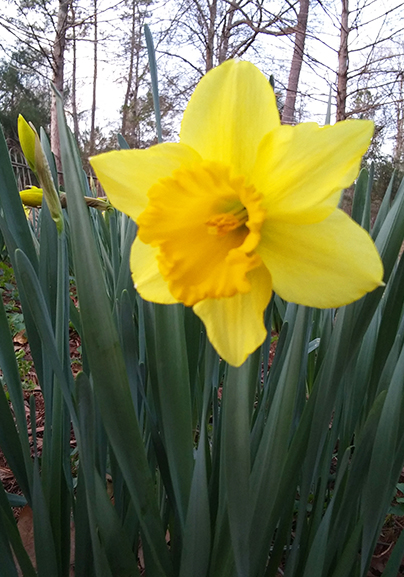
“These big yellow daffodils have multiplied and bloomed prolifically for us here,” wrote our good customer Carlos Doolittle, landscape manager at Southeastern Louisiana University, “and I’m hoping you can help me learn their true identity.”
The photos Carlos attached – including the one here – showed a Division 2/large-cup daffodil with petals a shade lighter than the cup, and he told me they usually started blooming in early February.
Since very few “big yellow daffodils” do well in climates that are as hot and wet as it is at SLU – which is 45 miles northwest of New Orleans, right on the border of zone 8b and 9a – I was intrigued.
“About a decade ago,” Carlos wrote, “an elderly lady, Mrs. Vertalie Blaylock, of Loranger, Louisiana, shared daffodils with my grandmother. They multiplied rapidly, and I transplanted some to my home and eventually to campus. Everywhere I have planted them, they have multiplied rapidly.”
Since there are literally thousands of varieties of big yellow daffodils, at first I worried that identifying this one would be a hopeless task. But after Carlos sent me measurements of its petals, cup, and foliage, and then described its scent as honey-like, I began to feel more optimistic.
I asked him to send his photos and information to a couple of friends who know a lot more about Southern daffodils than I do – Sara Van Beck of Georgia (and formerly Florida) and Greg Grant of Texas – and I’m happy to say we all came to the same conclusion: Mrs. Blaylock’s daffodil is probably ‘Carlton’.
“That’s what it looks like to me,” Greg said, adding that ‘Carlton’ is “the most dependable yellow daffodil here” in north-east Texas.
Sara agreed, and in her book Daffodils in Florida, she says ‘Carlton’ “should be the backbone of any daffodil bed” in the Deep South, partly because it’s “the most resistant (of the large yellows) to basal rot” which can wreak havoc on daffodils in hot, wet soils.
Carlos was happy to finally have a name for Mrs. Blaylock’s daffodil, especially since he’s planning “to eventually have masses of daffodils as a signature of our campus landscapes.” Daffodils, he says, are the perfect choice because “not only do their bright yellow blooms bring cheer during the dreary days of winter, but our campus colors here at Southeastern are green and gold.” (March 2019)
Watch New Ryan Gainey Film in Atlanta Feb. 27 – or the Trailer Now
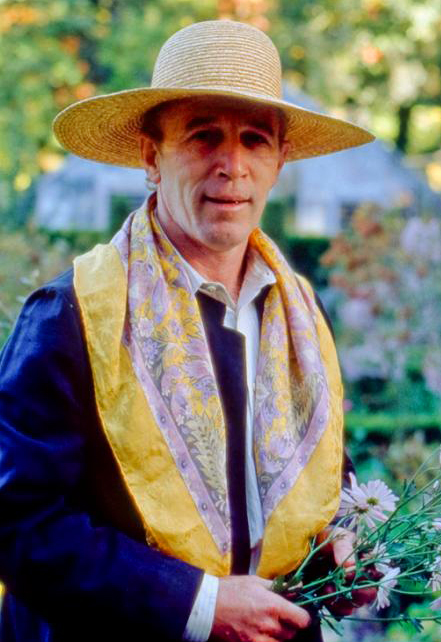
Fans of Ryan Gainey, the revered Southern garden designer and heirloom-plants lover, have been giving two thumbs up to The Well-Placed Weed: The Bountiful Life of Ryan Gainey.
The 2018 documentary interweaves shots of Gainey’s romantic, heirloom-filled garden with excerpts gleaned from a series of interviews that ended just a month before Gainey died in a house fire in 2016.
As the Cherokee Garden Library noted in a recent press release, this film is the first to “examine the complexities” of Gainey’s life. “He was a contradictory character, both off-putting and tender, self-absorbed and generous, artificial and authentic.” His home garden which was his masterpiece was, “as he often said, a ‘garden of remembrance’ where his old friends and family lived on in the overlapping blooms of heirloom plants.”
You can watch a 90-second trailer of the film, or a four-minute excerpt (accompanied by an excellent article), or buy the DVD, or – best of all – you can watch it at a special screening followed by a Q&A with the filmmakers on Wednesday, Feb. 27, at the Atlanta History Center. (Feb. 2019)
Southern Living Spotlights Dahlias for the South
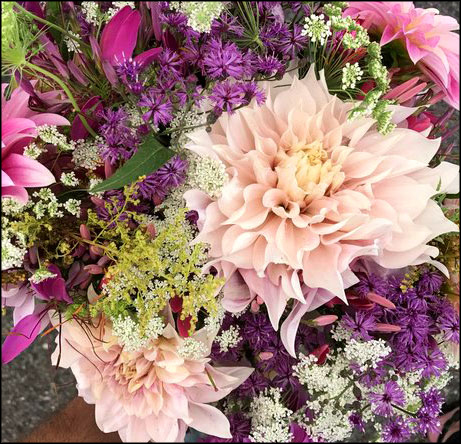
When we opened the September issue of Southern Living recently, we were surprised to find a big, beautiful dahlia staring at us from the first page of the lead article.
Dahlias like cool nights, so growing them in the South can be a challenge. But just outside zone-8a Birmingham, Deborah Stone grows them commercially for cut-flowers at her Stone Hollow Farmstead. In the article, Stone offers tips for success with dahlias in the South such as waiting until several weeks after the last frost date to plant them and giving them some protection from the hottest, midday sun.
A handful of heat-tolerant dahlias are mentioned in the article, including jewel-toned ‘Juanita’ and dark-leaved ‘Bishop of Llandaff’, and a dozen of “Deborah’s Favorite Dahlias” are pictured, including dreamy ‘Café au Lait’ (pictured here), frilly ‘Tsuki Yori no Shisha’, and deep purple, always dependable ‘Thomas Edison’.
To learn more about how you can grow dahlias in the South, see our tips from experts and customers at oldhousegardens.com/DahliasForHotNights . (Sept. 2018)
Wildflowery Tulips Charm Famous Southern Gardeners
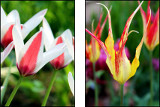
Two of the most unusual tulips we offer are the peppermint-striped T. clusiana, and stiletto-petalled T. acuminata – both of which have been grown and loved by a couple of unusually creative Southern gardeners.
In his 1993 classic The Well-Placed Weed, the celebrated Atlanta-area garden designer Ryan Gainey featured a masterfully harmonious planting combination: T. acuminata alongside American columbine (Aquilegia canadensis) in an informal cottage garden display where the red-and-yellow colors and wispy shapes of the two flowers echo one another perfectly.
A half-century earlier, the great American author Eudora Welty wrote to a friend from her home in Jackson, Mississippi (as quoted in One Writer’s Garden), “Species tulips are hard to get now, but I love them best. You know, the little wild tulips that still have lightness and grace and perfume and the clear delicate colors that I guess all original flowers had. One is clusiana, that you know, the white and red striped tulip with violet blotch. . . . They are all small and sort of bow in the wind and flare up.” (June 2018)
Preserving Plants at Home – Together
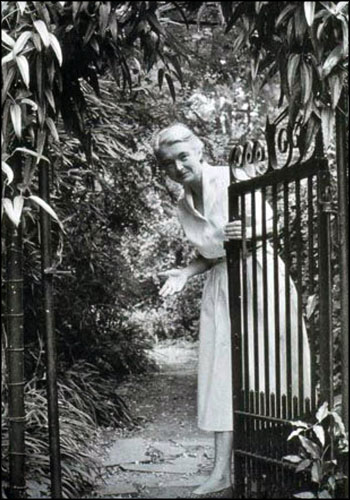
“I belong to that great fraternity whose members garden for love,” the eminent Southern garden writer Elizabeth Lawrence wrote in 1981. “They are called Brothers of the Spade” – a term first used in the 1700s by the great British plant collector Peter Collinson.
“Some own estates, some are directors of botanic gardens, and some have only small back yards,” Lawrence continued, but all are “amateurs in the true sense of the word – they garden for love.” (The Latin root of amateur is amare, to love.)
Together these garden lovers “keep in cultivation many a valuable plant that would otherwise be lost. Among them they preserve a reservoir of plants that could never be collected in any one place, even an institution, for the preservation of plants depends upon individual efforts, and it is only in private gardens, in lonely farm yards, and around deserted houses that certain plants no longer in the trade are found.”
Are you gardening for love? Are you nurturing plants in your garden that have all but disappeared everywhere else? If so, you’re one of us, and we’re proud to be gardening alongside you in the immortal Fellowship of the Spade! (May 2018)
Eudora Welty on Gardening, Creativity, and Where the Wonder Is
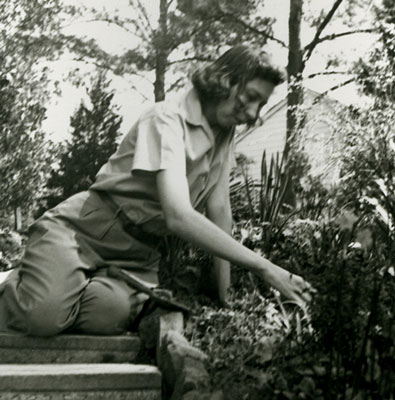
That’s not just any woman weeding her garden in this 1940s photograph – that’s the iconic Southern writer Eudora Welty.
Welty was a lifelong gardener, and in a conversation shortly before her death in 2001, she talked about gardening, her work as a writer, and finding wonder:
“I think that people have lost the working garden. We used to get down on our hands and knees. The absolute contact between hand and the earth, the intimacy of it, that is the instinct of a gardener. People like to classify, categorize, and that takes away from creativity. I think the artist – in every sense of the word – learns from what’s individual; that’s where the wonder expresses itself.” (Feb. 2018)
Warm Winter Woes: Iris “Lightbulbs” and Scanty Bloom
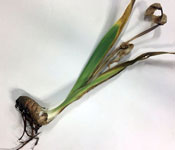
Warmer than usual winters can cause all sorts of problems for plants, including bearded iris. In a recent post at the AIS blog, World of Irises, Bonnie Nichols of zone-8a Dallas explains:
“In December [last year] when the Christmas Day temperature was 82 degrees . . . , we knew the iris bloom season was in jeopardy. And, it didn’t get better when on January 31 the high was 79 degrees.
“When I saw various bearded irises blooming in December and January, I asked friends if they thought it was rebloom or what would have been our spring bloom. We all had no idea. In April, we knew [it] was the ‘spring’ bloom because we . . . had no additional bloom. Maybe 20% of tall bearded irises bloomed. . . .
“We saw more than normal increases on some of the plants because they did not use their energy to bloom. On other plants we noticed something that we had not had much experience with – ‘lightbulb’ rhizomes. Lightbulbs are rhizomes with no increases and the roots wither away. . . . The rhizome increases in size and twists slightly as if it is pushed out of the ground. [If it blooms] the stalk comes up in the middle of the fan and dies back quickly. The rhizome eventually dries up and dies also. . . .”
Commenting on Bonnie’s post, Phil Williams offered an alternative explanation: “Strong root growth is what produces good spring bloom here. Makes me wonder if the prolonged heat [in summer and fall] might have created a false dormancy . . . , and the plants did not root deeply.”
Either way, warmer temperatures are the culprit. Is that global warming? Bonnie says she’s not sure but “I’m beginning to believe it is.” (Dec. 2017)
Winston-Salem to Host Conference on Restoring Southern Gardens
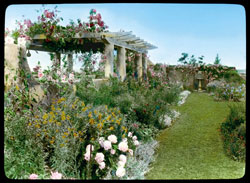
“Gardening in a Golden Age” is the theme of this year’s Conference on Restoring Southern Landscapes and Gardens scheduled for Sept. 21-23 at garden-rich and always fascinating Old Salem.
Focusing on the early 20th century, the conference kicks off with the hand-colored magic lantern slides of photographer Frances Benjamin Johnston in “Picturing the American Garden, 1900-1930.” Other lectures and tours will explore Ellen Biddle Shipman’s work in Winston-Salem, African-American landscape architect David Williston, garden writing and art in the early 1900s, and more.
The conference will be rich in the camaraderie of kindred spirits, too – and I’m speaking from experience. To learn more or register, visit oldsalem.org/events/event/landscapeconference/. (July 2017)
Paradise Lost: Winston-Salem’s Municipal Iris Garden
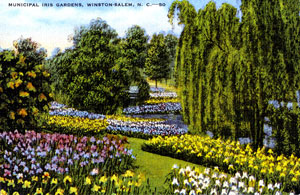
Does your city have a municipal iris garden?
That seems very unlikely, which is why I was so surprised when this postcard arrived in the mail recently.
It’s a modern reproduction of a 1949 postcard showing the “Municipal Iris Gardens, Winston-Salem, NC.” On the back it reads: “The Municipal Iris Garden contains 20,000 plants, of 525 varieties. The blossoms range from pure white to deep purple, gold, and dark red, and are at their best during May. Weeping willows and rustic bridges add to the beauty of the rolling parkway.”
20,000 plants – of 525 varieties! I had to know more, so I contacted the folks who sent the card – which announces the 2017 Conference on Restoring Southern Landscapes and Gardens– and here’s what I learned.
“The development of the gardens to their present state of beauty is a typical Cinderella story,” the Twin City Sentinel reported in 1938, “with many local iris growers acting as fairy godmothers.”
It all started in the early 1920s when a new neighborhood was laid out which included a four-acre “gully-way” that was left untouched “since there seemed no other purpose it could serve.”
Although today we’d probably consider it a valuable natural area, times were different then and in 1931 a doctor who lived nearby urged the city to beautify it with iris donated from his own extensive gardens. Iris were enormously popular at that time, and before long other neighbors joined the campaign and the Municipal Iris Garden was born.
The city parks department cleared the land, planted weeping willow trees, built stone and rustic-work bridges over the stream, and laid out gracefully curving beds. By 1938 the Twin City Sentinel reported that “Winston-Salem’s iris attract visitors from all parts of the state. From an unattractive gully the city parks department has transformed Runnymede Parkway into one of the most popular parks in the city.”
But that was then. By the early 1950s the iris had been replaced with lower-maintenance azaleas, and today even those are gone. The stone bridges still stand, though, bearing silent witness to the park’s glory days – and who knows what the next chapter might be for this Cinderella gully-way?
For additional images, visit digitalforsyth.org/photos/browse/places-gardens-runnymede-iris-gardens.
For your own little iris paradise, see the 17 heirloom iris we’re shipping this spring.
And many thanks to Camilla Wilcox, Kay Bergey, and Martha Hartley for sharing this remarkable story with me! (Feb. 2017)
Revamped Website Offers Historic Plant and Garden Riches
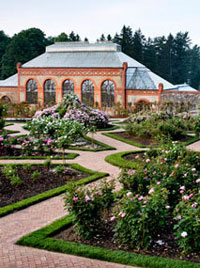
You don’t have to be a Southerner to appreciate the Southern Garden History Society, and a recent makeover has made its website better than ever.
The site is now filled with photos and antique images, and it’s user-friendly on all devices. Back issues of its excellent journal Magnolia are now searchable, and there’s an events calendar, dozens of book reviews, and links to historic sites and organizations.
Maybe best of all is the “Plant Lists” section, a fully searchable PDF of 50 Southern plant lists spanning two centuries, from a 1734 list of plants in the correspondence of John Custis of Williamsburg to a 1922-41 list of plants Beatrix Farrand specified for Dumbarton Oaks (including winter aconite, trillium, and lemon lily).
One of my favorite lists is a 1786 newspaper advertisement for Philadelphia’s “Peter Crouwells and Co., Gardeners and Florists” announcing that “they have for sale here” – in Alexandria, Virginia – “an extensive variety of the most rare bulbous flowers, roots and seed,” including 600 hyacinths, 400 tulips, 40 double narcissus, and 26 jonquils. “Those ladies and gentlemen who want any of the above articles,” the ad continues, “will please to apply immediately at his lodgings at Mr. John Gretter’s, King Street, as he intends to set off for Baltimore in a few days.”
Even if you can’t make it to King Street in time, there’s still a lot to enjoy at southerngardenhistory.org. (Oct. 2016)
Learning from You: Dahlias for Drought
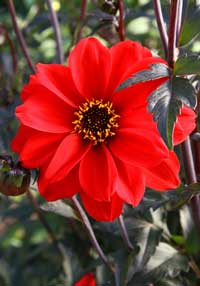
Although the West Coast drought has eased a bit, we thought you’d be interested in this success story from our good customer Pat of zone-9bWC San Jose. We can’t guarantee it will work for you, but . . . .
“I grew some of your ‘Bishop of Llandaff’ dahlias last year and found them great for our arid climate. I planted them very deep, maybe a foot down, which is low enough for our clay soil to remain moist with almost no watering, if you can believe it. Maybe once a week.
“I followed the directions at your website and put the tubers at the bottom of the hole and then filled in soil little by little as the leaves emerged, which they did very quickly.
“My tiny garden on the west side of our garage gets a good five to six hours of blazing, direct sun and then light shade later in the afternoon. Since we’re in a valley and not near the ocean, nights are generally cool and dry. [OHG: This is exactly what dahlias love!] The plants wilted on the hottest days but they perked up afterward, as you’d see with tomatoes or potatoes.
“Thank you for letting me ramble on. No one in my family is interested. My neighbors like all the free flowers, though! I give quite a few away.” (April 2016)
Happy 50th Anniversary, Southern Living!
Congratulations to our friends at Southern Living who are celebrating the iconic magazine’s 50th anniversary this month! February’s special double issue includes 21 of the magazine’s vintage front covers, 50 years of Southern recipes such as hummingbird cake (1978), and even a blooper section of “not-so-golden moments that we just couldn’t keep to ourselves.”
Gardening has always been an important part of Southern Living, and this issue is no exception. In “The Seed Saver” you’ll meet our friend Ira Wallace of Southern Exposure Seed Exchange. “The Camellia Man” spotlights Tom Johnson, curator of the nation’s largest collection of historic camellias. And then there’s Southern Living’s long-time garden editor Steve Bender– who’s also a long-time supporter of Old House Gardens – with “50 Golden Rules of Gardening.”
Steve calls himself the Grumpy Gardener, and though his rules may be the funniest garden tips you’ve ever read, they’re full of sage advice. Don’t miss his introduction, too, where he says that gardening is like cooking, and the best way to learn it – and to discover how much fun it is – is by doing it. When people tell him “Gardening is too hard. There is so much to learn. I just know if I plant something, I’ll kill it,” he replies, “Of course you will! Everyone who has ever gardened since Adam and Eve has killed a plant. That’s how we figure out what works and what doesn’t.”
And gardening, Steve says, is “the most gratifying of all human endeavors” – even “better than an accordion concert” or “fine aged possum.” (Feb. 2016)
Lost . . . and Found? Gaye’s “Tiny Little Cream-Colored Daffodils”
We love it when our customers use the “Special Requests and Feedback” section of our online order form. That’s where Gaye Ingram of Ruston, Louisiana, made this plea:
“If possible, I would like to order ten moschatus, even though the limit is five. I’ve missed it every year by ordering late. Saw it decades ago and fell in love with it. I’m well past retirement age and would like to see a wee colony in my lifetime. Thank you for considering my request.”
Being soft-hearted souls, we said yes, and when she replied, Gaye told us this story:
“Thank you! I’ve pursued that particular bulb (or what I believe is that bulb) since 1968. Not even 25 years old but with degrees almost in hand, my husband and I arrived in Ruston that year to teach literature (me) and history at Louisiana Tech. We found a sweet little 1930s house on a shady street that had belonged to the mother of the chair of the Interior Design department. We felt like grown-ups!
“In spring, tiny little cream-colored daffodils with nodding heads sprang up on the lawn. I’d grown up in Central Louisiana among people whose yards and gardens were filled with passalong plants and bulbs, but I’d never seen such a demure spring bulb. I marked them and vowed to dig one or two in the fall.
“Then we moved to another place, and built a new house. I searched ever after for those quiet creamy bulbs. Went back to the place where we’d lived, but the owners had seen no bulbs. Without care and probably having their leaves mowed in late spring, they’d given up the ghost.
“The next time I saw them was in Celia’s grandmother’s garden. [Ed. note: Our good friend Celia Jones owns a small farm near Shreveport where her grandmother once grew acres of daffodils.] Celia had only a few, and knew only a local name for them. Sometime later, when I discovered Old House Gardens, I talked with Scott, but back then you didn’t offer them and he couldn’t be sure about their exact identity. More recently, whenever you did offer moschatus I ordered too late. (One has to discipline herself to order bulbs when it is 95 degrees with 80% humidity, as it is here today!)”
We sent Gaye’s bulbs to her last week, but we’re still not sure whether our Dutch-grown moschatus – or the very similar ‘Colleen Bawn’ – is exactly the same as the once widely-grown heirloom she’s seeking. Daffodils are enormously varied, and the differences don’t always show up in photos. For example, the Dutch-grown N. jonquilla of mainstream catalogs looks very much like the heirloom N. jonquilla ‘Early Louisiana’ that we offer, but the Dutch jonquils bloom weeks later and never thrive as well in Southern heat. (Learn more here.)
But we’re hopeful that Gaye now has the sweet little daffodil she fell in love with almost 50 years ago – and if you happen to be growing the beloved Southern heirloom known as goose-neck, swan’s neck, or silver bells, we’d love to hear from you! (Nov. 2015)
Learning from California: Gardening with 28% Less Water
Congratulations to our friends in California who, faced with what’s been called the drought of a lifetime, have cut their water use by 28% in the first three months of state-mandated reductions.
In September, my wife and I saw the drought first-hand while visiting our son and daughter-in-law in San Francisco. Plants drooped, dead leaves littered the sidewalks, and lawns in the city’s parks sported signs proclaiming “Brown is the New Green.”
It’s no wonder our orders from California are down 25% this fall! But bulbs, ironically, are built for drought. Many have evolved in areas where summers are so dry that to survive they have to hide out underground. Tulips, hyacinths, alliums, Byzantine glads, freesia, and oxblood lilies, among others, actually do better with dry summers — although they need some water in fall through winter to develop roots and more in spring to grow leaves and bloom.
In August the Pacific Horticulture Society newsletter offered some excellent tips for xeric gardening, by editor (and OHG customer) Lorene Edwards Forkner:
“Recently I read some great, if somewhat blithe, advice from garden writer Amy Stewart on tending a low/no water garden:
“1. Plant drought tolerant plants.
“2. Wait and see what dies.
“3. Plant more of what didn’t die.
“You can read the entire piece at The No-Water California Garden.
Lorene also recommended “Adventures in Growing” about an American woman “creating a fertile landscape in Saudi Arabia and winning the hearts and minds of its caretakers,” this advice from “the great minds at Flora Grubb Gardens,” and Jeff Moore on the “Generosity of Succulents.”
“Then hit those fall sales,” she concluded, “for a dose of colorful, graphic, and resilient plants that take dry weather in stride” — including our fall-planted bulbs! (Oct. 2015)
How Do Your Dahlias Grow in the HOT South and Southwest?
In the highlands of Mexico where dahlias originated, the nights are always cool, and most varieties today still need those cool night temperatures to grow and bloom well. Some are more heat-tolerant, though, and we recommend these through zone 8 in the South and Southwest – as noted in our dahlia chart.
To expand our list of heat-tolerant dahlias, we’d like to hear from you if you garden in zone 8 or warmer in the South or Southwest. Which of our dahlias have thrived for you, and which haven’t?
Here’s one recent success story from zone-8b Mobile. (Read more at our Dahlias for Hot Nights page.) Our good customer Glenda Snodgrass emailed us last November to say her mother-in-law, Barbara Adair, bought a ‘Thomas Edison’ dahlia with a gift certificate Glenda had given her. “I told her dahlias couldn’t be grown in Mobile, but she said her mother always had dahlias here, and I’ve had to eat some crow because it bloomed last week and it’s beautiful!”
Barbara grew her dahlia in a large clay pot on her deck. (Pots can be tough for dahlias, but see our Bulbs in Pots page for tips.) “North side, full sun in morning, some shade during the day, until late afternoon full sun,” she explained. By mid-October the plant was six feet tall and the first flower opened. “It’s a darker purple than it looks in your catalog,” Barbara wrote, “a real beauty!”
Please help us guide other gardeners by telling us how our dahlias have done for you in the heat of the Deep South and Southwest. Thanks! (Oct. 2014)
Teach Us, Please: Where (and How) Do Pink Surprise Lilies Grow Best?
I was surprised to see a couple of pink surprise lilies (Lycoris squamigera) blooming here in Ann Arbor recently, and they reminded me that we wanted to ask your advice on growing them. Although we recommend them for just zones 6a-7b(8bWC), some authorities recommend them all the way from zone 5a through 9b, so . . .
1. If you garden in zone 6a or colder: Is pink surprise lily winter-hardy for you, and do you have any tips — sunlight, soil, planting depth, watering, winter protection, etc. — for getting it to multiply and bloom happily?
2. If you garden in zone 8a and warmer : Is pink surprise lily thriving for you, and do you have any tips — sunlight, soil, planting depth, watering, winter protection, etc. — for getting it to multiply and bloom happily?
One zone-5b garden where we know they’re flourishing is the spectacular Better Homes and Gardens Test Garden in downtown Des Moines. Garden manager Sandra Gerdes sent us a photo of them blooming there last year and wrote, “I love the surprise lilies, and they always generate a lot of comments from visitors, which is why I’m ordering more to add to our patch. You can also see clusters of them blooming in the older, established neighborhoods of Des Moines when you drive around in August. It is ‘surprising’ that we have success with them here in zone 5b, while you say they can be a challenge in 6a. We definitely experience the extremes of winter and summer here on the prairie! As the saying goes, ‘Plants can’t read those catalog restrictions.’” (Aug. 2014)
Grow Your Own Ryan Gainey Bouquet: Tiger Lilies and Crocosmia
Ryan Gainey, the celebrated Atlanta-area garden designer, has a special affection for heirloom flowers, including many of our bulbs. A while ago he sent us photos of a bouquet he’d made in a quirky old jug with tiger lilies — the iconic pass-along plant — combined with yellow ‘George Davison’ crocosmia, antique montbretia (which is also a crocosmia), and the berried stalks of Arum italicum. See Ryan’s bouquet here, and if you like it we’d be glad to send you everything you need to recreate it at home — except, unfortunately, for the Arum and the jug. (Please note: Since tiger lilies are fall-shipped but the crocosmia are spring-shipped, you’ll have to place two separate orders for them.) (Aug. 2014)
Elizabeth Lawrence (and Friends) on the Old White Trumpets
Elizabeth Lawrence, the revered Southern garden writer, had a great interest in heirloom plants, searching for them in rural “market bulletins” and researching them in old books. In this 1971 newspaper column (later collected in Through the Garden Gate), she weaves together her own observations with those of fellow daffodil-lovers from almost a century before:
“Many years ago Carl Krippendorf lent me William Baylor Hartland’s Original Little Book of Daffodils (1887), the first catalog ever to be devoted entirely to daffodils. Hartland, an Irish nurseryman, said white trumpets were a specialty at Temple Hill, his place near Cork, and he listed nine varieties. One of these was ‘Colleen Bawn’. ‘No daffodil is more pure white,’ he said, ‘or so easily recognized by its broad twisted propeller-like perianth segments, and long cylinder-like trumpet.’ It is described in A. M. Kirby’s Daffodils (1907) as ‘a gem among white daffodils, silvery-white, drooping, nodding flowers; gracefully twisted petals. Best when grown in shade and grass.’
“‘Colleen Bawn’ is still with us, though extremely rare. . . . It is very like the other small trumpets of its day, the silvery swan’s neck daffodil, Narcissus cernuus (now called N. moschatus), and the silver bells of old gardens, but the very narrow, very long trumpet distinguishes it from the others. The trumpet is distinctly yellow though very pale, at first, and the segments are fawn color. The second day it lifts its bowed head to a horizontal position, and both trumpet and perianth become silver white. It has a delicate fragrance.
“In One Man’s Garden, Miles Hadfield quotes from a letter that [daffodil breeder] George Herbert Engleheart wrote about these old trumpets: ‘Away back in the 188os and 1890s I was collecting old forms of white daffodil, chiefly from Ireland. Miss Curry — some years dead — used to hunt them up from old Irish gardens, and a small club of three or four of us used to share them. They were all white things of the ‘Colleen Bawn’ type, but varying in size and form. They didn’t take kindly to cultivation, and are mostly, I think, lost. I made some attempt to discover their history, and came to the conclusion that Irish religious houses must have had some connection with Spain and Portugal — the focus of the white species.’
“. . . From these beginnings Engleheart developed ‘Beersheba’ (1923), still to me the most beautiful of all white trumpets, and very early, usually blooming the first week in March. Engleheart described it as a ‘miracle of stately loveliness,’ and was vexed when [daffodil breeder] P. D. Williams criticized the trumpet as 1/4 inch too long.”
Another great old white trumpet is ‘Broughshane’, although it’s sturdy and handsome rather than graceful. See them all here — and if you’re thinking of ordering ‘Colleen Bawn’, we encourage you to do it NOW because savvy gardeners have already snapped up over half of our very small supply for this fall. (July 2014)
Eternal Spring in Alabama
A hand-written letter arrived here earlier this spring from our good customer Carolyn Brown of Creola, Alabama, and it was so joyful and inspiring, we wanted to share it with you:
“How I wish you could see your beauties in my colonial garden,” Carolyn writes. “My breath catches as I gaze upon the beauty. Why so few people here in the South have bulbs, I’ll never understand. As the daffies sway in the wind I’m reminded of Wordsworth’s poem “Daffodils.” How excellent a description it is.
“In your eighties, each day is more joyful than the day before, and the daffodils are prettier each day. I do hope God has daffies in heaven and I can plant acres and acres of them.
“My husband, Bob, has always said vintage roses are his favorite flower. He has around 150 this year. However he said my bulbs are getting to be his favorite, and they are far less work. In fact, he urged me to make this order [for the coming fall]. I try your smallest amount first and see how they do here and then I go for a larger amount. I’m going to start on hyacinths next.
“Give the little dog a pat and a rub for me. Keep up your good work and save as many bulbs as you can. And thank you all for giving an 80+ gal a wonderful life and joy with the beautiful — as my husband calls them — ‘daffy-down-dillies.’
“Your Garden Pal, Carolyn B.” (May 2014)
French Jonquils: Did “Early Louisiana” Get its Start in New Orleans?
Our heirloom “Early Louisiana” jonquils are a wonderfully fragrant, unusually vigorous form of N. jonquilla that blooms weeks earlier than the ones sold by mainstream sources — but why? The late Carl Amason, founder of the Arkansas Daffodil Society and a great mentor for me when I first got interested in old daffodils 30 years ago, offered an intriguing answer in the March 2012 edition of The Daffodil Journal.
Carl lived on the old family homestead in southern Arkansas, and four very old daffodils flourished there: Twin Sisters, Butter and Eggs, Buttercups (the original trumpet daffodil, aka Lent lily), and jonquils — which he described as “a strain of Narcissus jonquilla which was vigorous, prolific to self sow,” and had a fragrance that would “make a statement,” especially “by moonlight on a warm night.”
But, he wrote, “I was frequently asked why some jonquil plantings were much earlier and more vigorous than others.” At first he “assumed that the more vigorous . . . were growing in established places with good soil and more sun.” Later he realized “there were two or more distinct strains of N. jonquilla, and that was the primary reason for the differences.” The earlier-blooming strain was what he “came to call the French jonquil, to distinguish it from the English jonquil that bloomed a month later.” This strong-growing French strain “has become naturalized in north Louisiana, south Arkansas, and east Texas,” he wrote, but it’s not as common further east where the less vigorous strain “that came with the English speaking peoples from Virginia and the Carolinas” predominates. “Evidently,” he concluded, “the New Orleans settlers brought the earlier French strain upriver to Arkansas and east Texas.”
Native to Spain and Portugal, N. jonquilla has been naturalized in the nearby south of France for a very long time. Like many wild plants, it’s a highly variable species, and it’s reasonable to believe that centuries ago earlier-blooming strains were favored by gardeners along the sunny Mediterranean in France, while later-blooming strains were preferred in the more northerly British Isles — and the bulb fields of the Netherlands — where spring comes later and early flowers would be more likely to be damaged by late frosts. Carl’s French/English dichotomy also helps to explain why virtually all modern hybrid jonquils are later blooming. As he wrote, “The English strain was what the hybridizers, mostly British, used in their work because it was only natural for them to use what was readily available.”
“This is all speculation on my part,” he added, but his conclusions make sense to me. Today the English strain is widely offered by mainstream bulb-sellers, but if you want the vigorous, early-blooming, richly fragrant, heirloom French strain — grown for us in east Texas — we’d be glad to help you out. And if you order NOW for delivery this fall, we’ll give it to you at LAST fall’s prices! (March 2014)
Crinum’s “Sticky Candy Aroma” Brings Back Memories of Grasshopper Sticks
“The sticky candy aroma of Crinum x powellii ‘Album’ makes me wistful for a youthful memory I never quite conjure up, so deep is it buried,” North Carolina garden writer Pam Baggett wrote in Horticulture a while back. “Vague images of my childhood Methodist church haunt my mind when I smell crinums, making me wonder if perhaps they grew there. But then so does the dark, cramped interior of Sessom’s Grocery, and a lime green hard candy they sold, grasshopper sticks. Did someone, a gardener herself, once manage to distill the essence of crinum, making it into candy sure to tantalize the taste buds of children? Was she hoping to make gardeners of us later, we who might strive to recapture an instant of childhood by nestling our noses deep in to the crinum’s candied heart? And most important, did she leave behind her recipe book?” (Jan. 2014)
Bulbs for Partial Shade, South and North
In her weekly column in the Greenville [SC] News, Marian St. Clair offers good advice for shade gardeners everywhere — and recommends several of our bulbs that she’s planting this fall.
“Spring-flowering bulbs grow and bloom from energy stored within the bulb the previous year,” Marian explains. “For repeat bloom, gardeners must maintain nutrient-rich and moist soil conditions to nurture the bulb until foliage dies back and the bulb becomes dormant. Of course, this is also the most important time for bulb foliage to receive the maximum amount of sunlight. For success, shade gardeners should select bulbs that flower early, so foliage has time to restore energy to the bulb before trees produce a new crop of leaves.”
For her zone-8, South Carolina garden, Marian writes that she’s “especially excited about a pair of early-blooming daffodils from Old House Gardens. . . . Early Pearl, a tazetta . . . rediscovered in an old garden in our region’s ‘Spanish moss belt,’ [and] Campernelle; a tried-and-true heirloom grown for more than 400 years. . . . This fragrant yellow daffodil looks like a wildflower compared with many of the new, chunkier hybrids . . . and its slightly twisting petals remind me of a child’s pinwheel.” Other shade-tolerant heirlooms from us that she’s planting this fall — all of which are good north through zone 5 as well — include Crocus tommasinianus, “a lavender beauty known as the best crocus for the South,” white Spanish bluebell, giant snowdrop, and Trillium grandiflorum. (late Oct. 2013)
Peonies Thrive for Betty in Dallas, Despite Our Warning
When you ship flower bulbs to all 50 states, you learn a lot from your customers. For example, when we warned Betty Brownlee of Dallas that we didn’t recommend the peonies she was ordering for her zone-8a garden, she replied: “Please leave my order as is. I have a spot on the north side of my house that peonies love. I had 70 blooms last year. Thank you.”
Despite her success, most experts will tell you that peonies are always a bit of a crap shoot in zone 8a South (and 8b on the West Coast). If you’re determined to give them a try there, we recommend starting with two that need a little less “chill time” in order to develop buds and bloom: ‘Festiva Maxima’ and ‘Philippe Rivoire’. And good luck! (Oct. 2013)
“Chilly Lilies” Announce the Coming of Fall
A couple of years ago someone asked us if we carried “chilly lilies.” Since we’d never even heard of them, we googled the name and discovered this interesting little article posted by Julie at the humanflowerproject.com:
“The chilly lilies are up in Central Texas. Morton King of Georgetown gave this nickname to the old-fashioned oxblood lily (Rhodophiala bifida) after noticing that their blooms coincided with the first cold spell at summer’s end. ‘They’ve become famous,’ says King, 91, ‘because they come up a week or two before the first cold front in the fall. They are alleged to be an accurate predictor of when things are going to cool off and you’re going to have a fall rain.’ Each year when they bloom, King writes to the Georgetown Sun, telling the community that autumn is, blessedly, on the way. A PhD sociologist, King is careful about causality: ‘Now, it’s the coming cold weather that makes them come up, I suspect, rather than vice versa,’ he laughs.” (Aug. 2013)
‘Challenger’ Daylily Proves Its Worth to Arty in Atlanta
Arty Schronce lives in the historic Cabbagetown neighborhood of Atlanta and writes a column called “Arty’s Garden” for the Georgia Department of Agriculture’s 95-year-old Market Bulletin. With a philosophical outlook, a sense of humor, and an appreciation for heirloom plants, Arty is our kind of guy — as you can see in this excerpt about a daylily we’re offering for the first time this spring:
“Sometimes a plant grows on you. Not literally, of course. For example, several years ago I purchased a ‘Challenger’ daylily [Ed. Note: Not from us!] because it was taller and bloomed later than other daylilies. When it bloomed I was disappointed. The flowers were not as intensely red as the photograph in the catalog, and the petals were not as thin and ‘spidery’ as I had hoped.
“It was tall, however, rising to five feet or more, and extended my daylily season by beginning to bloom weeks after my other daylilies. I decided to keep it around a while longer instead of immediately casting it out of my little Eden.
“I am glad I did; ‘Challenger’ has proven its worth. It wasn’t exactly what I expected, but now I am quite fond of it. . . . Have you done this with plants as well, dismissing them without taking the time to learn their virtues? Unfortunately, I’ve also treated people that way. I’m trying to do a better job giving plants and people a fair chance.”
In another column Arty praises “Oxblood/Schoolhouse Lilies,” calling them “as refreshing as a glass of pomegranate juice” and wisely warning gardeners to keep them away from red spider lilies because “the oxblood lily undercuts the drama of the spider lily, and the spider overshadows the shorter, simpler oxblood.” Other columns of his we especially liked are “The Tulip Teacher,” “The Tawny Daylily,” and “The People Who Live in My Garden” — and once you get started, you may find yourself reading them all. (Dec. 2012)
Silver Bells, Presbyterian Sisters, and Eudora Welty
The small white daffodil known as Silver Bells, Swan’s Neck, or Goose Neck has been a cherished favorite in Southern gardens for a very long time. Author Eudora Welty and her mother grew it in their Mississippi garden, and she wrote about it in her Pulitzer Prize-winning novel, The Optimist’s Daughter, as Susan Haltom and Jane Roy Brown explain in their excellent One Writer’s Garden:
“Welty loved ‘Silver Bells’ daffodils, ‘the nodding, gray-white kind with the square cup’ that a family friend brings to the funeral in Laurel’s father’s house in The Optimist’s Daughter. ‘You know who gave me mine — hers are blooming outside,’ the friend says to Laurel, alluding to Becky [Laurel’s mother] having shared the daffodil bulbs in typical pass-along fashion. Years after her death, Becky’s gesture has circled back to comfort her daughter. Daffodils blooming in fields or woods throughout the South often mark the sites of bygone houses, where they traditionally lined the front walk. These flowers also may have reminded Welty of Elizabeth Lawrence, who also preferred white daffodils.”
Another favorite in the Welty garden was the fragrant, cluster-flowered narcissus ‘Avalanche’ which Eudora called Presbyterian Sisters “because they hang together.” Welty’s home has recently been restored and opened to the public as a museum, and we’re proud to have supplied the daffodils, Roman hyacinths, oxblood lilies, tuberoses, dahlias, glads, and other bulbs that once again grow in her garden. (Oct. 2012)
Mary Rediscovers Her Great-Aunt’s Spider Lilies
Sometimes the best thing about an heirloom plant isn’t its beauty or vigor or fragrance but the memories it evokes, as Mary Mattison of Sandy Springs, Georgia, reminded us recently: “My great aunt in Charleston, South Carolina, had a small garden in her backyard on Queen Street where she had lived since the 1870s. In the borders was a mass of spider lilies that held my attention as a young girl. Over the years I have inquired at numerous nurseries in Atlanta about spider lilies, only to be given a quizzical look. I thought perhaps my memory wasn’t serving me well as to the name, until I read an article in Southern Living this fall which led me to your website. Thank you!” (Oct. 2012)
How Do Red Spider Lilies Know It’s Fall?
“It’s the first great mystery of fall,” our long-time friend Bill Finch of the Mobile Press-Register wrote back in 2009, “and even after watching it happen for nearly 50 years, I can’t get over it: The naked flowers of the lycoris, the red spider lilies, emerging from the weeds of summer. Doesn’t it worry you in the way it worries me? How do they know, with such absolute certainty year after year, that it’s the first of September, and the great wheel of the seasons is slowly but inexorably turning toward fall?
“We both can imagine what drives the daffodils and azaleas to bloom in the spring — the lengthening days, the rapid warming of the ground under our feet. But what is the signal for lycoris in September, when the ground still blisters your bare feet as it did in July, and the reservoir of summer warmth only makes the longer nights hotter longer? The lycoris sense something in the change of season that I don’t have the sense to quantify, a change I’m never willing to believe, until I see the naked flower stems shoot up, reminding me that all my plans for fall are weeks behind.” (August 2012)
Book of the Month: One Writer’s Garden
Here’s a book to put at the top of your gift list — for you and anyone who loves gardening, history, American literature, independent women, or the South. Eudora Welty is one of the most revered American writers of the 20th century, and her home in Jackson, Mississippi is now a historical museum visited by pilgrims from all over the world. But when Welty first gave the property to the state in the 1980s, the garden which she had helped her mother plant and tend since the 1920s, and which offered her comfort and literary inspiration for decades, had all but disappeared from neglect.
This book is the story of the rediscovery and restoration of that garden, guided by author Susan Haltom and based mostly on family photographs, old letters, and Welty’s memory. What makes the book truly outstanding, though, is the way Haltom and co-author Jane Roy Brown integrate the story of the Welty garden into the broader social history of gardening and America — street-car suburbs, garden clubs, civic beautification, Progressivism, the conservation movement, and so on — and illuminate the many connections between Welty’s gardening and her writing. It’s also an especially attractive book, with big, full-color shots of the restored garden interspersed with a wide array of old photographs and historic images from books, magazines, and seed catalogs. We’re proud that many of our historic bulbs grow today in the Welty garden (Susan even thanks us in her acknowledgements), but even if they didn’t I’d be telling you this is a book you don’t want to miss! (Nov. 2011)
Got Drought? Bulbs Are Built for It
Our condolences to you if you’re one of the millions of gardeners suffering through the drought that’s afflicted huge swaths of the country this summer. (And our hearts go out to the farmers who are already facing billions of dollars in losses.) It may be small consolation, but bulbs are one of Nature’s clever ways for hanging on to a back-up supply of moisture, safe underground, and surviving when there’s no rain for days and days on end. They have their limits, of course, but when the drought finally breaks, you’ll probably find that your bulbs recover better than most plants. Here’s hoping that’s soon. (Aug. 2011)
Book of the Month: Bill and Greg’s Heirloom Gardening in the South
North, south, east, west — no matter where you garden, if you like heirloom flowers, you’ll want this book. Our friends Bill Welch and Greg Grant have been growing and championing heirloom plants for decades. Their 1995 The Southern Heirloom Garden became an instant classic, and although this new book is based on that landmark publication, it’s different enough to warrant the new title. Chapters on the garden influences of various ethnic groups — Native Americans, Africans, Germans, etc. — have been completely rewritten, and many new chapters have been added, including ones on naturalizing bulbs, traditional ways to multiply plants, heirloom fruits, and “Natives, Invasives, Cemeteries, and Rustling.”
It’s a hefty book at 537 pages, and nearly 350 of those are devoted to an encyclopedia of heirloom plants for the South. Some entries — such as the one for snowflakes — are pretty much identical to what originally appeared in The Southern Heirloom Garden, but others — such as the five pages on lilies — are completely new. Following the final entry (Zizyphus jujuba, with a recipe for jujube butter) comes one of the book’s best parts, “How Our Gardens Grew,” in which Bill and Greg tell the very personal stories of their own gardens. Don’t miss it.
The book is list-priced at $29.95, but Amazon is offering it for just $19.77 — less than I paid last weekend for two flats of annuals that will be dead by Thanksgiving. No matter how you do the math, this extraordinary book belongs on your bookshelf. (May 2011)
Garden Artist Embraces Heirloom Glads
Like most artists, Atlanta-area garden designer Ryan Gainey has a keen eye for beauty and a creative spirit that won’t be bound by convention. He even likes gladiolus! In fact, he wrote a whole article about them, “So Glad,” for Flower magazine. As he explains, “my great-grandmothers and my Aunt Marie grew gladiolus” and he did too when he started gardening in the 1960s. ‘Spic and Span’ was an early favorite, and when 40 years later he found it in our catalog, he was “swept away by a wave of nostalgia.” Since then he’s added many other heirloom varieties to his garden, including the rare parrot glad, an old Southern form of G. dalenii.
Our readers can receive a special discounted subscription to Flower — four quarterly issues for $14.99 — by going to flowermag.com/subscribe and entering the source code, GLAD. Enjoy! (Feb. 2011)
Book of the Month: Laughing and Learning with Greg Grant
For about 11 cents a piece, you can enjoy 54 essays by one of the smartest — and funniest — gardeners I know, Greg Grant. If you’ve ever heard Greg speak, or read his modern classic The Southern Heirloom Garden (co-authored with Bill Welch), you know how laugh-out-loud funny he can be. But he’s a world-class horticulturist, too. His new book, In Greg’s Garden: A Pineywoods Perspective on Gardening, Nature and Family gathers together the first nine years of his columns from Texas Gardener magazine. Topics range from “Heirloom Bulbs” and “The Lure of Nocturnal Flowers” to “Confessions of a Plant Rustler” and “White Trash Gardening.” Most are engagingly personal, and though they’re Texas focused I think any gardener anywhere will find them well worth reading.
The price is amazing, too: $5.95. But here’s the wrinkle: the book is only being published electronically. Don’t panic, though. If — like Greg and I — you don’t own an e-book reader, it’s easy to download the book to your computer at Amazon. Our easy instructions will guide you. (Oct. 2010)
Southern Living’s “10 Best Plants for Fall Planting”
“Order from oldhousegardens.com” — that’s what Southern Living’s senior garden writer Steve Bender recommends for all three bulbs on his recent “10 Best Plants for Fall” list. He calls Spanish bluebell “the best spring bulb no one seems to know about. It stands 15-20 inches tall, loves our climate, and spreads steadily into glorious sweeps. It comes in white and pink, but blue ‘Excelsior’ [the form we sell] is my favorite.” Steve also praises red spider lily and surprise lily. Both “send up foliage in the fall which remains through spring and then disappears. In August and September, spikes of flowers standing anywhere from 18-30 inches tall appear seemingly overnight without leaves. Both are easy to grow, spread into drifts, and last for generations.” (Sept. 2010)
A Tulip for Houston: T. clusiana “Officially a Success!”
Our good customer Dawn Anderson of zone-8/9 Missouri City, Texas, emailed us recently:
“Thank you, thank you, thank you for recommending T. clusiana! We usually grow tulips as annuals down here [southwest of Houston] by putting them in the fridge for a few weeks before we plant them. But these beautiful plants do not need to be babied here. They bloomed for a second time this spring, so I am officially calling them a success, especially since each bulb had doubled. Their cheerful blooms were simply joyous. I’m wondering, can I wait for them to multiply more to share with my mom, or will I have to give in and order some especially for her? (I’m not sure I want to share what I have!)” (Sept. 2010)
Four Favorites for Hilton Head and Points South
“Despite being housed in Michigan, Old House Gardens offers more heat-loving heirlooms than anyone else,” wrote Betsy Jukofsky recently in Hilton Head’s Island Packet. She grows many of our daffodils and reports that “‘Avalanche’ is a favorite as is ‘Sweetness’, . . . the ‘best daffodil for the South.’ Its fragrance is the sweetest.
“I know now that there is more than one grape hyacinth variety. I originally planted the standard that flowered well for only one season. Old House Gardens has Southern grape hyacinth that will repeat for years.
“I made a mental note last January to be sure to write a paragraph about snowflakes [Leucojum]. These, not from the sky but the ground, look like little pure white bells. . . . Each year these beautiful flowers produce more stems. They were planted about 20 years ago, require no care and, unusual for bulbs, tolerate wet conditions.” (Oct. 2009)
A Glimpse from 1810: Bulbs in South Carolina
In the Rare Books Library of the Missouri Botanical Garden, our friend Sara Van Beck tracked down a fascinating booklet titled Catalogue of Plants in the Botanick Garden of South-Carolina. Published in Charleston in 1810, it lists 494 plants, including these 25 ornamental bulbous ones (along with garlic and leeks). Though we wouldn’t recommend all of them for Southern gardeners today, the list offers a rare glimpse into the past.
Arum, esculent; Indian kale, Arum esculentum [probably Colocasia esculenta]
Asphodel lily, Crinum americanum
Atamasco lily, Amaryllis atamasco [= Zephyranthes atamasco]
Corn-flag, common, Gladiolus communis [most likely G. byzantinus]
Crocus, Crocus sativus [also listed as Saffron]
Crown imperial, Fritillaria imperialis
Daffodil, Narcissus poeticus [see also Jonquil and Polyanthes]
Day-lily, Hemerocallis flava
Flag, German, Iris germanica [= all bearded iris]
Flag, Virginian, Iris virginica
Four-o’clock flower, Marvel of Peru, Mirabilis jalapa
Hyacinth, garden, Hyacinthus orientalis [= all hyacinths]
Jonquil, Narcissus jonquilla [see also Daffodil and Polyanthes]
Indian kale, three-leaved, Arum triphyllum [= Arisaema triphyllum, jack-in-the-pulpit]
Indian reed, Canna indica
Lily, Canadian, Lilium canadense
Lily, Guernsey, Amaryllis sarniensis [= Nerine sarniensis]
Lily, Jacob’s, Amaryllis formosissima [= Sprekelia formosissima]
Lily, white, Lilium candidum
Paeony, Paeonia tenuifolia [= fern-leaf peony]
Polyanthes, Narcissus tazetta [see also Daffodil and Jonquil]
squill, officinal, Scilla maritima [= Urginea maritime]
Tuberose, Polyanthes tuberose
Tulip, common garden, Tulipa gesneriana [= all standard garden tulips]
Wake-robin, Arum maculatum [= lords-and-ladies, cuckoo-pint]
(Sept. 2009)
Ryan Gainey’s Tips for Canna indica
Romantic garden designer Ryan Gainey calls us every now and then with tips, requests, and reports on what’s looking especially good in his garden. Our Canna indica was at the top of his list when we talked last month. He calls it by its old name, Indian shot (the round black seeds are as hard as buckshot), and says the big clump of it in his Georgia garden looks even better now that he’s planted chartreuse ‘Limelight’ hydrangea and yellow ‘Hyperion’ daylily alongside it.
Indica looks great in bouquets, too, he says, especially when it’s combined with fiery little ‘Atom’ gladiolus. Give that a try, tell us what you think, and we’ll let Mr. Gainey know the next time he calls.
“Martagons Won’t Do Well in Your Zone,” We Said, But . . . .
Last fall when Master Gardener Linda Cobb of Spartanburg, South Carolina, ordered our martagon lilies, we told her we didn’t recommend them for her zone-7b/8a garden. But Linda loves a challenge, and this past June she wrote us happily:
“I visited England last year and fell in love with martagon lilies. I rushed home and ordered both the pink and white ones from you. You warned me that they might not grow in my South Carolina garden. But persist I did, and planted, watered, and waited. They came up and bloomed! I planted them in my shade garden because our shade is like the rest of the country’s sun. My soil is red clay but I amended it with 1/3 compost or peat moss and 1/3 sand which I’ve found works well in South Carolina.
“Now we wait to see if they come back next year. But in the meantime, I am so happy I was able to grow them in my own little English garden in South Carolina.” (July 2009)
‘Little Beeswings’ Earns Rave Reviews in South Carolina
‘Little Beeswings’ has been added to our list of dahlias that thrive in Southern heat, too, thanks to our good customer Miranda Hein of zone-8a North Augusta, SC. She writes: “I’m originally from Washington state and I LOVE my dahlias. I was advised not to grow them here, but couldn’t resist. The first year I planted ‘Little Beeswings’ and ‘Claire de Lune’ in my backyard, but they were not happy. So last year I put them on my back deck in whiskey barrel tubs, and they were beautiful! ‘Little Beeswings’ absolutely astounded me. It bloomed for ages, tons of flowers, and, let me tell you, my back deck faces south and is absolutely incinerated from sun-up till sundown. What an impressive little flower in every way!” (Mar. 2009)
Dahlias in Florida (and Another Sniff of Abyssinian Glads)
Our friend Jonathan Lubar reports “great luck” growing our old dahlias in his “trial bulb garden” at Kanapaha Botanical Gardens in zone-8 Gainesville, Florida. Those doing especially well this year were ‘Yellow Gem’, ‘Willo Violet’, and ‘Thomas Edison’.
“I followed some recommendations from your Dahlias for the South page,” he writes, “heavy mulch, etc. They limped through the hot summer but took off in fall and are still blooming [Nov. 1]. ‘Tom Edison’ is an impressive monster!”
As for Abyssinian glads, Jonathan adds this to our ongoing discussion: “I think they smell like four o’clocks (somewhat citrus flower-scented).” (Nov. 2008)
Black Beauty Lilies Thrive in Zone-8 Florida
Our good customer Judy Little of Cantonment, Florida, writes:
“When I ordered your ‘Black Beauty’ lilies a few years ago, you warned me that they might not do well in my zone-8 garden. They have done fantastic! Now I can’t wait to try the new lilies I’m ordering. Thanks!” (late Oct. 2008)
Another Southern Voter for ‘Gravetye Giant’ Snowflakes
Our long-time customer Peter Schaar of Dallas writes:
“I’ll second Richard Devine’s praise of Leucojum aestivum ‘Gravetye Giant’ for hot, stressful climates. Mine that I got from you have been my most reliable and productive spring bulbs, reliably blooming in late February regardless of the weather. Hooray for GG!” (Oct. 2008)
Tulipa clusiana Returns Happily for Mississippi Gardener
Our good friend Felder Rushing shared this email with us from one of his Mississippi Public Radio show listeners, Karen Lee:
“A few years ago you had a fella on the show from Old House Gardens with news about his having procured some clusiana tulip bulbs from an old farm in the Netherlands. Well, I contacted that guy and bought some. This is their second spring here in my [zone 7b-8a] Alcorn County garden. I think they love it. My neighbor and I say they look like a raspberry parfait.” (Sept. 2008)
Spring Starts with Stinky Narcissus
Spring has sprung for many of you (we’re jealous!), and your tazettas may already be blooming. These cluster-flowered narcissus include paperwhites which are often forced on pebbles for winter bloom. Some gardeners love their rich fragrance, and others can’t stand it.
Our California friend and tazetta expert, Bill Welch, explains, “About a quarter of the population cannot stand the scent of paperwhites, and that has poisoned their attitude towards the tazettas as a whole. Someone I know was doing a study of the chemical components of fragrance in various flowers, and he found that paperwhites had a lot more indole in them than other tazettas. Then he told me that indole is the same chemical given off by E. coli! Of course I don’t usually mention this to people who like paperwhites and ask if the others ‘smell as good’”!
On the other side of the fence, our Texas friend, Greg Grant, writes: “I love the smell of all narcissus including paperwhites. Living on a farm however, the ‘manure’ tinge doesn’t affect me, I guess. Not everybody thinks it smells like manure. A new gardener I worked with said, ‘Ooh, smells like pee pee!’ The general rule is the more yellow in the flower (cups or petals) the better the scent (inherited from Narcissus tazetta orientalis) and the more white, the more ‘manure’ the scent (inherited from N. papyraceous).” (Feb. 2008)
Campernelles and Heaven
Known since colonial days as the “large jonquil,” Campernelle narcissus are memorably fragrant — as our good customer Jan Ayers of Plano, Texas, makes clear:
“When I saw the Campernelles you offer, I knew I had rediscovered my first childhood love! We had a whole row of those in our yard. I believe that if I can smell them as I die, I’ll go straight to heaven.” (Aug 2007)
Rain Lilies for Elizabeth Lawrence’s Grave
This past May we were proud to be a small part of a ceremony honoring Elizabeth Lawrence, patron saint of Southern gardening and one of America’s most revered garden writers. At the 25th annual meeting of the Southern Garden History Society, members made a pilgrimage to Lawrence’s unadorned grave in a colonial churchyard outside Annapolis where they planted white rain lilies we had donated for the occasion.
Lawrence grew these tiny flowers and wrote about them in her classic A Southern Garden. In the right spot, they multiply happily into a permanent, ever more beautiful display. With Miss Lawrence looking on, we’re sure these will thrive.
Efforts are currently underway to save Lawrence’s house and garden in Charlotte, NC. To learn more or help, visit www.elizabethlawrence.org. (July 2007)
“Mardi Gras Lilies” Lead Spring’s Parade
“Mardi Gras lilies are nodding in the warm breeze,” Bill Finch wrote in the Mobile Press-Register February 2, giving a new name to a very old jonquil.
“I can’t remember a Joe Cain Day when the Campernelle daffodils weren’t nodding in the wind — which is why they are our own special Mardi Gras lilies. As is the case throughout the South, the blooming of the Campernelles is a signal that spring has just begun.” (June 2007)
Cannas in Colonial Williamsburg
Though cannas may seem flamboyantly modern, these New World natives were pictured in John Gerard’s Herbal of 1597, and in 1735 Peter Collinson of London wrote to his friend and fellow plant-collector John Custis of colonial Williamsburg:
“The seed you Call Indian frill Wee call Cana Indica or Wild Plaintain or Bonana from some Resemblance in the Leafe. With us it is perannuall by secureing the Roots from the Frost & Comes up Ev’ry Spring.” (March 2007)
Virginia Customer Awed by our TRUE Byzantine Glads
Our fall-planted Bulb of the Year is NOT your ordinary glad. For a start, it’s perennial through zone 6, and we have true stock! Our good customer Tamara Bastone of Chesapeake, Virginia, writes:
“Yes, without a doubt your Byzantine glad is the real thing and worth every penny to boot! I ordered one last fall and when it bloomed alongside of the other Byzantines I had grown for years (of course thinking they were the ‘real’ thing but wondering why they didn’t look like the ones in English gardens), I was in awe of its beauty. The color is a deep magenta and it is taller and sturdier. Plus, it’s a good investment for it will multiply over the years. Trust me, you are the only ones offering the ‘real’ thing. Thank you!” (Sept. 2006)
Gulf Coast Expert Surprised: Heirloom Tulip Thrives in Mobile
Bill Finch, Mobile’s garden guru and environmental editor of the Press-Register, reported recently:
“I had given up on any form of tulips for Mobile, until Scott beat me over the head with Old House Gardens’ selection of the old-fashioned ‘candy-striped’ species tulip, Tulipa clusiana. I’d tried various strains of this tulip before, without much success, and so gratuitously threw a few of Scott’s candy-stripers into some poor dry soil at the corner of my yard. I figured maybe my wife would get a brief kick out of them. Now I’m kicking myself that I didn’t start planting candy-stripe tulips years ago. They’ve come bursting out of the ground three springs in a row, each year better than the last.
In an email to us, Bill added: “Yes, I really do think your clusianas are pretty solid for sharply drained, humus-poor, sandy soil in at least upper zone 9A south. And they really have had a trial by fire here: much warmer than normal winters, hot springs, and (until this year) wetter than normal summers. In the past, I believe I must have trialed one or more of the chrysantha types, perhaps ‘Cynthia’. [Ed. note: These are clusiana cousins with yellow or cream and red blooms.] I don’t believe I ever had one survive the second summer, and lost most the first.” (Aug. 2006)
Mobile’s Favorite Gardener Lauds Our Freesia and More
Bill Finch, Mobile’s garden guru and environmental editor of the Press-Register, reported recently that he has had excellent results with our antique Freesia alba (which we usually recommend for dry-summer/Mediterranean-climate gardens only), Byzantine gladiolus, Spanish bluebells, true Tulipa clusiana, and the Narcissus he calls our “Gulf Coast All-Stars:” ‘Grand Primo’, ‘Campernelle’, ‘Carlton’, ‘Sweetness’, ‘Avalanche’, ‘St. Keverne’, and ‘Thalia’. (Aug. 2006)
When Bi-Color Dahlias Aren’t: Blame the Heat
If your purple and white ‘Deuil du Roi Albert’ is completely purple, or your silver-tipped ‘Princess de Suede’ has lost its silver, chances are it’s been hot lately. Bi-color dahlias normally vary a bit from bloom to bloom, but when the temperature goes up the varying can get extreme. In our trial garden we’ve seen blooms on a single plant of ‘Deuil du’ that are almost all white next to some that are completely purple.
If you watch your dahlias closely, you’ll find that the colors of many of them vary as temperatures rise and fall through the growing season. Sunset-colored ‘Arab Queen’, for example, is often much more yellow when it’s hot, and ‘Kaiser Wilhelm’ shows more of its rosy shading when fall brings cooler temepratures.
High temperatures often cause dahlias to slow their growth, too, but don’t worry. They’ll kick back into gear as temperatures cool and reward you with arm-loads of blooms in the fall. (July 2006)
Mississippi Expert Says: For Tough Southern Daffs, Start with St. Keverne
Mississippi daffodil expert Ted Snazelle writing in the March 2006 edition of the American Daffodil Society’s Daffodil Journal had this advice for modern hybridizers:
“Where does a Southerner begin in hybridizing daffodil reverse bicolors which are both resistant to the narcissus basal rot fungus [common in the South] and also of exhibition quality? I think one should look to cultivars which have ‘St. Keverne’ (1934, 2 Y-Y) in their pedigree or to ‘St. Keverne’ itself. ‘St. Keverne’ was used in hybridizing by the late Barbara Frye of Rosewarne because ‘many of the progeny acquired valuable basal rot resistance, upright bud, and good stem.’” (June 2006)
Schoolhouse Lilies and Surviving Katrina
Our good customer Nancye Renihan of Fairhope, AL, writes:
“I dug clumps of red spider lilies from my mother’s yard in Bay St. Louis, some of which had come from her mother’s yard. Whenever they pop up in my yard now, I think of the first day of school. We used to pick them for our teachers. Mom’s house was washed away by Katrina, but her spider lilies bloomed amid the rubble.” (2006-07 catalog)
More Success with Dahlias in the South
Here’s some more good news about growing dahlias where it’s HOT from our good customer Della Smith: “One of your ‘Bishop of Llandaffs’ is alive and well in zone-9 Houston, Texas! My daughter, who is a Master Gardener there, has had it return for three years now. She just leaves it in the ground over the winter and in the spring it pops back up. I was there last July, sweat box city, and it was gorgeous. I think that drainage is one of the keys for success there. It is planted in a raised bed.”
And Judy Blackwell of zone-7 Benton, Arkansas, wrote to say: “Dahlias thrive in my yard, so much so that when I inadvertently threw some away when cleaning out pots in the fall and they ended up in a nearby drainage ditch, they grew the following spring. No fertilizer, no mulch, no nothing. They bloomed all season.” (Editor’s note: Naturally we don’t recommend this technique!) (March 2006)
Farewell to Flora Ann Bynum
Many of us who love historic gardens were broken-hearted when we learned of the death on March 17 of Flora Ann Bynum. One of the warmest, most genuine people you could ever hope to meet, Flora Ann was devoted to her family and a wide circle of friends in historic Old Salem, NC, as well as in the Southern Garden History Society and all across the country. She founded and worked tirelessly for decades leading the SGHS and landscape-preservation efforts in Old Salem. She had a special affection for Roman hyacinths, making herself the country’s leading expert on these all-but-lost Southern heirlooms, and her big, old-fashioned garden on Main Street became a local landmark. The garden history community has lost one of its brightest lights, the world has lost an amazing human being, and we have lost a good friend who we will miss forever. (March 2006)
Tips for Growing Dahlias Where It’s HOT
Dahlias, we’ve always said, like it cool. They bloom best in the fall, they come originally from high mountain plateaus in Mexico, and they’re great favorites in northern states like Minnesota. So for years we warned gardeners in the Deep South and other hot areas to avoid them.
But our customers are constantly teaching us (thanks!), and we’ve learned that you can have great success with dahlias where it’s hot as long as you follow a few simple rules. For tips from five of our customers, including expert John Kreiner of the Dahlia Society of Georgia, click here. (Mar 2006)
Garden Design’s “Way Hot 100” Includes Three of Our Bulbs
Every year in March, Garden Design magazine names their “Way Hot 100.” These are, editor Jenny Andrews says, “insiders’ top picks . . . , what designers and avid gardeners are wild about this spring.” Many are brand new, but of the eleven bulbs listed we’re proud that three are heirlooms we offer:
Formosa lily: “This heirloom bulb is back in vogue,” and Jenny praises its rich fragrance.
Red spider lily, Lycoris radiata: Its “sea-urchin-like flowers” are showcased in a full-page photo. (Please note that we recommend it for zones 7-10 only).
Tulipa clusiana: “One of the few tulips that will perennialize (especially in the South), thriving in dry soils.” (We offer the hard-to-find, original, red-and-white T. clusiana.) (March 2006)
Newsletter Special: Parrot Gladiolus, Rare African Wildflower
Don’t delay! It’s been years since we’ve had enough of this rare glad to offer it, and we expect the handful of corms we have will sell out in a flash.
The parrot gladiolus was the first African glad to reach American gardens way back in the early 1800s, and though it has long disappeared from commerce it can still be found in old Southern cottage gardens. Small-flowered and bright, this rare wildflower will add an exotic touch to any garden, and it’s hardy through zone 7 at least. (Feb. 2006)
Felder Reports: Hurricane Lilies Light Up Katrina-Browned Mississippi
Our friend Felder Rushing (www.felderrushing.net) emailed us recently:
“The hurricane lilies (aka red spider lilies, Lycoris radiata) were outstanding in September and into October, in many cases the ONLY color in the landscapes. The Gulf Coast of Mississippi was eerily brown. The sustained winds, salt spray, and 20-foot surge wave that went over two miles inland in some places turned EVERYTHING a uniform sepia, like an old post card, including live oaks and pines to ligustrum, azaleas, hollies, ivy and everything else evergreen (even the aspidistra, liriope, and ivy). But because of the wind-induced hormone stress, all the spring flowering trees (Asian magnolias, flowering pears, etc.) were in full bloom. And then there were all the red lycoris popping up through the debris.” (Dec. 2005)
Hurricane-Ravaged Historic Sites Need Our Help, Too
The Gulf Coast is rich in history, and hundreds of historic buildings and gardens were devastated by Hurricanes Rita and Katrina. To help, please join us in making a contribution to the Hurricane Relief Fund of the National Trust for Historic Preservation. To learn more, click here. (Sept. 2005)
Hot and Dry? Try These Daffodils!
When the American Daffodil Society met in Dallas a couple of years ago, our friend Phil Huey gave a talk on daffodils for public plantings. Varieties he recommended as thriving in warm climates even without irrigation included our Erlicheer, Grand Primo, and Trevithian, along with heirloom February Gold, Fortune, Golden Dawn, Ice Follies, and Peeping Tom, and modern Dik Dik, Eclat, High Note, Pink Declaration, Pipit, Quail, and White Magnolia. (Sept. 2005)
Daffodils for Florida, Arizona, and Other Hot Places
Many of our Southern friends have snapped up the new Daffodils in Florida book which is based on the life’s work of the late John Van Beck. John was a great friend of ours and of historic daffodils. He tested hundreds of varieties in zone 8b Tallahassee to discover those that did best in what he called the Spanish Moss Belt where modern, mainstream cultivars often fail. Here are ones John recommended to us before he died in 2001, with a few additions from the book itself. Most should thrive throughout the South.
John Van Beck’s Very Best for Zone 8b: Avalanche, Carlton, Dick Wellband (needs shade), Early Pearl, Erlicheer, Geranium, Grand Primo, N. jonquilla Early Louisiana
, Mrs. Backhouse (needs shade), Tenby, Texas Star, Thalia (needs shade), Sweetness, Trevithian.Other Excellent Performers: Butter and Eggs (needs shade), Campernelle, Double Campernelle, Orange Phoenix [currently unavailable], N. pseudonarcissus (Lent lily), Queen of the North (despite its name!), St. Keverne, and Van Sion.
Another challenging area for bulbs is the arid Southwest. Our friend Mary Peace Douglas who gardens in Tucson and Sonoita, Arizona, has been growing our bulbs since 1997. She reports great success with Avalanche, Conspicuus, Double Campernelle, Grand Primo, N. jonquilla Early Louisiana, and White Lady. If you’re in the Southwest, you might want to give some of these a try as well! (June 2005)
“Stunning” and “Profuse” in Mae’s California Garden
Our long-time customer Mae Hoag of Orinda, California, writes of a new favorite and two old friends that just keep going and going:
“What a beautiful flower ‘Red Devon’ is! I think it is my favorite of all. The deep orange on the outer edge of the cup softening to yellow closer to the perianth is truly stunning. The Campernelles and Early Louisiana jonquils I bought from you many years ago are still blooming profusely, too. Thank you!” (2005 catalog)
Watch for Our Tuberoses at Mount Vernon and the National Arboretum
Our ravishingly fragrant 2004 Spring-Planted Heirloom Bulb of the Year continues to gain converts. This spring we delivered bulbs of ‘Mexican Single’ tuberose to both Mount Vernon, where it is historically appropriate, having been grown in America since colonial days, and the US National Arboretum in Washington, DC. We’re honored! (April 2005)
‘Vuurbaak’ Hyacinths Wow Them in Fort Worth
Our good customer Steve Leahy of Fort Worth wrote recently:
“I just had to tell you that your ‘Vuurbaak’ hyacinths are probably the most beautiful of any hyacinth that I have ever seen. They’re blooming now and couldn’t look better. I still have several other varieties just coming up, so I’m excited and eager to see them as well. Is your limit on the ‘Vuurbaaks’ still 50? Too bad if it is; I want to order at least 100 more of them for next year!” (March 2005)
Erna Says, “Plant Some Tuberoses This Spring!”
Our good customer Erna Hassebrock of Hot Springs, Arkansas, writes:
“I was very pleased with your ‘Mexican Single’ tuberoses. Wouldn’t it be wonderful if the folks who produce those fabric softener sheets could copy this delightful fragrance? I smelled it every time I went to the back of the yard and again when I returned. Thanks, thanks, thanks! I am old enough not to get very excited about plants but this one really surprised me and fulfilled its description.” (Mar. 2005)
Pink Roman Hyacinths Smell Like Cinnamon Candy
Scott has a pot of pink Roman hyacinths blooming on his desk right now. The dainty flowers are graceful and charming, but what’s really fantastic is their fragrance. It started light and springy but then deepened into rich cinnamon or cloves, like the most potent pinks (Dianthus). Wow! (Feb. 2005)
New Daffodils in Florida: A Field Guide to the Costal South
Daffodils in Florida? You betcha! Self-published by our friends Linda and Sara Van Beck, this exciting new book is, as Scott says on the back cover of it, “a friendly, knowing guide” for gardeners in the Deep South, especially zones 8b-9a, who have been “disappointed by daffodil duds while longing for — and wondering about — the hosts of nameless daffodils thriving without care in old gardens and abandoned places.” The Van Becks are passionate amateurs whose advice and lists of recommended varieties are based on years of research in Florida gardens. This is no slick coffee-table book but a labor of love for everyone who “loves daffodils and the tough, gorgeous, traditional flowers of the South.” (Jan. 2005)
Did You Know Fragrant Tuberoses Make Great Cut Flowers?
Our good customer Judy Sanders of Montgomery, Texas, writes:
“I cut several stems of tuberose and they lasted a full two weeks in the house. Every few days I’d trim a bit off the stems and refresh the water. And, as outside, the fragrance was stronger in the early evenings. We really enjoy this bulb!”
Big bunches of freshly-cut tuberoses are sold today in Mexican street markets, as they probably were in Aztec street markets long ago. Plant your own this spring and you can enjoy a fragrance prized by gardeners for a thousand years. (Jan. 2005)
Eudora Welty’s Garden Restored with Our Heirlooms
Roman hyacinths, ‘Twin Sisters’, and other classic Southern bulbs are blooming again in the Jackson, Mississippi, garden of author Eudora Welty — and we helped! The garden opened to the public this past spring after a careful restoration led by landscape historian Susan Haltom who turned to us for authentic bulbs.
Our customer and friend Jeannette Hardy writes in the Nov.-Dec. 2004 issue of Horticulture: “If you go to the garden on Pinehurst Street, brace yourself for a primer on the native and heirloom plants that dominate Mississippi’s landscape. There are camellias of every stripe, banana shrub and other fragrant plants, along with bulbs galore — daffodils, spider lilies, silver bells, and hundreds of other favorites that planted Welty’s writings into the tough soil of the Deep South.”
To learn more, visit mdah.state.ms.us/welty/index.html. (Dec. 2004)
Protecting Your Plants from Armadillos
Our creative customer Sharon Black of Paris, Texas, writes:
“I finally found a solution for armadillos. In the spring, I place what we Southerners call hog wire on top of the prepared soil in my beds. This wire is constructed with 4 x 4 inch square openings and can be cut to fit with wire cutters. I place decorative flat stones over the edges of the wire. Most annuals do OK when one is planted in each square. For larger plants, I just skip a square. Once the plants grow a little, the wire can’t be seen or it can be covered with mulch right after planting. The ‘dillos can’t break the wire that is between the plants and soon get frustrated and give up.” (April 2004)
No Joke: Kind Words from Felder Rushing
Felder Rushing, horticultural demi-god, garden comedian, and author of Passalong Plants and other great books, stopped by to see us last summer. Recently he emailed us:
“When I talk about places to start shopping for tough plants and passalongs, I wave around three catalogs and I give out three web addresses: yours (Old House Gardens) Mike Shoup’s (Antique Rose Emporium), and Kent Whealey’s (Seed Savers). I mention that y’all have three things in common: a love of plants that goes beyond the pale, networking with other hardcore plantsmen, and sharing both plants and what you learn.”
We love you, too, Felder! (March 2004)
Excellent New Book: Bulbs for Warm Climates
Thad Howard of Texas has spent 45 years collecting and growing bulbs that like it HOT. His encyclopedic Bulbs for Warm Climates is a terrific, scholarly companion for one of our all-time best-selling books, Scott Ogden’s Garden Bulbs for the South. Read them both before it’s hot again! (Jan. 2004)
Mobile’s Bill Finch Lauds OHG and Daffodils for Zone 8/9
Bill is the environmental editor for the Mobile Press-Register, and after reading one of his articles you’ll probably wish he wrote for your local paper. Recently he wrote, “Let me remind you where you’re most likely to find the bulbs that grow well in our climate: Old House Gardens.” Then he listed the daffodils he has found most reliable in his zone 9 garden. His top three are ‘Campernelle’, ‘Carlton’, and ‘Grand Monarque’ [currently unavailable], and he also highly recommends ‘Trevithian’, ‘Sweetness’, Lent lily (N. pseudonarcissus), ‘Avalanche’, ‘Thalia’, and ‘Early Louisiana’ jonquil. (Dec. 2003)
Good News — Louisiana’s Old Dickory is Saved!
The centuries-old live oak that we told you a couple of months ago was threatened by a highway project has been saved, thanks to an outpouring of support sparked by our good customer Coleen Perriloux Landry. The great old tree and its surrounding land have been donated to the local government, and three projects that would have fatally damaged it have been redesigned to protect it. Click here and scroll down the page for a photo and more info, and be sure to read the editorial from the New Orleans Times-Picayune, too. Who says one person can’t make a difference?! Thanks, Coleen, for the inspiration, and for saving this VERY historic plant. (July 2003)
Byzantine Glads Take Jim Back to Texas in the Fifties
Our good customer Jim Massey of Moncure, NC, writes:
“Your Gladiolus byzantinus were spectacular this spring — just like being in my grandmother’s garden in Mart, Texas, in the 1950s. I had bought this plant a dozen times from as many sources searching for the true old variety. They are worth the price and more!” (2003-04 catalog)
Kind Words from Williamsburg
Our good customer Wesley Greene of Colonial Williamsburg, VA, writes:
“We are thrilled to be able to include your heirloom bulbs in the demonstration beds at the Colonial Garden. They were a great fascination to our visitors last year, and we frequently recommend your website to interested visitors. Your company is a wonderful resource.” (2003-04 catalog)
OHG Customer Protects 800-Year-Old Live Oak
When an 800-year-old live oak is threatened by a $6-million highway extension, what do you do? Well, if you’re Coleen Perilloux Landry of Metairie, LA, you call local officials and even the governor, alert the media, organize volunteer crews to clean up the woods surrounding it, and speak eloquently about the value of a living giant that was already old when La Salle claimed the Mississippi Valley for Louis XIV in 1682. Thanks to Coleen’s efforts, the DOT is now studying alternative plans for re-routing the project and saving “Old Dickory.” Yea, Coleen! For a 14-state registry of ancient live oaks, visit the Live Oak Society website at www.louisianagardenclubs.org/live_oak_society/about.html. (March 2003)
Garden-Bubba Felder Rushing Visits, Writes About Us
Felder Rushing is one of the funniest guys in horticulture, and passionate about getting more people to have more fun gardening. We’re proud to call him a friend. Felder visited us here last month, picked our brains for his NEW edition of Passalong Plants, and then wrote about us for the Jackson, Mississippi, Clarion-Ledger. If you missed his column there, you can enjoy it here: oldhousegardens.com//FelderRushing. (March 2003)
First Blooms of Spring: Our Southern Customers Write
Many thanks to everyone who shared stories of their first spring bloomers! Here are two from a couple of our favorite Southern gardeners.
Scott Thigpen of Sumter, SC, wrote: “Having grown up in Florida where we really don’t have a spring bloom, I get so excited when I see the first daffodils blooming here. They are usually our first change from brown and dead to color and life.” The earliest — starting February 1 this year — is “an abundant stand of small yellow daffodils” naturalized from an old homesite. These are N. pseudonarcissus, often known as the Lent lily and cherished since colonial days.
Doug Ruhren of Belmont, NC, has flowers blooming all winter long, but he also wrote of the Lent lily: “I saw the first one yesterday, 2/7/03. It appeared freshly open. The gardens here were started in 1989, but these clearly are from an earlier inhabitant. They are mixed with “Scrambled Eggs” [‘Van Sion’ or ‘Butter and Eggs’] around an ancient Yoshino cherry tree.” (March 2003)
Tips for Success: Too Hot?
Though your dahlias may have stalled and looked stressed this summer, chances are they will revive in the fall — which is their glory season. They’re native to the highlands of Mexico and like it cool. For best bloom, give them plenty of water and don’t forget to fertilize.
Glads may grow with kinked stems in extra-hot weather as they sag a bit during the heat of the day — unable to keep their cells full of water — and then grow upright at night. Thrips (tiny sucking insects) may attack your glads when it’s extra hot, too. Insecticidal soap is one mild control.
Heat affects flower color, too. ‘Black Dragon’ lilies in many areas were pale this year and ‘Green Woodpecker’ [not currently available] glads more yellow due to abnormally high temperatures. Dahlias and other flowers often take on rosier hues as fall weather cools. (Sept. 2002)
In John Van Beck’s Memory, Plant Florida-Loving Daffodils
OHG and historic daffodils lost a great friend this past year with the passing of John Van Beck, founder of the Florida Daffodil Society. John was full of enthusiasm, humor, deep daffodil knowledge, and a maverick spirit. I’ll miss him a lot.
John tested hundreds of Narcissus in zone-8b Tallahassee to discover the best ones for “the Spanish Moss Belt” where modern, mainstream cultivars often fail. For those we offer, click here. All will do well throughout most of the South. (2001 catalog)
The Southern Heirloom Garden by Bill Welch and Greg Grant
I wish we had a book like this for every region in the country. Lively, serious, and beautifully illustrated, it starts with eight chapters, each by a different expert, on how various cultures — Native American, Spanish, French, African-American, and so on — have shaped Southern gardens. The second half is an encyclopedia of Southern heirloom plants, including many bulbs. It’s rich with historical facts, growing advice, and Bill and Greg’s entertaining reminiscences. (1996 catalog)



